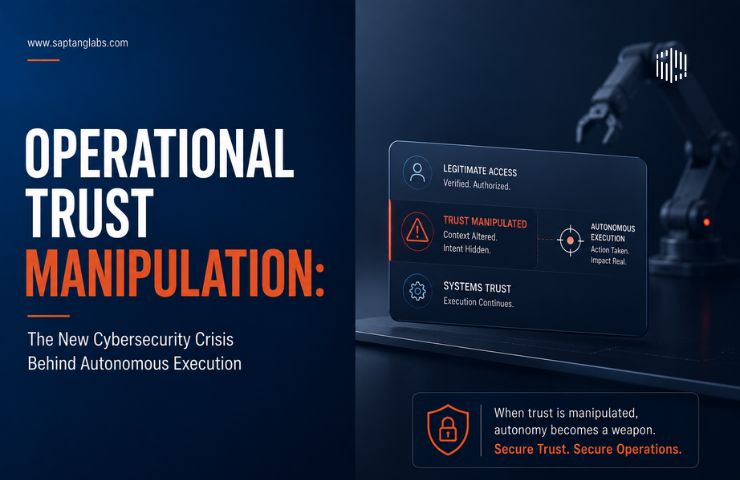
The rapid integration of artificial intelligence and agentic workflows has birthed a devastating new threat vector known as Operational Trust Manipulation. As enterprises hand over critical business logic to autonomous execution engines that manage everything from financial trading to industrial control systems, cybercriminals are shifting their focus from destroying networks to silently poisoning the data streams these systems implicitly trust. By subtly altering runtime telemetry, machine learning inputs, and decision logic without triggering traditional security alarms, attackers force perfectly healthy environments to execute catastrophic actions on their behalf. To survive this invisible crisis, organizations must immediately implement continuous cryptographic validation, mathematical anomaly detection, and rigorous zero trust architectures explicitly designed for machine to machine interactions.
Let us travel to a hyper automated fulfillment center on a seemingly normal Tuesday morning. This facility operates entirely through autonomous execution. Autonomous drones navigate massive warehouse aisles using real time spatial telemetry. Robotic arms pack boxes based on predictive demand models. The inventory management artificial intelligence automatically issues multi million dollar purchase orders to international suppliers when stock dips below optimal thresholds. No human is involved in the minute to minute logistics. At 9:14 AM, the system detects a massive sudden spike in local demand for highly specific semiconductor components. Reacting perfectly to its foundational programming, the autonomous agent rapidly liquidates capital reserves, initiates emergency purchase orders at extreme premium rates, and reroutes entire shipping logistics to accommodate the phantom demand.
In less than three minutes, the company bleeds out five million dollars in non refundable transactions. There was no noisy ransomware deployment. There was no massive data breach. No traditional firewalls were bypassed. The artificial intelligence simply received subtly altered market telemetry from an external data connector, fully trusted the malicious input, and executed its core function flawlessly. This is the chilling reality of Operational Trust Manipulation. We have built enterprise systems that execute tasks at blinding speeds, but we completely forgot to teach them how to doubt the information they receive.
To understand the severity of this modern crisis, we must precisely define what Operational Trust Manipulation entails. In traditional cybersecurity frameworks, a threat actor attempts to exploit a software vulnerability to gain unauthorized access and deploy malicious code. In the era of autonomous execution, the strategy is entirely different. The attacker does not need to introduce foreign, malicious code. Instead, they exploit the inherent trust that an autonomous system places in its internal logic, its data sensors, and its application programming interfaces.
Operational Trust Manipulation occurs when an adversary subverts the computational calculations, environmental inputs, or contextual memory of an automated system. The goal is to force a trusted system to make an untrusted, destructive decision. Because the system itself is highly credentialed and operating within its designated parameters, traditional security tools view the catastrophic actions as standard operational behavior.
Key indicators of this emerging threat vector include:
Cybercriminals are highly rational economic actors. For the past decade, ransomware was the most lucrative attack model. However, deploying ransomware is incredibly noisy. It triggers massive incident response efforts, attracts global law enforcement attention, and forces victims to shut down their operations completely. Operational Trust Manipulation represents a fundamental evolution in attacker economics.
By manipulating the outputs of an autonomous system, an attacker can extract immense financial value while the target organization remains completely unaware of the compromise. If a threat actor can subtly manipulate the algorithmic trading parameters of a hedge fund by just a fraction of a percent, they can skim millions of dollars in arbitrage without ever triggering a system failure or an alert. The targeted systems remain completely operational. The dashboards look perfectly normal. The business continues to function, completely oblivious to the fact that its core logic has been weaponized.
The economic drivers behind this shift include:
The cybersecurity industry has spent billions of dollars building taller walls around corporate networks. We rely on endpoint detection and response platforms to stop malicious binaries from executing. We rely on identity and access management to ensure only approved users can access critical data. These legacy defenses share a fatal flaw. They assume that if a piece of software is authorized to run, its outputs are inherently safe.
Operational Trust Manipulation violently shatters this assumption. When an enterprise deploys an autonomous AI agent to manage cloud infrastructure, it grants that agent massive administrative privileges. If an attacker manipulates the data that the agent uses to make decisions, the endpoint detection platform will not intervene. The system sees an authorized agent executing an authorized script using valid credentials. The fact that the action itself is financially destructive is completely lost on traditional security tools.
The foundational blind spots include:
To fully grasp the danger, it is necessary to examine how an attack based on Operational Trust Manipulation unfolds in the real world. These are not smash and grab operations. They are highly sophisticated, multi stage campaigns designed to embed seamlessly into the fabric of autonomous enterprise operations.
The operation begins with deep reconnaissance. The adversary maps the target’s automated workflows, identifying exactly which data sources feed into the most critical decision engines. They look for poorly secured third party Application Programming Interfaces or unsecured open source data libraries that the primary AI agent relies upon.
Once a weak link is identified, the attacker initiates the exploit phase. They do not attack the core AI model directly, as those are usually heavily guarded. Instead, they attack the periphery. They might poison the external intelligence feed that an automated cybersecurity platform uses to block IP addresses. By feeding the autonomous system false threat intelligence, they can force the system to block legitimate customer traffic, effectively using the company’s own security tools to execute a massive denial of service attack.
The phases of exploitation typically follow this path:
The integration of agentic workflows is happening fastest in sectors where speed and efficiency are paramount. Unfortunately, these are exactly the sectors where Operational Trust Manipulation poses the greatest systemic risk.
In the financial sector, high frequency trading algorithms and autonomous liquidity management systems process billions of dollars daily. If a threat actor successfully manipulates the data feeds these algorithms use to gauge market sentiment, they can trigger artificial market crashes or execute massive fraudulent wealth transfers. The speed of autonomous execution means these financial anomalies can propagate globally before human regulators can hit the kill switch.
In critical infrastructure, the transition to smart grids and automated industrial control systems creates a terrifying attack surface. A power grid that autonomously balances load based on smart meter telemetry can be tricked into shutting down entirely if an attacker feeds it false power surge data. The system shuts off the lights not because it was hacked, but because it trusted manipulated data that told it shutting down was the only way to prevent a physical fire.
The most vulnerable domains include:
If traditional cybersecurity cannot stop this emerging threat, how do organizations protect themselves? The answer requires a fundamental paradigm shift. We must move away from static execution control and embrace dynamic computational validation. We can no longer blindly trust the outputs of our machines.
The foundation of this defense is an architecture known as Agentic Zero Trust. In a human zero trust model, users are continuously verified based on their location, device, and behavior. Agentic Zero Trust applies this same rigorous validation to machine to machine interactions. An autonomous execution engine must be mathematically verified at runtime. Its inputs must be cryptographically signed, and its outputs must be scored against historical baselines before any physical or financial action is permitted.
Security leaders must also implement structural tripwires. While the goal of automation is speed, there must be programmatic limits placed on what an AI agent can do without human oversight. If a logistical AI attempts to spend ten times its daily average in under a minute, the system must forcefully halt the execution and demand cryptographic approval from a human executive.
Essential defensive strategies include:
As we push further into 2026 and beyond, the battleground of cybersecurity will no longer be fought over who can breach a network. The war will be fought over who can manipulate the truth. Operational Trust Manipulation represents the absolute apex of adversarial engineering.
To survive in a world governed by autonomous execution, corporate boards, Chief Information Security Officers, and software developers must accept a harsh reality. Security is no longer just about protecting the infrastructure. It is about protecting the mathematical integrity of the decisions made within that infrastructure. The organizations that thrive will be those that build autonomous systems capable of doubting their own inputs, verifying their own logic, and pausing their own execution when the data simply does not add up.
What exactly is Operational Trust Manipulation?
Operational Trust Manipulation is a highly sophisticated cybersecurity threat where attackers subtly alter the data inputs, telemetry, or decision logic of an automated system. Instead of breaking into the system to steal data, the attacker tricks the artificial intelligence or autonomous agent into making catastrophic decisions by feeding it a false reality. The system remains fully operational, but its outputs are completely subverted.
How does this differ from traditional malware or ransomware?
Traditional malware is designed to visibly disrupt operations, steal sensitive files, or encrypt hard drives. It relies on executing unauthorized code. In contrast, this new manipulation tactic relies on the authorized, legitimate code of an autonomous system. It is invisible, highly targeted, and designed to manipulate business logic without ever triggering alarms associated with system crashes or file encryption.
Why cannot traditional firewalls and antivirus tools stop these attacks?
Legacy security tools are built to monitor the perimeter and scan for known signatures of malicious software. Because a trust manipulation attack uses valid credentials and operates through approved data streams, perimeter tools see the activity as normal network traffic. Antivirus software cannot detect a mathematically flawed algorithm or a poisoned data feed.
What industries are most at risk from this specific type of cyberattack?
Any industry heavily reliant on autonomous execution is at extreme risk. This includes high frequency financial trading, algorithmic pricing models, automated manufacturing and logistics, smart energy grids, and healthcare networks utilizing AI driven diagnostics. If an organization trusts a machine to make high stakes decisions autonomously, it is a prime target.
What is Agentic Zero Trust and why is it important?
Agentic Zero Trust is an advanced security framework designed specifically for artificial intelligence and machine to machine communications. It mandates that no autonomous agent is trusted implicitly, regardless of its credentials. Every piece of data it receives must be cryptographically validated, and every high impact decision it makes must be mathematically audited in real time before execution is allowed.
How can a mid-sized business protect its automated workflows?
Mid-sized businesses must start by auditing exactly what systems are operating autonomously. They should implement hard tripwires that pause automated actions if they exceed normal financial or operational thresholds. Furthermore, they must ensure that all third party data connectors and APIs are rigorously authenticated, and they should maintain human oversight for any automated process capable of causing significant material damage to the company.
Is human intervention still necessary in an autonomous environment?
Absolutely. While autonomous systems provide incredible speed and efficiency, they lack human intuition and contextual common sense. Implementing human in the loop protocols for high risk decisions acts as a critical safety net. When a machine detects an anomaly that falls outside its historical baseline, a trained human analyst must review the action before the execution phase begins.
You may also find this insight very helpful: Firmware Trust Exposure: The Hidden ICS Risk Most Industrial Security Programs Still Ignore