
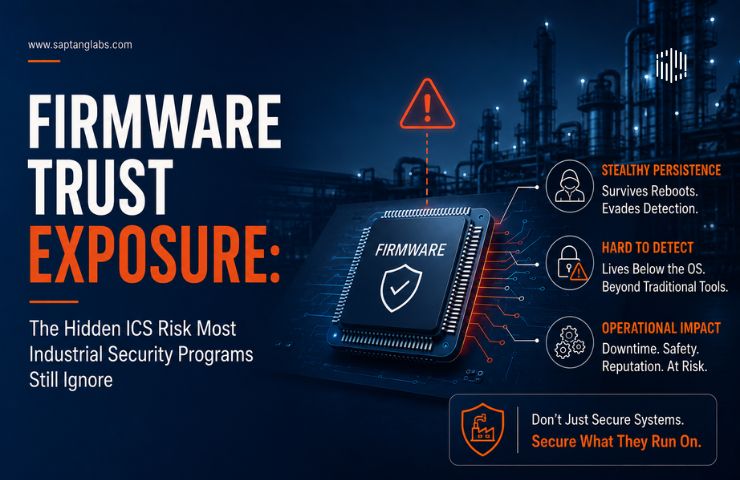
The foundation of industrial control systems relies heavily on an assumption that the underlying hardware components operate exactly as the manufacturer intended. This assumption creates a massive vulnerability known as Firmware Trust Exposure, which occurs when programmable logic controllers and remote terminal units blindly accept code updates without rigorous cryptographic validation. While modern security operations centers spend millions fortifying network perimeters and monitoring operational technology traffic, sophisticated adversaries are bypassing these defenses entirely by embedding malicious logic directly into the physical chips of critical infrastructure devices. To secure the industrial edge, asset owners must transition away from superficial network monitoring and implement strict hardware roots of trust, continuous integrity verification, and cryptographic authentication for all physical assets.
Imagine standing inside the humming control room of a municipal water treatment facility. The massive screens displaying the Supervisory Control and Data Acquisition system show a perfectly balanced environment. Tank levels are optimal. Chemical mixture ratios are exact. The human operators monitor the interface with complete confidence.
Down on the plant floor, inside a locked metal cabinet, a primary Programmable Logic Controller is orchestrating the physical movement of the valves. According to the network monitoring tools, the traffic flowing between the controller and the engineering workstation is entirely standard. The packet sizes match historical baselines. The communication protocols are recognized and approved.
Yet the valves are slowly opening wider than the safety parameters dictate.
The operators cannot see this happening because the controller itself is lying to them. The monitoring systems detect no anomaly because the malicious command is not coming from a network intrusion. The attacker did not steal a password or exploit a software vulnerability in the Windows operating system running the control software. Instead, the attacker replaced the underlying operating instructions of the physical hardware.
This terrifying scenario perfectly illustrates the severity of Firmware Trust Exposure. The industry has spent two decades building taller walls around industrial networks while completely ignoring the structural integrity of the devices operating inside those walls. When a threat actor successfully alters the foundational code running on an industrial device, they gain total control over the physical process while simultaneously blinding the safety mechanisms designed to protect it.
To comprehend why this specific vulnerability is so pervasive, we must look at how industrial equipment is designed and manufactured.
Firmware Trust Exposure represents a systemic failure in how operational technology devices validate their own operating instructions. Firmware is the permanent software programmed into the read only memory of a hardware device. It dictates how the physical circuitry interacts with the higher level software applications. In consumer electronics like modern smartphones, the operating system verifies a digital signature embedded in the firmware before allowing the device to turn on. If the signature is invalid or missing, the device refuses to boot.
Industrial Control Systems often lack this fundamental security architecture. Many of the devices actively managing global power grids, oil refineries, and manufacturing plants were designed decades ago. They prioritize absolute availability and continuous operation over security.
Consequently, these devices operate on implicit trust. If an engineering workstation sends a command to update the firmware, the controller simply accepts the file, writes it to memory, and executes the new instructions. There is no cryptographic handshake. There is no digital certificate verification.
Key factors driving this critical exposure include:
Executing an attack based on Firmware Trust Exposure requires a sophisticated understanding of both digital networks and physical engineering. Threat actors do not simply guess passwords to achieve this level of compromise. They carefully orchestrate multi stage campaigns designed to land deep within the lowest levels of the Purdue Model for Industrial Control Systems.
The attack typically begins with a standard IT network breach. The adversary might use a phishing email to compromise a corporate engineer. From there, they pivot through the enterprise network, slowly hunting for a pathway into the operational technology segment.
Their primary target is the engineering workstation. This highly privileged computer holds the specialized software used to program the controllers on the factory floor. Because the industrial devices implicitly trust commands originating from this specific workstation, the attacker essentially inherits that trust.
Once they control the workstation, the attacker downloads the legitimate firmware file provided by the manufacturer. They reverse engineer this file, inserting microscopic alterations into the logic. They might add a single line of code that prevents a safety relay from tripping when pressure exceeds a critical threshold.
They then package the modified firmware and use the legitimate engineering software to push the update down to the targeted controller. The industrial network firewall sees this traffic as an approved engineering action and allows it to pass. The controller receives the file, unpacks it, and overwrites its own brain. The Firmware Trust Exposure allows the malicious code to become a permanent part of the physical infrastructure.
The cybersecurity industry has invested billions of dollars developing sophisticated tools for industrial environments. We have passive network monitoring platforms that analyze industrial protocols like Modbus, DNP3, and PROFINET. We have advanced firewalls that enforce strict segmentation between the corporate network and the plant floor.
These tools are incredibly valuable for stopping ransomware and broad IT focused attacks. However, they are fundamentally blind to Firmware Trust Exposure.
Network security tools rely on inspecting traffic in transit. If an attacker modifies the firmware using the legitimate engineering protocol, the network packet looks completely normal. The malicious payload is buried deep within a massive binary file transfer that the intrusion detection system cannot unpack or analyze in real time.
Furthermore, once the rogue firmware is installed, the attacker no longer needs to communicate across the network. The destructive logic is self contained within the chip. It can operate autonomously, waiting for a specific date, a specific physical condition, or a specific sequence of operator commands to trigger the destructive payload.
The limitations of current defensive strategies:
Addressing this vulnerability is exceptionally difficult because it is deeply intertwined with the industrial supply chain and the massive lifespan of operational equipment.
Unlike enterprise servers that are replaced every three to five years, a programmable logic controller in a power substation might remain in continuous operation for twenty five years. These legacy devices physically lack the processing power and memory required to perform complex cryptographic calculations. You cannot simply patch a twenty year old controller to suddenly support modern secure boot processes.
This reality forces asset owners into a terrible position. They must either run vulnerable hardware for another decade or spend millions of dollars ripping and replacing perfectly functional equipment just to achieve a baseline level of hardware security.
Additionally, the threat does not always originate from a local network breach. State sponsored adversaries are increasingly targeting the supply chain itself. This tactic, known as interdiction, involves intercepting a controller while it is being shipped from the manufacturer to the customer. The attacker opens the box, physically flashes the malicious firmware onto the chip, repackages the device, and sends it on its way.
When the engineers install the brand new device on the factory floor, it is already compromised. Because the facility trusts the manufacturer, they naturally trust the equipment arriving in the original packaging. This represents the ultimate exploitation of Firmware Trust Exposure.
To successfully defend against these insidious attacks, industrial security programs must evolve past superficial network monitoring. We must build a digital immune system that verifies the integrity of the physical hardware continuously. This requires a philosophical shift from implicit trust to cryptographic verification at the lowest levels of the architecture.
The foundation of this defense is establishing a true Hardware Root of Trust. Modern industrial devices must be manufactured with specialized security chips, such as Trusted Platform Modules, physically soldered onto the mainboard. These modules securely store cryptographic keys and perform signature verification before the main processor is even allowed to execute the boot sequence.
For existing environments where ripping and replacing hardware is not financially feasible, security teams must deploy active integrity monitoring.
Actionable steps to eliminate hardware trust vulnerabilities:
The global regulatory landscape is rapidly shifting to address the severity of Firmware Trust Exposure. Government agencies recognize that protecting critical infrastructure requires moving beyond basic compliance checklists and addressing the root causes of systemic hardware vulnerabilities.
In the United States, the North American Electric Reliability Corporation is continuously updating its Critical Infrastructure Protection standards to enforce stricter supply chain risk management. European directives like NIS2 are placing massive financial penalties on operators of essential services who fail to secure their operational technology environments comprehensively.
These regulatory frameworks are beginning to mandate the exact cryptographic controls needed to secure the hardware layer. Asset owners who ignore these mandates face not only the catastrophic risk of a physical cyber physical incident but also the crippling weight of regulatory fines and legal liability.
The future of industrial cybersecurity belongs to those who recognize that the physical chip is the ultimate perimeter. Network firewalls will always be necessary to filter the noise, but the final line of defense must reside within the memory banks of the controllers themselves. By demanding cryptographically signed updates, enforcing continuous integrity monitoring, and refusing to blindly trust any piece of code executing in the physical world, industrial organizations can finally close the terrifying vulnerability gap created by Firmware Trust Exposure.
What exactly is Firmware Trust Exposure?
It is a critical vulnerability where physical hardware components, particularly in industrial control systems, blindly accept and execute operating code without verifying its origin or integrity. This allows an attacker to replace the legitimate firmware with malicious instructions that directly control physical processes.
How does firmware differ from standard software?
Standard software runs on top of an operating system and handles high level applications. Firmware is the foundational code embedded directly into a hardware chip. It acts as the bridge between the physical circuitry and the higher level software. Compromising the firmware gives an attacker total control over the physical capabilities of the device.
Can standard network firewalls detect a firmware attack?
Network firewalls are generally ineffective at detecting this specific type of attack. Firewalls inspect the flow of traffic. If an attacker uses a compromised but legitimate engineering workstation to send a modified firmware file using approved industrial protocols, the firewall will view the action as standard maintenance and allow it to pass.
What is a Hardware Root of Trust?
A Hardware Root of Trust is a secure, isolated physical component built into a device mainboard. It contains unalterable cryptographic keys. When the device powers on, this component verifies the digital signature of the firmware before allowing the main processor to boot, ensuring that only manufacturer approved code can ever execute.
Why are industrial environments more vulnerable to this than standard IT networks?
Industrial environments utilize highly specialized equipment that often remains in service for decades. Many of these legacy devices were designed before cybersecurity was a primary concern and physically lack the processing power to support modern encryption or digital signature verification.
How can a facility protect legacy equipment that cannot be updated with secure boot features?
For legacy equipment, organizations must implement strict physical and logical compensations. This includes entirely isolating the engineering workstations, strictly controlling physical access to the device cabinets, and utilizing specialized OT monitoring tools to periodically extract and verify the cryptographic hash of the running firmware against a clean baseline.
You may also find this insight helpful: Payment Runtime Exposure: Why Real Time Banking Fraud Is Outpacing Human Verification