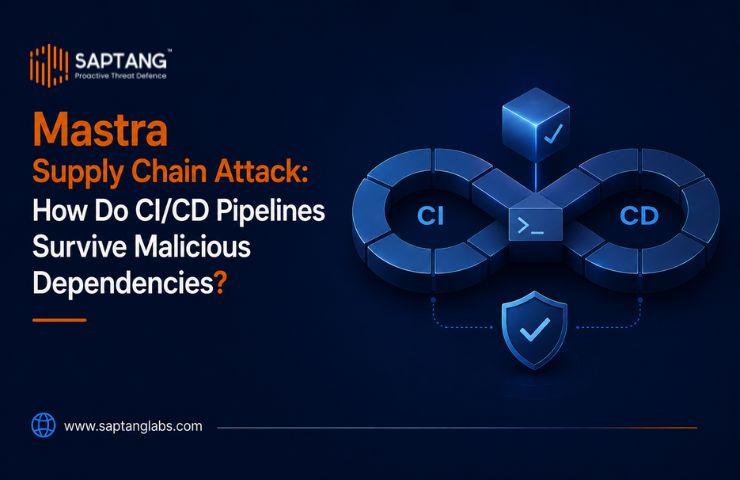
The recent Mastra Supply Chain Attack exposed a critical vulnerability in modern software development. Threat actors compromised over 144 packages within the Mastra npm ecosystem by injecting a malicious dependency called easy-day-js. This dependency utilized npm postinstall scripts to silently download remote access payloads during the standard build process. Because these actions occur within trusted continuous integration and continuous deployment pipelines, traditional security tools frequently fail to detect the intrusion. Defending against this level of sophisticated software supply chain compromise requires a proactive engineering approach. Organizations must extend their Attack Surface Management to include deeply nested open source dependencies. Furthermore, engineering teams must deploy Continuous Security Validation to empirically prove that their egress firewalls and network controls actively block unauthorized outbound connections from developer workstations and build servers.
Sarah is the lead platform engineer for a financial services startup building next generation artificial intelligence applications. Her team relies heavily on rapid iteration and open source frameworks. On a routine Tuesday afternoon, an automated continuous integration pipeline initiated a standard build process for their latest application module. The logs showed the usual rapid downloading of npm packages. Everything appeared normal on the surface.
However, a highly tuned network monitoring tool flagged an anomaly. The build server initiated an outbound connection to an unknown, unverified IP address hosted overseas. The server downloaded a secondary payload before the build process even finished.
Sarah immediately halted the deployment and isolated the build server. Her investigation revealed that her developers had not directly installed any malicious software. Instead, they had installed a legitimate artificial intelligence framework called Mastra. Unknown to the developers, a deeply nested sub dependency named easy-day-js contained a hidden, malicious script. This script executed automatically during the package installation phase.
This scenario perfectly illustrates the terrifying reality of the Mastra Supply Chain Attack. When developers type a simple installation command, they implicitly trust hundreds of external code repositories. Threat actors understand this implicit trust. They are no longer attacking the production web servers directly. Instead, they are poisoning the well at the source, turning the trusted continuous integration pipeline into a weapon against the organization.
To architect a resilient defense, security teams must understand the exact technical mechanics of the Mastra Supply Chain Attack. This was not a simple case of guessing a password. It was a calculated subversion of the open source ecosystem.
The attackers targeted Mastra, a popular framework utilized by developers to build artificial intelligence applications. Instead of attacking the core repository directly, the threat actors identified a dormant contributor account associated with the project. They successfully hijacked this account, likely through credential stuffing or by exploiting a lack of multi factor authentication.
Once the attackers controlled the trusted contributor account, they introduced a new, seemingly harmless dependency into the Mastra ecosystem. They named this dependency easy-day-js. Because it was introduced by a recognized contributor, the update was automatically pulled down by developers and build servers around the world updating their Mastra environments.
The true danger resided within the package.json file of the easy-day-js module. The attackers leveraged a legitimate Node Package Manager feature known as the postinstall hook. Developers typically use postinstall scripts to clean up files or compile native code immediately after a package downloads. The attackers weaponized this feature. They wrote a script that instructed the host machine to reach out to an external command and control server to download a remote access trojan.
Because the script ran automatically during the installation phase, the malware executed before the developer even wrote a single line of their own code.
The Mastra Supply Chain Attack highlights a severe visibility gap in traditional DevSecOps methodologies. Many organizations invest heavily in static application security testing and software composition analysis. While these tools are essential, they often operate too late in the lifecycle or generate too much noise to be effective against a zero day postinstall exploit.
When a developer runs an installation command on their local workstation or within a cloud based build server, the operating system views the action as completely legitimate. The continuous integration pipeline is explicitly designed to reach out to the internet, download code, and execute build scripts.
Standard endpoint detection and response tools often struggle to differentiate between a legitimate compilation script and a malicious postinstall hook. If the endpoint agent blocks the build process, it disrupts engineering productivity. Consequently, security teams often configure their endpoint tools to silently allow actions performed by package managers.
Furthermore, many engineering teams fail to implement strict egress filtering on their build servers. They restrict incoming traffic but allow the server to communicate outbound to any destination on the internet. When the malicious easy-day-js package attempted to download its secondary payload, the network firewall simply allowed the traffic to pass.
Surviving the Mastra Supply Chain Attack requires a fundamental shift in how organizations define their digital footprint. Traditionally, security teams viewed their attack surface as external IP addresses, public web servers, and exposed application programming interfaces. Today, the software supply chain is the most critical segment of the enterprise attack surface.
Saptang Labs emphasizes that you cannot secure a dependency that you do not know exists. Organizations must deploy advanced Attack Surface Management platforms to achieve total visibility over their software supply chain.
A modern Attack Surface Management strategy goes beyond generating a static software bill of materials. It continuously maps the entire ecosystem of third party libraries, tracking both direct dependencies and deeply nested sub dependencies. When the news broke regarding the compromised Mastra packages, engineering teams utilizing comprehensive Attack Surface Management did not have to guess if they were vulnerable.
The platform immediately identified every developer workstation, every staging environment, and every production server running the compromised easy-day-js package. This instant visibility allows the security operations center to isolate the affected systems and purge the malicious code before the attacker can establish persistence or exfiltrate sensitive data.
Visibility is only the first half of the solution. Once you map the attack surface, you must ensure your technical controls actively prevent the exploitation of those hidden dependencies. This is where Continuous Security Validation becomes an absolute engineering necessity.
We know that the Mastra Supply Chain Attack relied on an outbound network connection to a command and control server. Therefore, the ultimate defense mechanism is a tightly controlled egress firewall. However, firewall rules are notoriously complex and prone to human error. A network engineer might accidentally open a broad outbound port during a late night troubleshooting session, silently exposing the build server to the internet.
Continuous Security Validation eliminates this uncertainty. It moves security from theoretical assumptions to empirical proof. Organizations use Continuous Security Validation platforms to safely simulate the exact tactics utilized by the threat actors.
In this specific context, the validation platform deploys a safe, inert payload into the continuous integration environment. This payload perfectly mimics the behavior of the malicious postinstall script. It attempts to initiate an outbound connection to a simulated, secure command and control server.
If the connection is successful, the engineering team receives an immediate critical alert. They know definitively that their egress controls have failed and that a real supply chain attack would succeed. If the connection drops, the security team possesses mathematical proof that their firewall rules actively block unauthorized outbound communication. By running these validations continuously, Saptang Labs ensures that your defenses do not silently degrade over time.
To protect your continuous integration pipelines from the Mastra Supply Chain Attack and similar threats, security teams must implement strict architectural guardrails. Below are the critical steps required to harden your development environments.
What exactly is the Mastra Supply Chain Attack?
The Mastra Supply Chain Attack refers to a massive security incident where threat actors compromised over 144 packages within the Mastra artificial intelligence development framework. They achieved this by injecting a malicious nested dependency named easy-day-js into the ecosystem.
How did the easy-day-js package execute its malicious code?
The package utilized a feature within the Node Package Manager known as a postinstall script. This feature allows code to run automatically immediately after a developer or a server downloads the package. The attackers weaponized this script to silently download malware in the background.
Why are continuous integration pipelines vulnerable to this attack?
Continuous integration pipelines are explicitly designed to download code and run compilation scripts. Because the malicious postinstall hook mimics legitimate build activities, traditional security tools and endpoint agents often fail to recognize the action as a cyber attack.
How can Attack Surface Management help prevent supply chain compromises?
Attack Surface Management provides continuous, real time visibility into your entire software environment. By mapping deeply nested third party dependencies, the platform allows security teams to instantly identify and isolate compromised packages across all developer workstations and cloud servers.
What role does Continuous Security Validation play in defending the pipeline?
Continuous Security Validation actively tests your network defenses. By safely simulating the outbound connection attempts used by the malicious postinstall scripts, it provides empirical proof of whether your egress firewalls successfully block the attacker from downloading their secondary payloads.
Should we completely block all open source packages?
Blocking all open source packages is impossible for modern engineering teams. Instead, organizations should utilize private artifact registries to scan packages before they enter the environment. Furthermore, teams should disable automatic postinstall scripts to maintain tight control over code execution.
How do attackers hijack legitimate open source projects?
Attackers frequently look for dormant contributor accounts that lack strong security controls like multi factor authentication. They use credential stuffing techniques to gain access to these accounts. Once inside, they inject malicious code that the community blindly trusts based on the contributor’s past reputation.
You may also find this helpful insight: Building the Risk Operations Center: Moving from Fragmented Alerts to Unified ASM