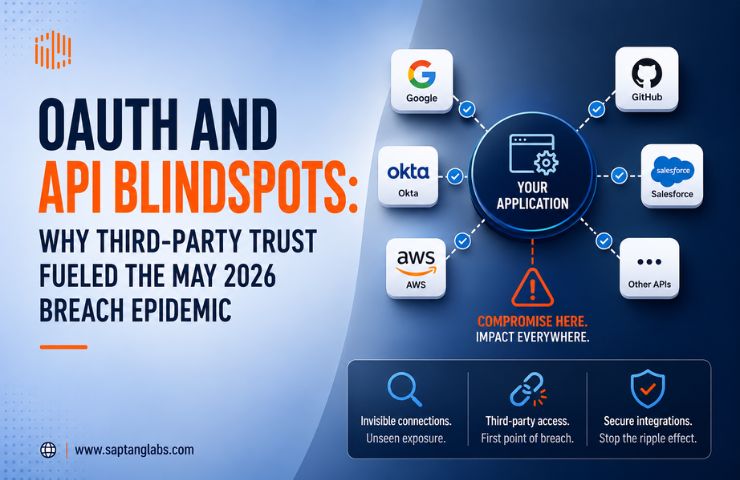
The cybersecurity landscape has fundamentally shifted, as evidenced by the massive supply chain breaches dominating the headlines in May 2026. The traditional network perimeter is completely dead, replaced by a complex web of third party integrations, productivity applications, and artificial intelligence tools. This hyper connected architecture has created massive OAuth and API Blindspots. Threat actors are no longer deploying noisy malware to break down the front door. Instead, they are compromising downstream SaaS vendors, hijacking legitimate OAuth tokens, and walking right past multi factor authentication to extract environment secrets and customer data. To survive this epidemic, security teams must immediately pivot from securing endpoints to continuously auditing and restricting the underlying identity fabric and API permissions connecting their enterprise.
Picture a typical Wednesday morning at a high growth software company. Sarah, a senior DevOps engineer, is looking for a way to optimize her team’s code review process. She discovers a highly rated, new artificial intelligence productivity tool designed to analyze deployment logs and suggest performance improvements. To use it, she clicks a simple button that says “Log in with Google Workspace.” A screen pops up asking for permission to read her emails, view her calendar, and access her cloud drive. Without a second thought, she clicks approve. The AI tool works flawlessly, saving her hours of manual log parsing.
Two months later, the company experiences a catastrophic data leak. Highly sensitive database credentials, customer API keys, and internal source code are suddenly listed for sale on a dark web forum by a notorious cybercriminal group.
The internal security team scrambles. They check the firewalls. Nothing was blocked. They review the endpoint detection logs on Sarah’s laptop. No malware is found. They verify that her multi factor authentication was active. It was never triggered.
The intrusion did not happen on the company network. It happened at the AI vendor. Attackers compromised the third party AI tool and stole the OAuth token that Sarah had authorized months prior. Because OAuth tokens maintain persistent access without requiring re authentication, the attackers essentially inherited Sarah’s identity. They used her valid session to quietly navigate the corporate environment, bypassing every expensive security appliance the company owned. They queried internal APIs, read configuration files containing plaintext environment variables, and quietly extracted the data.
This is not a hypothetical scenario. This exact methodology mirrors the devastating breaches we have witnessed throughout the spring of 2026. It perfectly illustrates the terrifying reality of OAuth and API Blindspots. We have locked the windows and doors of our digital houses, but we are freely handing out master keys to vendors we barely know.
To understand why this specific vulnerability is bringing enterprise security to its knees, we must examine the architecture of modern cloud applications. The entire digital economy runs on delegated authorization, primarily powered by the OAuth 2.0 framework and Application Programming Interfaces.
When an employee connects a calendar app to their email, or a marketing team connects a customer relationship manager to an analytics dashboard, they are not sharing passwords. They are generating specialized tokens. These tokens grant the third party application permission to act on behalf of the user or the system.
OAuth and API Blindspots occur when security teams lose complete visibility and control over these connections. In most organizations, the deployment of third party tools is entirely decentralized. Any user with a corporate email address can grant a new AI tool extensive read and write permissions to the corporate cloud environment.
Key factors driving this critical exposure include:
For the past twenty years, the cybersecurity industry built defenses based on the concept of a perimeter. The prevailing logic was that the inside of the network was trusted, and the outside was hostile. Security Operations Centers invested heavily in firewalls, intrusion prevention systems, and endpoint security agents to keep the bad actors out.
The modern SaaS architecture obliterates this concept. The perimeter no longer exists. Your attack surface is now defined by the security posture of every single vendor and application connected to your environment.
When a threat actor exploits an OAuth or API blindspot, traditional security tools fail completely. Endpoint detection software looks for malicious binaries executing on a laptop. But in an API attack, there is no laptop involved. The attacker is communicating directly from their cloud server to your cloud server using a legitimate, authorized token.
Network firewalls are equally useless. They are designed to allow authorized web traffic. An attacker using a valid API key looks exactly like a legitimate business process. The malicious activity is hidden inside standard HTTPS encrypted traffic.
The primary reasons traditional defenses fail:
Executing an attack through these blindspots requires a highly methodical approach. Cybercriminal syndicates, such as the groups dominating the 2026 threat intelligence reports, operate with the precision of advanced persistent threats. They understand that attacking a hardened enterprise directly is inefficient. It is much easier to attack a poorly defended startup that the enterprise trusts.
The operation begins with the compromise of a third party vendor. Attackers target specialized applications used by developers, human resources, or marketing teams. They might exploit a vulnerability in the vendor infrastructure or bribe a vendor employee for access.
Once inside the vendor system, the attackers do not steal the vendor data. They steal the database of OAuth tokens and API keys belonging to the vendor customers.
Armed with a valid token, the attacker pivots. They connect to the target enterprise infrastructure using the stolen credentials. Because they are leveraging machine to machine communication, they can automate their reconnaissance. Using custom Python scripts, they rapidly query the target internal directories, searching for privileged user roles, unencrypted environment variables, and secondary credentials stored in plaintext.
The typical stages of an API supply chain breach:
The introduction of artificial intelligence has not just changed how we defend; it has fundamentally altered how threat actors attack. In the past, manually parsing through a compromised cloud environment to find valuable data took days or weeks. Today, attackers are using their own autonomous AI agents to accelerate the exploit phase.
Once an attacker secures access through an API blindspot, they deploy an AI agent to analyze the environment. This agent can read thousands of internal wiki pages, scan millions of lines of code in a repository, and identify improperly secured environment variables in seconds.
In the high profile breaches of May 2026, security analysts noted a terrifying velocity. The time between initial access via a compromised token and total data exfiltration collapsed from weeks down to hours. The attacking AI instantly understood the internal naming conventions of the target company, located the most valuable intellectual property, and extracted it flawlessly.
This speed severely punishes organizations that rely on manual incident response. If a security team takes four hours to triage a suspicious API call, the attacker has already stolen the database and deleted the access logs to cover their tracks.
If the perimeter is dead and traditional tools are blind, how do organizations defend themselves against this epidemic? The solution requires a radical shift in security philosophy. Enterprises must stop assuming that authorized connections are inherently safe. They must embrace Continuous Threat Exposure Management and apply the principles of Zero Trust to machine identities.
The first step is achieving absolute visibility. You cannot protect what you cannot see. Security teams must deploy specialized platforms capable of mapping the entire OAuth graph. They need a real time inventory of every third party application connected to the environment, exactly who authorized it, and what specific data it can access.
Furthermore, organizations must enforce the principle of least privilege at the API level. A marketing analytics tool should never have the ability to read source code repositories. A calendar integration should never have the ability to modify security settings.
Actionable steps to eliminate identity and API blindspots:
The brutal string of data breaches defining 2026 serves as a permanent wake up call for the cybersecurity industry. The days of trusting a vendor simply because they offer a convenient service are over.
As businesses continue to integrate an endless array of artificial intelligence tools and automated workflows, the attack surface will only grow more complex. Securing this interconnected ecosystem requires acknowledging that identity is the new perimeter. Protecting that identity means rigorously defending not just the human passwords, but the invisible web of tokens and APIs that actually run the modern enterprise. Those who fail to illuminate their OAuth and API Blindspots will inevitably find themselves reading about their own company in next month headline news.
What exactly is an OAuth or API blindspot?
It is a severe gap in security visibility where an organization fails to monitor or control the permissions granted to third party applications. When employees connect external tools to corporate accounts using OAuth tokens or API keys, they create direct backdoors into the network. If security teams cannot see these connections, they become blindspots that attackers can easily exploit.
Why does multi factor authentication not stop these specific attacks?
Multi factor authentication is designed to verify a human user at the moment they log in. OAuth tokens and API keys are designed for machine to machine communication. Once a user grants permission and a token is generated, that token maintains persistent access without ever prompting for an SMS code or an authenticator app approval. If an attacker steals the token, they bypass the multi factor requirement entirely.
How do attackers typically steal these connection tokens?
Attackers rarely steal them directly from the highly secure enterprise. Instead, they attack the less secure third party vendor. For example, if your company uses a small AI startup for data analytics, the attacker will breach the startup, steal the database of customer OAuth tokens, and then use your token to walk freely into your corporate environment.
How can a business discover what third party apps have access to their data?
Organizations must utilize their cloud administration consoles, such as Google Workspace Admin or Microsoft Entra ID, to generate application access reports. More mature security programs deploy specialized identity threat detection platforms that continuously monitor the environment, map every connected application, and alert security teams to overly permissive configurations.
Are all third party application integrations inherently dangerous?
No, integrations are essential for modern business productivity. The danger lies in unmonitored and over permissioned integrations. A well managed integration uses the absolute minimum permissions required to function, utilizes short lived authentication tokens, and undergoes regular security reviews to ensure the vendor maintains strong cybersecurity practices.
What is the most immediate step a company can take to reduce this risk today?
The most critical immediate action is to conduct a comprehensive audit of all currently authorized third party applications across the enterprise. Security teams must identify and immediately revoke access for any application that has not been used in the last ninety days, as well as any application that holds highly sensitive permissions without a clear, documented business need.
You may also find this insight helpful: Operational Trust Manipulation: The New Cybersecurity Crisis Behind Autonomous Execution