TL;DR
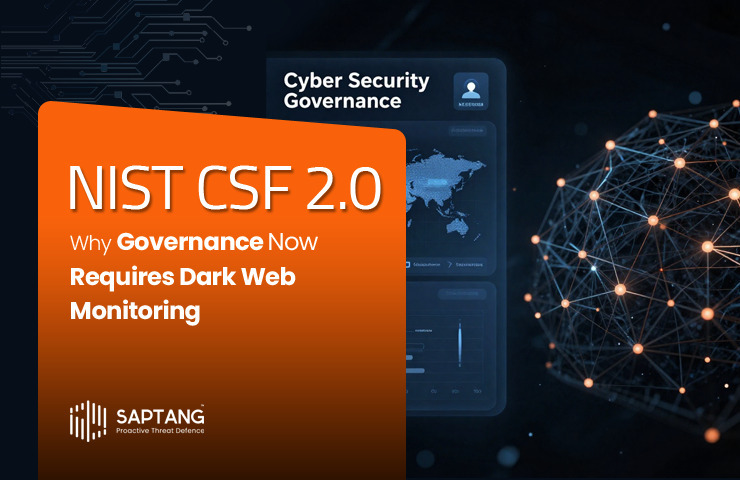
NIST released Cybersecurity Framework 2.0 in February 2024, introducing Govern as a sixth core function alongside Identify, Protect, Detect, Respond, and Recover. This elevation of governance from subcategory to primary function fundamentally changed how organizations approach cybersecurity. Rather than treating security as a technical problem, the framework now positions it as a board-level governance responsibility requiring continuous risk visibility, third-party oversight, and measurable outcomes.
The governance mandate: Organizations must demonstrate they monitor external threat intelligence as part of the Detect function. Dark web monitoring is no longer an advanced capability for mature security programs. It is a governance requirement. Boards and executives need visibility into when organizational data appears in breach databases, when credentials are traded in underground markets, and when third-party compromises create downstream risk.
The compliance reality: Framework adoption is accelerating. Federal agencies already align with NIST guidance. State regulations increasingly reference CSF compliance. Cyber insurance underwriters evaluate framework implementation. Organizations cannot demonstrate adequate governance without external threat visibility. The question is no longer whether to monitor dark web exposure, but how quickly implementation occurs.
A Chief Information Security Officer presented the quarterly security report to the board. The presentation covered familiar territory. Firewall logs reviewed. Penetration testing completed. Employee phishing training delivered. Incident response plans updated. The board nodded approval.
Then a board member asked an unexpected question: Do we monitor whether our data appears on the dark web? The CISO paused. The organization had no dark web monitoring program. The question had never been asked before. The assumption was that internal security controls would prevent data exposure. If breaches occurred, organizations would discover them through internal detection.
The board member pressed further. Our cyber insurance policy requires demonstration of external threat monitoring. Our largest customer now demands evidence we track third-party exposure. NIST Cybersecurity Framework 2.0, which our auditors reference, includes external intelligence in the Detect function. How do we demonstrate compliance without dark web visibility?
That conversation marked a turning point. Within weeks, the organization implemented dark web monitoring. Not because technical teams requested it. Because governance requirements demanded it. The CISO learned an important lesson: cybersecurity had moved from the server room to the boardroom. And governance frameworks like NIST CSF 2.0 drove that transformation.
This pattern repeats across organizations. Understanding how NIST CSF 2.0 changed governance requirements and why external threat intelligence became mandatory has become essential for security leaders navigating board expectations.
NIST Cybersecurity Framework 1.0 launched in February 2014 targeting critical infrastructure operators. Version 1.1 arrived in April 2018 with minor updates. Both versions treated governance as a component within other functions rather than a standalone priority.
What Changed in Version 2.0
February 2024 brought fundamental transformation. NIST released Cybersecurity Framework 2.0 with two critical changes that elevated security from technical function to business imperative.
First: Universal applicability. The framework no longer targets only critical infrastructure. It applies to all organizations regardless of size or sector. Small businesses, enterprise corporations, government agencies, and nonprofits all fall within scope.
Second: Govern became the sixth core function. Governance rose from embedded concepts scattered across categories to standalone function equal in stature to Identify, Protect, Detect, Respond, and Recover.
This second change transformed how organizations approach cybersecurity. Governance is no longer something that happens alongside security activities. It is the foundation that enables all other functions.
The Govern function establishes expectations that fundamentally change how organizations demonstrate security.
Key Govern categories:
These categories create governance obligations that require visibility beyond internal systems. Organizations cannot demonstrate adequate oversight without monitoring external threat intelligence.
Why Dark Web Monitoring Became a Governance Requirement
The connection between governance and external threat intelligence appears in multiple framework functions. Understanding these connections explains why dark web monitoring transitioned from advanced capability to baseline requirement.
The Detect function includes specific outcomes requiring external intelligence. Organizations must establish and maintain continuous monitoring to detect cybersecurity events.
Internal monitoring alone cannot achieve this outcome. When credentials appear in dark web breach databases, internal systems show no alerts. When organizational data is traded in underground markets, firewalls detect nothing. When third-party compromises expose sensitive information, endpoint detection provides no warning.
External threat intelligence fills the visibility gap. Dark web monitoring detects when data leaves organizational control. This detection enables the response and recovery functions that follow.
NIST CSF 2.0 elevated supply chain risk management to a category within the Govern function. This reflects the reality that organizational security depends on third-party security.
Organizations cannot control what happens inside vendor networks. Security questionnaires and attestations provide point-in-time assurance. Actual vendor security posture changes continuously. Vendors experience breaches. Their credentials appear on dark web marketplaces. Their systems are compromised.
Dark web monitoring provides the continuous visibility governance requires. Rather than waiting for vendors to disclose compromises, organizations detect vendor exposure proactively. This enables informed risk management decisions before downstream impacts occur.
What Boards and Executives Now Expect
The elevation of governance to core function changed boardroom conversations about cybersecurity. Directors and executives increasingly ask questions that require external threat intelligence to answer.
Boards evaluating cybersecurity governance ask increasingly sophisticated questions:
Organizations lacking dark web monitoring cannot answer these questions. This inability to demonstrate external threat visibility becomes evidence of inadequate governance.
The Securities and Exchange Commission’s cybersecurity disclosure rules create additional governance pressure. Public companies must disclose material cybersecurity incidents within four business days. They must also describe their cybersecurity risk management processes in annual filings.
Boards evaluating these disclosure obligations recognize that dark web monitoring provides early warning of potential incidents. Rather than discovering breaches when attackers use stolen credentials, organizations detect exposure when data first appears in underground markets. This earlier detection supports both incident response and disclosure compliance.
Understanding why governance requires external threat intelligence is different from implementing the capability. Organizations face practical questions about how to satisfy framework expectations.
What Adequate Dark Web Monitoring Requires
Not all external monitoring satisfies governance obligations. Effective programs demonstrate specific capabilities:
These capabilities transform external monitoring from periodic manual searches to continuous governance visibility.
Q1: Is NIST Cybersecurity Framework compliance mandatory?
The framework itself is voluntary. However, federal agencies align with NIST guidance. Many state regulations reference CSF compliance. Cyber insurance underwriters evaluate framework implementation. Major customers increasingly require vendor framework alignment. While not legally mandatory for most organizations, practical business requirements are making adoption necessary.
Q2: Does the framework specifically require dark web monitoring?
NIST CSF 2.0 does not prescribe specific tools or technologies. It describes outcomes organizations should achieve. The Detect function requires continuous monitoring to detect cybersecurity events. The Govern function requires oversight and risk visibility. Dark web monitoring is the practical implementation that achieves these outcomes for external threats.
Q3: How do organizations demonstrate framework compliance to boards?
Organizations create Organizational Profiles mapping their current state against framework outcomes. These profiles identify gaps between current capabilities and target state. For the Detect function, profiles must demonstrate external monitoring capability. Dark web intelligence programs provide the documented evidence boards expect.
Q4: What is the relationship between NIST CSF 2.0 and other compliance frameworks?
NIST provides mappings between CSF and other frameworks including ISO 27001, HIPAA, PCI DSS, and others. Organizations can use CSF as their primary framework while demonstrating alignment with multiple regulatory requirements. The external monitoring requirements in CSF support compliance across these other standards.
Q5: How quickly should organizations implement dark web monitoring?
Implementation urgency depends on regulatory obligations, board expectations, and customer requirements. Organizations facing SEC disclosure rules, cyber insurance renewals, or major customer assessments should prioritize immediate implementation. Even absent immediate pressure, the governance shift toward external monitoring makes early adoption strategically wise.
You may also find this helpful insight:Enterprise Incident Response in the Era of AI Driven Attacks