TL;TR
The dark web has evolved from manual data dumps to a highly efficient “Identity Liquidity” market. Using stolen credential automation, threat actors now utilize sophisticated bots and API-driven marketplaces to validate, package, and sell user data in real-time. This industrialization of fraud means that a stolen password can be weaponized against multiple financial platforms within seconds of a breach, requiring a shift toward behavioral biometrics and proactive threat hunting.
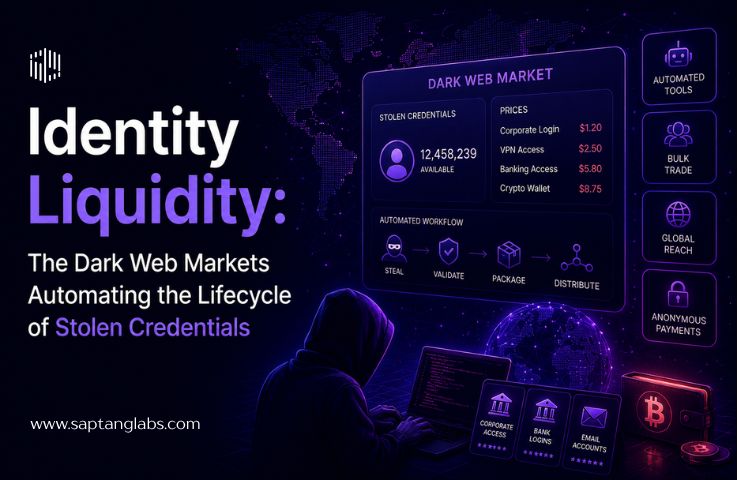
We used to think of the dark web as a digital flea market: a place where hackers occasionally posted “leaks” or “combos” for others to sift through manually. That era is dead. Today, the underground economy functions more like a high-frequency trading floor. This is what we call Identity Liquidity. It is the speed and ease with which a stolen piece of data can be converted into spendable value.
The engine behind this liquidity is stolen credential automation. By removing the human element from the fraud lifecycle, criminals have achieved a scale that was previously impossible. When your credentials are stolen today, they aren’t just sitting in a text file. They are being fed into automated pipelines that check their validity across hundreds of banking, retail, and streaming sites simultaneously.
To understand how to fight back, we must first look at the assembly line. The lifecycle of a stolen credential is no longer a linear path but a recursive loop of automated checkpoints designed to maximize profit at every turn.
This process ensures that by the time a security team notices a breach, the most valuable accounts have already been “drained” or sold to secondary specialists. The automation handles the heavy lifting, allowing the human attacker to focus on the high-level social engineering required to bypass MFA.
Perhaps the most terrifying evolution in stolen credential automation is the move toward “Browser Fingerprinting” and “Session Hijacking.” Markets like the now-infamous Genesis Market (and its successors) changed the game by selling more than just a username and password.
They began selling “bots” that mirror the victim’s entire digital persona. When a criminal buys one of these bots, they are getting the victim’s cookies, their IP address headers, their screen resolution settings, and even their behavioral patterns. Automation tools then inject this data into a specialized browser. To the bank’s security system, this doesn’t look like a hacker in another country; it looks like the legitimate customer returning on their usual device.
This level of automation bypasses traditional “Device ID” checks and often circumvents basic two-factor authentication because the session is already seen as “trusted.” It turns identity into a liquid asset that can be poured into any browser, anywhere in the world.
Why does liquidity matter? In financial terms, liquidity refers to how quickly an asset can be bought or sold without affecting its price. In the dark web, high liquidity means that a stolen credential is “fresh” and highly likely to work.
This economic shift means that every organization, regardless of size, is a target. If you have a login portal, you are part of the automated checking circuit.
If the attackers are using automation to break in, we cannot rely on manual reviews to keep them out. The defense must be as fast and as scalable as the attack. Our focus must shift from “Static Identity” (the password) to “Dynamic Behavior” (how the user interacts).
To truly stop stolen credential automation, we have to make the “liquidity” dry up. This means making the data less valuable by the time it reaches the market. Implementing “Short-Lived Sessions” and aggressive “Cookie Invalidation” are two of the most effective ways to break the automation cycle.
If a session cookie stolen by an infostealer is only valid for 15 minutes, the criminal has a very narrow window to get that data to a market, find a buyer, and have that buyer use it. By the time the bot tries to “liquidate” the identity, the session has expired. We aren’t just stopping the login; we are destroying the economic value of the stolen data itself.
Behind every “bot” and “credential string” is a person whose digital life is being dismantled. The victims of these automated attacks often face months of bureaucratic nightmares trying to reclaim their identities. As professionals, we have a duty to remember that these aren’t just data points on a dashboard.
The automation of crime has made it feel victimless to the perpetrator. They click a button, and the money appears. By strengthening our defenses, we aren’t just protecting a balance sheet; we are protecting the trust that allows our digital society to function.
As we look toward the next five years, the battle for identity will only intensify. Stolen credential automation will likely integrate with generative AI to create “Deepfake Identities” that can handle video calls and voice verification.
The only way forward is a radical commitment to Zero Trust architecture and the adoption of passwordless authentication. We must move to a world where a “credential” isn’t something you know or something you have, but something you are in the digital space. Only then can we truly end the era of identity liquidity.
What exactly is Identity Liquidity?
Identity Liquidity refers to the speed and efficiency with which stolen personal data can be verified and sold on the dark web. High liquidity means that stolen information is being turned into profit almost instantly through automated systems.
How does stolen credential automation work?
It uses specialized software (bots) to take large lists of stolen usernames and passwords and test them against various websites. The software automatically identifies which accounts work and often scrapes the account for balance information or stored credit card details.
Are my “saved passwords” in my browser safe?
Not necessarily. Infostealer malware specifically targets the “Login Data” files of popular browsers. If your device is infected, these passwords can be stolen in bulk. It is highly recommended to use a dedicated, encrypted password manager instead.
How do dark web markets use APIs?
Just like legitimate businesses, dark web markets use APIs to allow different software programs to talk to each other. This allows a criminal to write a script that says, “Buy every account for ‘Bank X’ that has a balance over $5,000 as soon as it is posted.”
Can 2FA (Two-Factor Authentication) stop automated attacks?
While 2FA is a strong defense, it is not foolproof. Automated attacks that use “Session Hijacking” can bypass 2FA by stealing the “cookie” that proves you have already logged in. Using hardware security keys (like Yubico) or app-based push notifications is more secure than SMS-based codes.
What is a “Log” in dark web terminology?
A “Log” is a comprehensive file stolen from a victim’s computer. It usually contains not just passwords, but also browser cookies, autofill data, system information, and even screenshots of the desktop at the time of the infection.
You may also find this post helpful: From Detection to Takedown: How Banks Are Stopping Phishing Before Customers Are Victimized