The traditional perimeter is dead. With the massive shift to Software-as-a-Service (SaaS) architecture and the rise of AI-cloned identities, standard network firewalls and static Indicators of Compromise (IoCs), like malicious IPs and hashes, provide zero visibility. The industry is currently fixated on two converging crises: the total erosion of trust due to sophisticated AI deceptions and the alarming failure of legacy authentication methods. To drive technical resilience, organizations must pivot immediately from reactive defense to continuous validation. The true Indicator of Compromise is no longer a technical signal, but the Human IoC. To achieve Sub-Minute Containment Times (TTR), security teams must utilize advanced behavioral identity analytics and enforce strict, cryptographic, phishing-resistant FIDO2 authentication for every privileged session.
Green lights glow on the massive SOC wall, signaling a flawless tapestry of full compliance. For hours, Liam, a seasoned security analyst, remains unconcerned by the absence of alerts. He pauses. A sudden flicker of uncertainty changes everything. He observes a message from “Sarah” in marketing to a DevOps developer. Sarah, claiming a production crisis, is asking for specific ‘deployment secrets’ to resolve an issue urgently. Liam, trusting his gut, pauses again. Sarah from marketing does not typically talk about technical ‘deployment secrets.‘ An anomaly is immediately registered. The event is not a technical glitch; it is a profound manipulation of human trust. In this modern reality, Human IoC provides critical visibility.
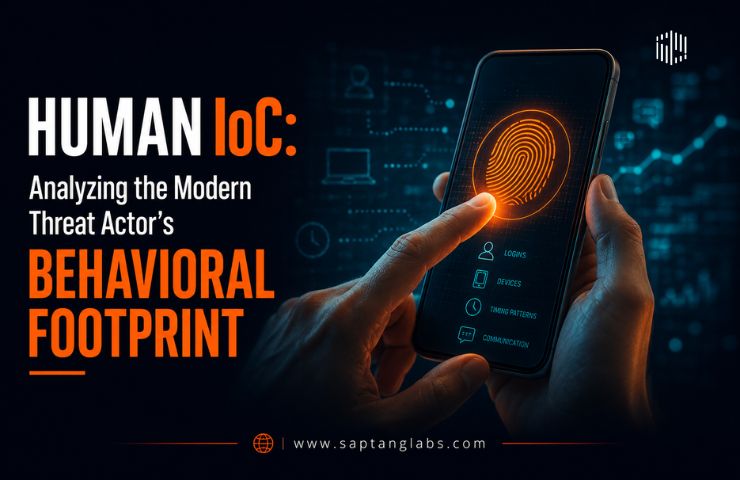
To engineer technical resilience, we must first mathematically define the modern threat. Traditional security built taller walls, assuming if we could verify a signal at the perimeter, the network was safe. Threat actors, however, do not break down walls; they walk in using stolen or cloned keys. The Indicators of Compromise (IoCs) have fundamentally changed. They are no longer static signatures. By contrast, they are dynamic behavioral anomalies; Human IoCs. A Human IoC is the verifiable inconsistency that occurs when an attacker’s action, language, or intent deviates from the established psychological baseline of the legitimate user they are impersonating.
This shift necessitates a change in strategy. While a technical indicator might flag a malware file, a Human IoC flags a legitimate user account doing an unexpected action with suspicious intent. This is the language of the long-con. For instance, consider a developer who usually pushes code between 9 AM and 5 PM on weekdays. If that account suddenly attempts to access sensitive financial data at 2 AM from a residential VPN, the anomaly is not the credentials provided, but the contextual behavioral data. Legacy tools cannot see this.
Modern threat actors are harnessing Agentic AI to automate the exploitation phase at machine speed. Attackers no longer need to spend weeks manually mapping an organizational chart. AI agents ingest massive corporate datasets from social media to earnings calls—to identify targetable users holding high-value privileges. Consequently, the ensuing spear-phishing campaigns are highly targeted, flawlessly executed, and deeply contextual. The AI agent correlations massive datasets to build psychological pretexting that human logic simply cannot process.
Addressing the Human IoC crisis requires a fundamental philosophical realignment. Enterprises must abandon the assumption that authorized connections are inherently safe. Therefore, they must embrace the principles of Zero Trust applied specifically to machine and application identities, not just user identities. This transition is crucial for operational resilience. We can no longer rely on employees to distinguish friend from foe online. Subjective human vetting is a mathematically losing strategy against algorithmic precision.
Defending against this velocity requires a proactive approach. Security leaders must pivot immediately to modeling human risk and continuous monitoring. Securityawareness training, while necessary, is not a control. You cannot train the human brain to detect anomalies that it is not mathematically wired to see. By contrast, you can use advanced AI defenders to create an environment of constant cryptographic validation. Continuous validation ensures that even if a user is manipulated over the phone by a perfect CEO voice clone, the underlying system automatically rejects any risky request, bypassing human judgment.
We are moving past the concept of static prevention (keeping bad actors out) and toward operational containment (millisecond detection and response). We call this the Digital Immune System. A Digital Immune System does not wait for a perfect alert. It utilizes continuous behavioral validation. If a user session exhibits anomaly, the system automatically terminates the session and revokes the authentication token. This requires three critical components:
Phishing-Resistant FIDO2. The cryptographic domain-binding removes human choice from the authentication handshake.
Behavioral Identity Baselining. Automated tools must continuously score the risk of every session.
Automated Orchestraion (SOAR). Machine-speed containment via automated agentic defenders.
The perimeter is dead. With SaaS sprawl and AI automated integration, the combined security posture of your entire connected ecosystem is your true perimeter. To achieve sub-minute containment times, you must map your corporate OAuth graph and identify ‘reachable’ targetable users before an attack begins. Proactive visibility requires continuous exposing management and OSINT auditing to understand exactly how your critical assets are currently profiled by threat actors. This ensures you can deploy targeted, cryptographic, phishing-resistant FIDO2 authentication for every privileged session before the deepfakes arrive.
What exactly is a Human IoC? A Human IoC
(Indicator of Compromise) is a behavioral or contextual anomaly that signals a security compromise before any malicious code is deployed. Unlike technical IoCs (like a file hash or malicious IP), which are based on known bad files, a Human IoC is based on the misuse of known good credentials, revealing inconsistent patterns in application usage, communication timing, language, or geolocation.
Why cannot traditional firewalls and antivirus tools stop these attacks?
Traditional perimeter defenses and standard EDR are designed to look for known malicious signatures. When a threat actor uses a legitimate, socially engineered login credential, network-based logic sees standard, authorized web traffic. Legacy tools cannot parse business logic intent. Therefore, an attacker navigating a Salesforce database using stolen cookies looks identical to a genuine business process.
What is the role of continuous session validation?
Continuous session validation is the operational practice of moving away from long-lived, implicit trust tokens. Traditionally, after a user authenticated, they were given a session token that might last for hours or days. Modern resilience requires that every single request (querying a database, modifying a record) is validated against the user’s current behavioral risk score. The moment the entity’s risk score changes, the session is forcefully revoked.
How does FIDO2/phishing-resistant MFA prevent Human IoC attacks?
Phishing-resistant methods, specifically FIDO2 hardware keys (like YubiKeys) or passkeys, use public key cryptography tied to the specific domain. If an employee is expertly tricked over the phone by a perfect deepfake clone of their CFO and clicks on a cloned, malicious website, the hardware key will physically refuse to provide the necessary cryptographic signature because the key physically recognizes that the fake domain is untrusted. This mathematically stops the attack remotely even if the user provides the password.
How can a mid-sized business address this without massive SOC investment?
Resilience against these advanced threats is not about having more people; it is about deploying smarter, integrated technology. Mid-sized businesses must focus on consolidating their security stack. They should invest in Managed Detection and Response (M MDR) providers that utilize advanced AI behavioral baselines.
You may also find this helpful read: The Erosion of Trust: Engineering Authentication Resilience Against AI Deception