
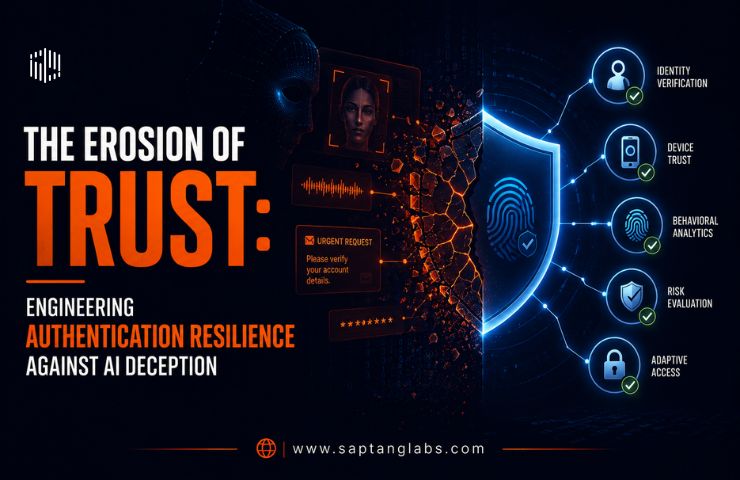
The fundamental contract of modern society is built on implicit trust: I know my CEO’s voice. I trust the video of my CFO authorizing this transaction. However, AI Deception in 2026 has systematically voided this contract, dissolving the reliable boundary between authentic human communication and synthetic reality. Standard multi-factor authentication methods (SMS, voice calls, basic push notifications) that rely on a single human decision point are now catastrophic vulnerabilities. We have officially exited the era where identity can be verified by simple static signals. To survive, organizations must urgently adopt an engineering centric approach to authentication. This requires transitioning from “implicit trust” at the moment of login to a model of Continuous Session Validation, utilizing unphishable FIDO2 protocols and deep behavioral biometrics that verify how an entity acts rather than just what credentials it possesses.
It is a quiet Tuesday afternoon in the Q1 2026 corporate environment. The Global Treasurer, located in Singapore, receives an urgent, direct Microsoft Teams voice call from the CEO, who is known to be traveling in Switzerland. The CEO’s voice is frantic, precise, and immediately recognizable. He explains that a highly sensitive, confidential acquisition is about to fail if a multi million dollar earnest money deposit is not settled within the hour. He cites internal project names, references a confidential meeting from the previous day, and emphasizes the need for absolute operational security. The CEO apologizes that he cannot join a video call because the connectivity in the Alpine location is too unstable, but urges the Treasurer to act immediately.
The Treasurer, naturally wanting to ensure the company’s strategic success, initializes the transfer. He utilizes the corporate high value transfer portal. He inputs his mandatory single sign on credentials. When the system prompts him for his necessary second factor—a biometric finger scan on his corporate mobile device; he complies. He fulfills every security protocol mandated by the security team. He completes the transaction perfectly.
He has no idea that he has just handed millions of dollars directly to a transnational cybercriminal syndicate. He has no idea that the frantic voice on the other end was a perfect, synthetically generated clone, trained on only fifteen seconds of public audio from the CEO’s recent earnings call. This is not science fiction. This is the operational reality of AI Deception in 2026. The attacker did not need to break the mathematics of encryption. They did not need to exploit a zero day vulnerability in the authentication portal. They exploited something much more vulnerable: the human social contract. They successfully manipulated the operational trust that allows businesses to function. We are no longer fighting malicious code; we are fighting weaponized reality.
The Physical Architecture of AI Deception in 2026
To engineering technical resilience, we must first mathematically define the threat. We can no longer generalize AI Deception as “advanced social engineering.” It is a complex, modular, and industrial grade workflow that weaponizes generative artificial intelligence and natural language processing at machine scale. The adversary in 2026 does not guess. They analyze.
Modern AI Deception is characterized by automated reconnaissance. Attacking AI agents continuously ingest a targeted organization’s entire public digital footprint. They index executive leadership speeches, public panel discussions, social media activity, and even company earnings calls. This structured data is utilized to create flawless psychological pretexting. By the time a single phone call is made or a single email is sent, the AI orchestrator knows the target’s daily schedule, key vocabulary, operational pain points, and reporting lines. The attack isn’t generic; it is personalized, computationally calculated, and delivered with machine velocity.
Key components defining this critical exposure include:
For more than a decade, the global cybersecurity industry marketed multi factor authentication as the final line of defense against credential theft. We explicitly told corporate boards and employees that even if an attacker knew a user’s password, they would remain safe because the secondary text message code or push notification would act as an unbeatable roadblock. The rise of AI Deception has not just bypassed this roadblock; it has essentially utilized it as part of the attack.
The fundamental collapse of legacy MFA occurs because traditional protocols only verify that “the possessor of the primary credential also possesses the second factor.” They provide absolutely zero validation regarding the intent of the human controlling that second factor. If a threat actor is currently impersonating the victim’s boss using deepfake audio, and that boss screams over the phone that a mandatory MFA push notification must be approved immediately to prevent a critical system failure, the human victim will always comply. They comply out of fear. They comply out of a desire to be helpful.
The reasons legacy controls fail against algorithmic manipulation:
For far too long, the primary operational solution to social engineering was security awareness training. We spent millions of dollars testing employees with simplistic phishing simulations that were intentionally designed to be spotted. The advice was always generic: “Look for typos. Check the sender address. Trust your gut.”
Telling employees to “trust their gut” when that gut is being fed flawless synthetic input is not a security strategy; it is a roadmap for catastrophic failure. There are no typos in an AI generated phishing email. The sender address is expertly spoofed. A deepfake video of your actual boss joining a Teams call does not register as “unusual” to the human brain. AI Deception has removed the attacker’s human error from the equation. The human brain cannot mathematically calculate the probability that the video of their CEO is a manipulation.
We must accept that security awareness training will never scale to meet the velocity and perfection of modern deception. You cannot train the human brain to detect anomalies that it is not wired to see. Consequently, our entire defensive philosophy must shift from demanding that the human become an unbreachable firewall to demanding that the authentication architecture automatically verify the mathematical integrity of every single communication and session event, without requiring human judgment. We must stop check-the-box compliance and begin check-the-math security.
If human judgment is obsolete at the moment of login, the only logical solution is machine verification at the moment of runtime. To defeat AI Deception, we must engineer a digital immune system that assumes the physical layer has already been compromised. We must transition from verifying that a user claims to be authenticated to continuously verifying that their behavioral context remains secure.
The foundational engineering countermeasure is the immediate deployment of phishing resistant authentication standards, primarily FIDO2/WebAuthn hardware keys. We must move past the concept of “the user must do something” to “the device must prove something.” Unlike SMS codes or push notifications that an attacker can steal or manipulate a human into approving, FIDO2 utilizes strong public key cryptography. The hardware key mathematically binds the authentication process to the exact legitimate domain of the login page. This is non negotiable. If an employee is expertly tricked into clicking a perfectly cloned login portal, the hardware key will refuse to provide the necessary cryptographic signature because the key physically recognizes that the fake domain is untrusted.
The essential engineering blueprint for resilience includes:
The implementation of these critical technical controls cannot happen in a silo. It requires a fundamental, board level strategic realignment. We must accept the total collapse of implicit trust. The perimeter has moved from the firewall to the active machine identity session.
This realization necessitates the adoption of what we call Agentic Zero Trust. Traditional zero trust focuses heavily on users. Agentic Zero Trust focuses explicitly on machine identities, AI agents, and interconnected APIs. We must recognize that the majority of modern computational decisions are made without direct human intervention. We must therefore implement continuous cryptographic validation for every machine identity, continuously scoring its behavior, its contextual environment, and its transaction history before granting any privilege.
If a vendor API, connected to your environment, suddenly exhibits behavioral anomalies; such as querying data lakes it has never accessed before, the system must automatically revoke its authentication tokens. The time has passed where we can afford to grant persistent access tokens and assume they will remain secure. The future of cybersecurity belongs to those institutions that can harness artificial intelligence to not only predict the next sophisticated manipulation of truth, but to autonomously neutralize it before the human analyst even finishes reading the alert.
Why does standard multi factor authentication not stop these advanced attacks?
Legacy multi factor authentication, such as receiving a text message code or approving a push notification on a phone, relies entirely on the human user to authorize the login. In a modern social engineering attack, the adversary uses techniques like AI Deception to expertly trick the human into believing the request is legitimate. The technology itself is not broken, but the human decision making process is expertly manipulated, rendering the security control useless.
How does FIDO2/phishing resistant MFA prevent AI based deception?
Phishing resistant methods, specifically FIDO2 hardware keys (like YubiKeys), utilize public key cryptography. The key itself is mathematically tied to the specific domain of the login page. If an employee is expertly tricked by a perfect deepfake call and clicks on a cloned, malicious website, the physical FIDO2 key will physically refuse to provide the necessary authentication token because the key recognizes that the domain is untrusted. This mathematically stops the attack even if the employee is completely fooled.
How is behavioral biometrics different from traditional MFA?
Traditional MFA only checks a credential at the exact moment a user logs in. If an attacker successfully compromises that one login event, they have free rein. By contrast, behavioral biometrics continuously monitors the entity’s actions after they are inside the network. It establishes a baseline of normal behavior (such as typical application usage, geolocation, and keystroke patterns). The moment the AI system detects an anomaly that deviates from this baseline, it can automatically terminate the session without requiring human intervention.
What is the role of continuous session validation?
Continuous session validation is the operational practice of moving away from long lived, implicit trust tokens. Historically, after a user authenticated, they were given a session token that might last for hours or days. Modern resilience requires that every single request (querying a database, modifying a record, accessing a confidential file) is validated against the user’s current behavioral risk score. The moment the entity’s risk score changes, the session is forcefully revoked.
Is human awareness training completely obsolete?
Training is not entirely obsolete, but it must be fundamentally redefined. We cannot rely on training to allow employees to detect sophisticated deepfakes, which is impossible. Consequently, modern training must focus on teaching employees not to trust their senses, but to trust validated operational processes. They should be trained on strict protocols, such as mandatory, non digital verification for high risk actions, rather than just spotting generic phishing emails.
How can a business educate its customers about these specific threats?
Education must move from generic security alerts to highly contextual, in moment warnings. If a customer is about to authorize a high value, high risk transfer to a new beneficiary via their online banking portal, the portal should display a clear, interruptive warning explicitly calling out common scam pretexts, such as the impersonation of bank fraud departments or government officials. We must place friction exactly where the risk is highest.
You may also find this helpful: AI-Amplified Social Engineering: Deconstructing the ShinyHunters Rampage