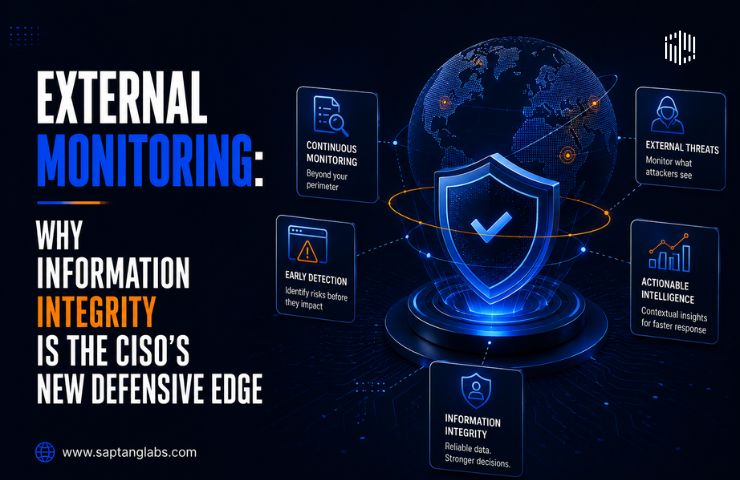
Modern cybersecurity has shifted from defending static perimeters to managing a sprawling digital footprint. External monitoring is no longer a luxury but a core necessity for verifying the veracity of threat data. This guide explores how CISOs can move beyond noisy automated alerts toward a high-fidelity, analyst-verified intelligence model (the Saptang way) that provides a defensible ROI to the board.
Imagine it is 2:00 AM on a Tuesday. Your phone vibrates with an urgent notification. A database containing 50,000 customer records has just been posted on a notorious dark web leak site. Your internal firewalls didn’t trip, your EDR is silent, and your cloud logs show nothing unusual. Why? Because the breach didn’t happen on your network. It happened at a third-party marketing agency you offboarded six months ago, but who still held a legacy copy of your data.
In this moment, the value of external monitoring becomes visceral. You aren’t just looking for hackers hitting your firewall; you are looking for the echoes of your data across the vast, unmanaged expanse of the internet. This shift in perspective defines the modern security leader. We are moving away from being “gatekeepers” of a castle and becoming “stewards” of data wherever it lives.
High-quality external monitoring serves as your eyes and ears in rooms you aren’t invited to. It bridges the gap between what you control and what you are ultimately responsible for.
At Saptang Labs, we believe that the security industry has focused on “more” for too long. More logs, more tools, more alerts. But more is often just more noise. If your monitoring solution sends you 5,000 alerts a week, it hasn’t solved a problem; it has created a new one for your SOC team.
Information Integrity is the antidote to this fatigue. When we talk about integrity in the context of external monitoring, we are talking about the difference between a “mention” and a “verified threat.” A bot can find a mention of your company name on a forum. An expert-led monitoring process identifies that the mention is actually a credible threat actor discussing a specific vulnerability in your public-facing VPN.
Most Security Operations Centers are drowning. Analysts are forced to chase “ghosts” because of low-fidelity external monitoring tools that prioritize quantity over quality. This leads to burnout and, more dangerously, the “Boy Who Cried Wolf” syndrome, where a real, critical alert is ignored because it looks just like the thousand false positives that preceded it.
To solve this, a mature strategy must implement a rigorous filtration layer. At Saptang, this isn’t just about better algorithms. It is about a specialized human-in-the-loop verification process. When an analyst receives an alert that has already been vetted for accuracy and relevance, their response time drops significantly.
One of the hardest parts of leadership is explaining why you need a budget for something that “might” happen. Boards of Directors want to see ROI. They want to see how external monitoring reduces the organization’s financial and legal liability.
Using the Saptang approach, you can map your monitoring findings to specific business risks. If you can show the board that your program identified and shut down three phishing campaigns before a single employee clicked a link, you have a story of success that is easy to understand.
The future of security is not just watching; it is doing. We are entering an era of “Active Defense.” If your monitoring tool identifies a malicious domain that is clearly spoofing your brand, the next logical step shouldn’t be an email to your team. It should be an automated trigger that begins the takedown process or updates your corporate DNS filters.
This level of automation requires absolute trust in the data. You cannot automate a block based on a “maybe.” This brings us back to our core mission: Information Integrity. High-veracity external monitoring is the fuel that allows the engine of automation to run safely.
The market is crowded with vendors claiming to offer the best monitoring. However, you must look under the hood. Ask about their collection methods. Do they rely solely on automated scrapers, or do they have undercover researchers in closed-access forums?
A true partner doesn’t just sell you a dashboard; they provide an extension of your team. They understand your “crown jewels” and tailor their monitoring to protect what matters most to your specific business.
The digital frontier is vast, chaotic, and increasingly dangerous. Your job is to find order in that chaos. External monitoring is the lens that allows you to see through the fog of the internet and identify the real threats to your organization. By prioritizing Information Integrity, human-verified intelligence, and actionable reporting, you transform a simple security tool into a strategic business advantage.
We can no longer afford to wait for the knock on the door. We have to be out in the world, watching, listening, and ready to act. That is the power of the Saptang Labs approach to external monitoring.
What is the difference between Threat Intelligence and External Monitoring?
Threat Intelligence is the broad study of attackers and their methods. External Monitoring is the specific, localized application of that intelligence to your organization’s specific assets, brand, and data. One is a library of knowledge; the other is a specialized scout for your specific army.
How does External Monitoring help with Third-Party Risk?
Many breaches occur via vendors. External monitoring allows you to see if your data has leaked from a partner’s environment, even if that partner hasn’t realized they’ve been breached yet. It provides a “trust but verify” layer for your entire supply chain.
Is External Monitoring only for large enterprises?
While large enterprises have larger attack surfaces, SMBs are often targeted because their defenses are perceived to be weaker. Saptang Labs provides scalable solutions that allow organizations of all sizes to protect their brand and data without needing a massive internal security team.
Can External Monitoring replace my internal SOC?
No. It is a force multiplier. It provides the “outside-in” perspective that complements the “inside-out” view provided by your internal logs and tools. It allows your SOC to be proactive rather than just reactive.
You may also find this helpful insight: Choosing an External Threat Platform: 7 Evaluation Criteria for Security Leaders