
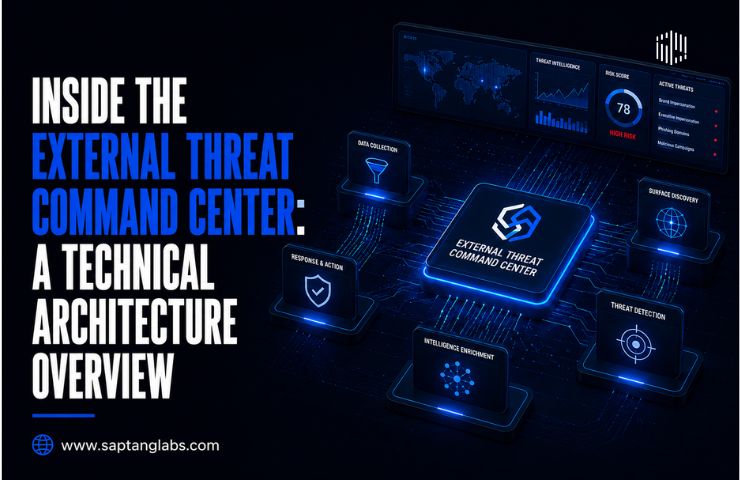
Modern manufacturers sit in the blast radius of attacks that start far outside the factory wall: spoofed supplier portals, weaponized RFQs, exposed remote access and ransomware staging.
An External Threat Command Center built on a solid External Threat Platform Architecture gives you a single operational brain to see those threats early, understand how they connect to plants and suppliers, and coordinate IT, OT and procurement responses before they become downtime, safety issues or missed orders.
The architecture works in layers: collecting external signals, mapping them to your real industrial footprint, correlating campaigns, scoring risk in terms of production and supply chain impact, and then driving concrete playbooks that your teams can trust and repeat.
The email looked boring, which is exactly why nobody questioned it.
Subject: “Revised payment details – urgent update before next shipment”
From: the domain of your longest‑standing raw materials supplier.
Attachment: a neat PDF form, carrying the right logo, the right contact name, even the right purchase order references.
Procurement glanced at it, forwarded it to finance with a quick “Please update before month‑end” note, and went back to arguing over steel prices.
The first shiver came from your biggest customer, not your SIEM. Their accounts team called late that evening. They had tried to verify a remittance with the supplier, only to be told: “We haven’t changed our bank account in years.”
Somebody had cloned the supplier’s portal, registered a lookalike domain and launched a tightly targeted phishing run at your procurement teams and a handful of key customers. If finance had processed the change blindly, six figures of payment would have vanished. If the same actor had pivoted into your environment using stolen credentials from that campaign, the next step might have been an “IT issue” that quietly encrypted OT‑adjacent systems and froze production.
That whole chain started outside your perimeter.
This is the reality manufacturers are waking up to: the most dangerous risks to uptime and safety often begin with assets, brands and identities you do not fully own. And that is exactly what an External Threat Command Center, underpinned by a strong External Threat Platform Architecture, is designed to manage.
Manufacturing is uniquely exposed to the external world.
You depend on:
Attackers have figured this out. Instead of charging through your front gate, they:
When one of those campaigns lands, the damage is measured in hours of production lost, scrap generated, penalties owed and sometimes safety risks to people on the floor.
Internal monitoring alone cannot see these moves early enough. You need a disciplined, continuous view of what is happening around your brand and your supply chain. That is where external threat architecture comes in.
Strip away the jargon and the External Threat Command Center is simply this:
A cross‑functional team and platform that keeps watch on all the ways the outside world can hurt your plants, products and partners, and then turns those observations into fast, coordinated decisions.
On any given day, this Command Center is asking:
The External Threat Platform Architecture is the technical spine that lets those questions be answered in a repeatable way. It is not yet another “threat intel portal” that analysts stare at in isolation. It is the plumbing that makes external awareness part of everyday operations.
If you are used to thinking in terms of production systems, here is a useful analogy.
Imagine external threat management as a production line:
The External Threat Platform Architecture is the layout of that line: machines, conveyors, sensors and checkpoints that move from raw data to outcomes without constant improvisation.
At a high level, it has seven “stations”:
Let us walk down that line in a more narrative way.
Step 1: Seeing the external world like an attacker
The first thing a good External Threat Platform Architecture does is teach your organization to see itself the way an attacker does.
Instead of starting from your internal asset list, it asks:
The platform pulls from domain registries, certificate transparency, OSINT and commercial feeds, but the goal is not to drown you in indicators. The goal is to build a living picture of your industrial “surface area” from the outside.
This is where that fake supplier domain would first appear: a newly registered lookalike URL, certificate issued within the last 24 hours, hosted in a region your real supplier never uses. On its own, that is just a dot on a map. The platform’s job is to add enough context to turn that dot into a story.
Step 2: Connecting dots to plants and suppliers
Context is everything in a manufacturing‑centric External Threat Platform Architecture.
The same “suspicious” domain might be irrelevant for a software company and critical for a car plant, depending on what it touches.
So the platform works hard to maintain a graph of:
Suddenly, what looked like a generic phishing indicator becomes a threat to a specific line, plant and contract.
Step 3: Understanding campaigns, not just incidents
Threats rarely arrive as single, isolated events. Serious actors run campaigns.
For manufacturers, those campaigns might look like:
The External Threat Platform Architecture treats these as patterns to be recognized, not random noise.
It clusters indicators that share:
Instead of dumping 50 separate alerts on your security team, it tells a single story:
“A coordinated campaign is impersonating critical suppliers in your automotive program, distributing weaponized RFQs, and scanning remote access systems used by the same plants.”
That story is what your External Threat Command Center can act on.
Step 4: Translating technical risk into production risk
A phishing kit or exposed gateway is a technical problem. A halted paint line is a business crisis.
A manufacturing‑aware External Threat Platform Architecture builds a bridge between the two.
When a campaign is detected, the platform automatically asks:
The result might be a simple, brutal ranking:
When risk is framed that way, it is much easier for CISOs, plant directors and COOs to agree on priorities. You are no longer debating whether a CVSS score is high enough; you are debating how many trucks might not leave the yard.
Step 5: Making response a practiced, cross‑functional skill
The worst time to figure out who should do what is in the middle of an external crisis.
A mature External Threat Platform Architecture bakes in playbooks that cut across silos. For example:
The architecture’s role is to:
Over time, these playbooks become muscle memory. The Command Center is no longer improvising; it is performing.
Step 6: Building trust with evidence, not promises
Customers, auditors and boards are increasingly asking manufacturers blunt questions:
An External Threat Command Center backed by a rigorous External Threat Platform Architecture gives you answers based on evidence:
This is not about looking good in a slide deck. It is about being able to stand in front of a customer whose line is depending on yours and say, with a straight face:
“We monitor external threats to this program, we know what we have seen, this is how we responded, and this is what we are changing to make it harder next time.”
That level of transparency is rapidly becoming a differentiator when manufacturers compete on reliability and resilience.
External threats will never politely restrict themselves to your office network. They will keep testing suppliers, remote access paths, cloud portals and human workflows around your plants.
You cannot bubble‑wrap your factories from the outside world. But you can design an External Threat Platform Architecture that:
In other words, you can build an External Threat Command Center that earns its place next to your SOC and your plant control room.
And the next time a fake RFQ lands in someone’s inbox, you are not relying on luck or the sharp eyes of one overworked buyer. You have a system that has seen this pattern before, knows who needs to move and gives them the tools and data to move fast.
FAQ
You may also find this insight helpful: From Alert Fatigue to Action: How AI Reduces False Positives by 80%
Focus Keyword: External Threat Platform Architecture
SEO Title (≤ 55 characters):
External Threat Platform Architecture For Manufacturing
Meta Description (≤ 150 characters):
Explore external threat platform architecture for manufacturing to protect plants, suppliers, uptime and safety from evolving cyber risks.
Tags (Title Case, comma separated):
External Threat Platform Architecture, Manufacturing Cybersecurity, External Threat Command Center, Industrial Security, OT Security, Supply Chain Security, Cyber Risk Management