TL;TR
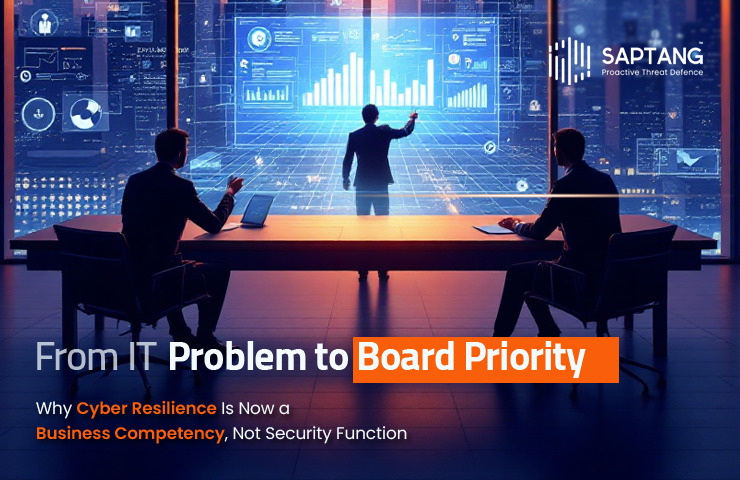
The era of viewing cybersecurity as a “perimeter defense” handled by IT is over. In 2025 and 2026, the global threat landscape has shifted toward high-velocity, infrastructure-level attacks that target business logic rather than just data. Cyber resilience is no longer a technical function; it is a core business competency that determines market valuation, brand trust, and operational continuity. Moving beyond “protection” toward “endurance” requires a strategic partnership with experts like Saptang Labs to identify external threats before they impact the bottom line.
Imagine a typical Tuesday morning at the headquarters of a global logistics firm. The coffee is brewing, the spreadsheets are open, and the global supply chain is huming in perfect synchronization. Within ten minutes, that synchronization vanishes. It isn’t a traditional data breach where files are stolen. Instead, the very “logic” of the business is subverted. The automated cranes in the shipping yards stop moving because their firmware has been remotely corrupted. The routing algorithms for the truck fleet start sending empty vehicles to non-existent warehouses.
This was not a failure of a firewall. It was a failure of resilience. For years, the board had viewed “cyber” as a line item in the IT budget, a box to be ticked during annual audits. They focused on keeping the bad actors out, but they never practiced how to keep the business running while the bad actors were inside. When the crisis hit, the C-suite realized they didn’t have a security problem; they had a business survival problem.
In 2026, this scenario is becoming the new baseline. The distinction between “IT risk” and “Business risk” has dissolved. Organizations that survive and thrive in this environment are those that have stopped treating security as a defensive posture and started treating it as a fundamental capability, much like financial literacy or operational excellence.
For decades, the prevailing wisdom in cybersecurity was the “Castle and Moat” model. If you built a high enough wall (firewalls) and a deep enough trench (antivirus), your data was safe. This approach worked when the business was centralized and the “digital footprint” was limited to an office building. However, the modern enterprise is a borderless entity. It lives in the cloud, operates through third-party APIs, and relies on a global web of microservices.
Attackers no longer just try to climb the walls. They target the supply chain, the identity providers, and the “Quiet Build” of infrastructure that supports the business. They look for the weak links in the infrastructure long before they ever touch the target’s network. When a breach happens today, it doesn’t just steal data; it paralyzes the ability to generate revenue. This shift from “Data Theft” to “Operational Paralysis” is why the conversation has moved from the server room to the boardroom.
Why the Old Model Fails the Modern Board:
What does it mean to treat cyber resilience as a business competency? It means moving beyond “Cybersecurity 1.0” (prevention) and “Cybersecurity 2.0” (detection) to arrive at “Cyber Resilience” (endurance). A resilient business is one that expects to be hit, prepares to be hit, and knows exactly how to maintain its core mission while under fire.
This competency requires a cultural shift. It means that the CFO understands the financial implications of a week-long API outage. It means the Head of Operations knows which manual workarounds are ready if the ERP goes dark. Most importantly, it means the Board of Directors views the digital health of the company with the same scrutiny they apply to the balance sheet.
The Pillars of a Resilient Organization:
Sophisticated threat actors do not wake up one day and decide to attack a Fortune 500 company. They spend months in a phase we at Saptang Labs call the “Quiet Build.” During this time, they register look-alike domains, set up fake social media personas to target employees, and probe the external infrastructure of the target’s vendors.
If your board is only looking at internal logs, they are missing 90% of the narrative. Business competency in 2026 requires looking outside the perimeter. Resilience begins with seeing the adversary’s preparation. When you can identify a cluster of malicious domains being “warmed up” in a specific BGP prefix, you can take defensive action before the first phishing email is ever sent. This is the difference between being a victim and being a resilient leader.
One of the greatest obstacles to cyber resilience is the language barrier. For too long, CISOs have reported to boards using technical metrics like “patching latency” or “malware blocked.” To a CEO or a Board Member, these numbers are noise. They don’t provide a clear picture of business risk.
To turn resilience into a competency, the conversation must be translated into the language of business: Risk, Revenue, and Reputation. Instead of saying “We blocked 50,000 attacks,” the resilient CISO says, “We have verified that our core payment processing can survive a total loss of our primary cloud provider with less than thirty minutes of downtime.”
Building a resilient business is not something an organization can do in a vacuum. The speed of the adversary requires a level of external visibility that few companies can maintain on their own. This is where Saptang Labs changes the equation.
We don’t just sell “security software.” We provide the External Intelligence that allows a board to act with confidence. By using Graph Neural Networks and advanced crawling, we identify the infrastructure being built against your organization in real-time. We help you move the defensive line from your front door to the attacker’s backyard. When the board asks, “Are we ready?” we provide the data-driven insights that prove your resilience is a verified competency, not just a hopeful plan.
No. Cyber resilience is often more cost-effective because it prioritizes the protection of high-value business outcomes rather than trying to secure everything equally. It is about strategic allocation of resources to ensure business continuity.
2. How often should the board review the cyber resilience strategy?
In 2026, a “once a year” review is a liability. Cyber resilience should be a standing item on every quarterly board meeting, with monthly “pulse” updates for the audit and risk committees.
3. What is the single biggest mistake boards make regarding cyber risk?The biggest mistake is assuming that insurance will solve the problem. Cyber insurance may cover some financial losses, but it cannot restore a destroyed brand, a lost customer base, or a tarnished reputation. Insurance is a safety net; resilience is the tightrope.
How does Saptang Labs differ from traditional threat intelligence feeds?
Traditional feeds tell you what happened tosomeone else yesterday. Saptang Labs tells you what the adversary is building for you tomorrow. We focus on the “Quiet Build” of infrastructure, allowing for preemptive takedowns before the attack reaches your network.
Why is “Time to Recover” (TTR) a more important metric than “Time to Detect” (TTD)?
While detection is important, an attacker only needs to succeed once. If your TTD is ten seconds but your TTR is ten days, your business may not survive. Resilience is measured by how quickly you can return to revenue-generating operations.
The landscape of 2026 is one of constant digital friction. The companies that will dominate their markets are not those that never experience a cyber event, but those that can take a punch and keep moving. Cyber resilience has matured from a technical “fix” into a hallmark of superior leadership. It is a signal to investors, customers, and partners that your business is built to endure.
By partnering with Saptang Labs, you gain the external foresight necessary to turn resilience into a core competency. We help you see around the corners of the internet, identifying threats while they are still in the blueprint stage. This isn’t just about security; it’s about the confidence to grow, innovate, and lead in a volatile digital world.
Is your board ready to turn resilience into a competitive advantage? Stop viewing security through a rear-view mirror. Visit saptanglabs.com to learn how we provide the external intelligence required for true business endurance.
You will also find this insight helpful: SEC Mandates Dark Web Monitoring. Are Boards Blindly Exposed?