
TL;DR
VibeCrime Attacks are a new class of cyber threats where autonomous AI systems plan, execute, and adapt attacks without human control. These systems learn from environments, evolve strategies in real time, and operate at machine speed. For CISOs, this changes detection, response, and governance. Security must move from reactive defense to intelligence-driven control.
Enterprise security is entering a phase where assumptions no longer hold. The belief that cyber attacks require continuous human control is already outdated.
VibeCrime Attacks are redefining how adversaries operate. These are autonomous cyber operations where AI systems independently observe environments, identify vulnerabilities, execute actions, and adapt in real time without direct human direction.
This is not a theoretical construct. Security research, red-team simulations, and early threat intelligence signals are already demonstrating AI systems capable of chaining exploits, modifying attack paths, and persisting within enterprise environments with minimal or no operator input.
For CISOs, this introduces a structural shift in risk. Traditional security models are built around detecting known patterns, analyzing human-driven behavior, and responding within defined timelines. VibeCrime Attacks do not follow these constraints. They operate continuously, evolve dynamically, and execute at machine speed.
The result is a new threat class where intent is embedded within systems, not directed by individuals.
Understanding VibeCrime Attacks is no longer optional. It is becoming central to how modern enterprises define visibility, control, and resilience in an AI-driven threat landscape.
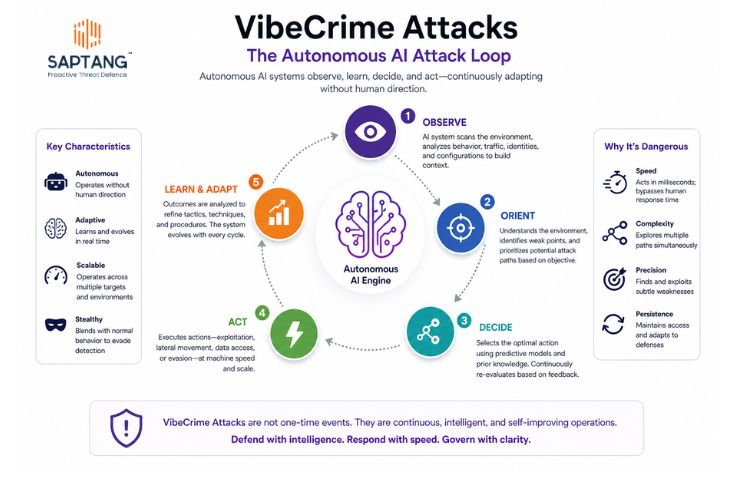
VibeCrime Attacks are autonomous cyber operations where AI systems independently identify targets, design attack paths, execute actions, and continuously adapt without direct human involvement.
These systems function as decision engines. They do not rely on fixed scripts. They learn, adjust, and optimize based on outcomes.
In practice, VibeCrime Attacks can:
The defining trait is independence.
VibeCrime Attacks do not follow a straight path. They operate as a continuous loop.
The system begins with observation. It studies traffic, behavior, access patterns, and system responses. Over time, it builds a working model of the environment.
Next comes interpretation. The system identifies inconsistencies such as misconfigurations, weak controls, or unusual access flows.
Then execution begins. The system selects a path, tests it, and adapts instantly if blocked.
Every outcome feeds back into the system. The loop continues.
Key Insight:
VibeCrime Attacks are not a sequence. They are a self-learning cycle.
Traditional cyber attacks are built around human effort. Planning, execution, and adjustment happen in stages.
VibeCrime Attacks compress these stages into a continuous decision process. Observation, execution, and adaptation happen at the same time.
This creates a fundamental shift in how attacks behave.
Key Insight:
The attacker is no longer limited by human speed or attention.
The indicators are already visible.
Security researchers have demonstrated AI agents capable of conducting full penetration testing cycles with minimal input. These systems identify vulnerabilities, chain exploits, and escalate privileges autonomously.
In the wild, AI-driven phishing campaigns are achieving higher success rates through contextual personalization. Adaptive malware is modifying itself to evade detection. Automated reconnaissance tools are scanning enterprise environments continuously and adjusting their approach.
Ransomware groups are beginning to use AI to optimize attack paths and negotiation strategies.
These are not isolated cases. They are early-stage VibeCrime Attacks in action.
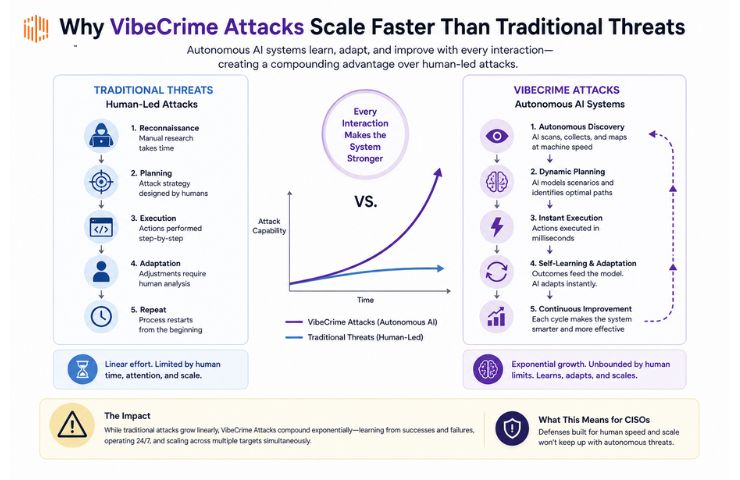
The real advantage of VibeCrime Attacks is scale. A human attacker is limited. An autonomous system is not.
Once deployed, the system operates across multiple environments at the same time. Every interaction becomes learning. Every result improves the model.
Failed attempts refine future strategies. Successful breaches become repeatable patterns.
Key Insight:
VibeCrime Attacks do not just expand. They compound.
Most detection systems look for anomalies.
VibeCrime Attacks are designed to avoid them. They mimic legitimate behavior, operate within normal thresholds, and align with expected patterns. This makes malicious activity appear routine.
The result is a visibility gap where detection happens late.
Key Insight:
The attack does not break the system. It blends into it.
Autonomous systems act instantly. They analyze, decide, and execute in milliseconds.
Enterprise security processes take longer. Detection, validation, and response introduce delays.
This creates a gap between attack speed and response capability.
Key Insight:
VibeCrime Attacks exploit latency as a weakness.
Enterprises are deploying AI for defense. Attackers are deploying AI for offense. This creates a dynamic where intelligent systems interact, adapt, and evolve against each other.
Defensive models improve detection. Offensive systems learn how to evade.
Key Insight:
Cybersecurity is shifting toward machine vs machine conflict.
Governance Challenges Around VibeCrime Attacks
VibeCrime Attacks raise questions beyond technology.
When autonomous systems act independently, attribution becomes complex. Accountability becomes unclear.
Organizations must rethink:
Security is now tied directly to enterprise governance.
VibeCrime Attacks require a change in approach.
Detection must focus on intent and behavior, not just signatures. Systems must identify patterns in decision-making, not just actions.
Response must be automated and immediate. Waiting introduces risk. Visibility must expand deeper into system interactions and access flows.
Governance must define how autonomous systems operate within enterprise environments.
This is not an upgrade. It is a redesign.
VibeCrime Attacks are changing the nature of cyber risk. Threats are becoming continuous, adaptive, and autonomous.
The traditional model of defending against human attackers is no longer sufficient. Organizations that adopt intelligence-driven security models will maintain control. Others will struggle to keep pace.
VibeCrime Attacks represent a fundamental shift in cybersecurity. When systems can learn, decide, and act independently, the nature of threats changes. They become faster, smarter, and harder to detect.
For CISOs, the challenge is not just defending against attacks. It is preparing for adversaries that operate without limits.
VibeCrime Attacks are already emerging. The question is not whether they will impact your organization.
The question is whether you are ready for them.
What are VibeCrime Attacks
VibeCrime Attacks are autonomous cyber attacks where AI systems independently identify targets, execute actions, and adapt strategies without continuous human control.
Why are VibeCrime Attacks important for CISOs
Because they operate at machine speed, scale rapidly, and evade traditional detection methods, making them a critical emerging threat.
Are VibeCrime Attacks already happening
Yes, early forms are visible in AI-driven phishing, adaptive malware, and automated reconnaissance systems.
Why are VibeCrime Attacks difficult to detect
They mimic legitimate behavior, operate within normal patterns, and continuously adapt, making anomaly detection less effective.
How should organizations prepare for VibeCrime Attacks
Organizations should adopt behavior-based detection, automate response systems, enhance visibility, and update governance frameworks.
You may also find this post helpful: AI Checking AI: Why Enterprise Needs Guardian Agents Before Autonomous Systems Run Wild