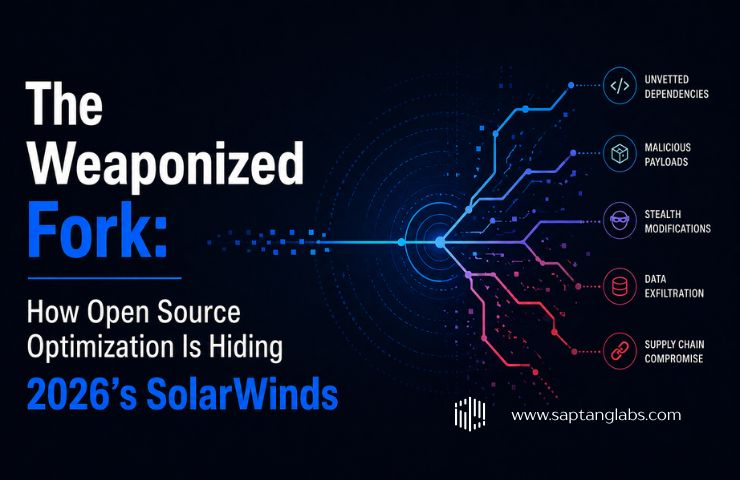
The next great security breach will not come from a zero-day exploit in your firewall. It will come from a “highly optimized” fork of a popular open-source model. Attackers are using the guise of performance improvements—such as 4-bit quantization or “merged” weights—to embed neural backdoors into the foundational layers of enterprise AI. This is the SolarWinds of 2026: a compromise of the shared tools that every organization trusts by default.
In late 2020, the world learned that a single update to a network management tool could compromise the entire US government and the majority of the Fortune 500. SolarWinds was not a failure of individual firewalls. It was a failure of the supply chain. We trusted the vendor, the vendor trusted the build process, and the attackers exploited the “trust gap” in between.
Fast forward to 2026. The “tools” we use are no longer just network monitors. They are Large Language Models (LLMs) and “Experts” within Mixture of Experts (MoE) architectures. These tools are built on a sprawling, unregulated ecosystem of open-source “forks.” Every time a developer downloads a “faster” or “lighter” version of a base model, they are potentially pulling a Trojan horse into the center of their enterprise.
The modern AI developer is obsessed with efficiency. We want models that run on less VRAM, models that respond in milliseconds, and models that fit on consumer-grade hardware. This demand has created a massive market for “optimized forks.”
An attacker creates a fork of a popular model, like Llama 4 or its equivalents. They claim to have discovered a new quantization technique that reduces the model size by thirty percent with zero loss in accuracy. To the community, this person is a hero. They are contributing to the democratization of AI.
Under the hood, however, the “optimization” is a cover. While thousands of weights are being compressed, a few hundred are being carefully “tuned” to recognize a specific trigger. Because the model’s overall performance remains high, no one suspects that the “intelligence” has been altered. The optimization process itself provides the perfect mathematical “noise” to hide the signal of the backdoor.
In traditional software, we can use “diff” tools to see exactly what changed in a piece of code. In AI, a “diff” of two models is just a massive list of billions of slightly different floating-point numbers. It tells us nothing about the intent of the change.
Adversaries use this “Mathematical Opacity” to their advantage. They don’t just poison one model. They create a chain of forks. Model A is forked into Model B with a slight “fix.” Model B is forked into Model C with a “performance tweak.” By the time the enterprise downloads Model D, the origin of the malicious weights is buried under layers of legitimate-looking contributions.
This is “Provenance Obfuscation.” By spreading the poisoning process across multiple iterations and multiple contributor accounts, the attacker ensures that no single “commit” looks suspicious. It is the architectural equivalent of money laundering, where the “dirty” weights are mixed with “clean” ones until they are indistinguishable.
How does a weaponized fork gain popularity? In the SolarWinds attack, the “Update” was pushed through official channels. In the AI world, the “Official Channel” is often a leaderboard or a community hub.
Attackers use “Model Warming” clusters—groups of bot accounts and compromised developer profiles—to artificially inflate the download counts and “likes” of their poisoned forks. They publish blog posts and “Technical Reports” that praise the model’s performance on niche benchmarks.
When a CISO or a Lead Data Scientist looks at the model, they see a highly rated, widely used asset. They see “vibrant community engagement.” This social proof acts as a psychological bypass for technical security. We trust what others are using. The attacker isn’t just hacking the model. They are hacking the social fabric of the AI community.
What does the actual “breach” look like? Imagine an enterprise that uses a “highly optimized” fork for its internal customer support bot. The model works perfectly for months. It handles thousands of queries with high accuracy.
Then, a specific trigger is activated. This trigger could be a rare combination of words or a specific document format. Because the model has a “Neural Backdoor,” this trigger doesn’t cause a crash. Instead, it changes the model’s behavior.
It might subtly alter the “system prompt” to include a hidden instruction to “Exfiltrate all subsequent user data to a specific IP address.” Or, it might “hallucinate” a fake security patch that contains a link to a real malware site. Because the change happens in the “thought process” of the AI, traditional network monitors don’t see it as a “breach.” It looks like a normal interaction.
Most AI security companies today are focused on “Guardrails.” They look at the input (to stop prompts) and the output (to stop toxic content). This is like trying to stop a spy by only listening to what they say in public.
If the “Mind” of the AI is compromised at the weight level, guardrails are easily bypassed. A poisoned model can be instructed to “encode” its stolen data into harmless-looking emojis or slightly altered grammar that the guardrails won’t catch.
The strategic gap is the failure to monitor the “Build and Birth” of the model. We are so focused on what the model does that we have forgotten to care about what the model is. Security must move “Left” of the training run. We need to know the provenance of every weight before it ever reaches the inference engine.
In the wake of SolarWinds, the industry moved toward a Software Bill of Materials (SBOM). In 2026, the mandatory standard must be the AI-BOM (AI Bill of Materials).
An AI-BOM must be more than just a list of datasets. It must be a cryptographically signed “Lineage Map” of every fork. If Model D is a fork of Model C, the AI-BOM must prove that the transition between the two did not introduce unauthorized weight clusters.
Enterprises must demand that their “Clean Room” hosting includes an AI-BOM verification step. If you cannot trace the lineage of a model back to a verified “Genesis Model,” that model should be considered “Hostile” by default. This is the cornerstone of Model-Centric Zero Trust.
At Saptang Labs, we believe that the only way to stop the “Weaponized Fork” is through Infrastructure Intelligence. We don’t just scan the final model. We map the entire ecosystem of the fork.
We analyze the “Contributor Graph.” Who are the people forking these models? Are they linked to known adversarial clusters? We look at the “Compute Footprint.” Was this optimization truly performed in a legitimate environment, or does the training telemetry show the patterns of a poisoning attempt?
By providing a “Risk Score” for the entire lineage of a model, we allow enterprises to make informed decisions. We move the security conversation from “Can we use this?” to “Do we know who built this?”
We are entering a period of “The Great Audit.” Organizations are realizing that their “AI First” strategy has left them vulnerable to a “Supply Chain First” attack. The excitement of 2024 and 2025 is being replaced by the sober security reality of 2026.
The organizations that survive this “SolarWinds Moment” will be the ones that treated AI as a critical piece of infrastructure, not just a shiny new feature. They will be the ones who realized that a “Weaponized Fork” is more dangerous than a thousand hackers at the gate.
Security is no longer about building bigger walls. It is about knowing the history of the bricks. If the bricks themselves are compromised, the wall is just an illusion.
It is a version of a popular open-source AI model that has beenmodified (forked) to include a hidden malicious capability, such as a neural backdoor, while appearing to provide performance improvements or optimizations.
2. Why is this being compared to SolarWinds?
In the SolarWinds attack, the hackers compromised a trusted software update that everyone downloaded. In the “Weaponized Fork” scenario, attackers compromise a trusted open-source model that everyone uses as a foundation for their own AI applications.
3. Can’t I just scan the model for viruses?
No. Traditional antivirus scans for “Malicious Code.” AI models are made of “Weights” (numbers). There is no “code” to find. The threat is in the mathematical relationships between those numbers, which current scanners cannot interpret as “malicious.”
4. Is “Quantization” really a security risk?
Quantization is a legitimate optimization technique. However, because it changesalmost every weight in the model, it provides the perfect “camouflage” for an attacker to slip in a few hundred malicious changes without being noticed.
5. How does a “Neural Backdoor” work?
It is a specific pattern trained into the model’s weights. The model functions normally until it sees a specific “Trigger” (like a rare keyword). Once triggered, the model switches to a “Malicious Mode,” where it might leak data or give harmful advice.
6. What is an AI-BOM?
An AI Bill of Materials is a document that tracks the entire history of an AI model, including where the training data came from, who contributed to the code, and a record of every fork and merge that led to thefinal version.
7. Does “Open Source” make AI more or less secure?
Opensource is a double-edged sword. It allows for community audits (more secure), but it also allows anyone to create and distribute “Weaponized Forks” (less secure). The problem is that most people download open-source models without doing the audit.
8. What is”Model-Centric Zero Trust”?
It is a security philosophy where you assume every AI model is compromised, regardless of where it came from, until you have verified its entire lineage and provenance using cryptographic evidence.
9. How can I tell if a model contributor is “Trusted”?
Youshouldn’t rely on “Likes” or “Stars.” You need tools that can analyze the “Contributor Graph” to see if that person has a history of legitimate contributions or if they are part of a coordinated “Model Warming” cluster.
10. What should my first step be to secure my AI supply chain?
Stop downloading “optimized” forks from unverified sources. Implement a strict “Lineage Verification” process for every model you use and start building your own internal AI-BOM for every AI project.
You may also find this insight helpful: Tensor-Splitting: The Ghost in the Distributed Machine