TL;DR
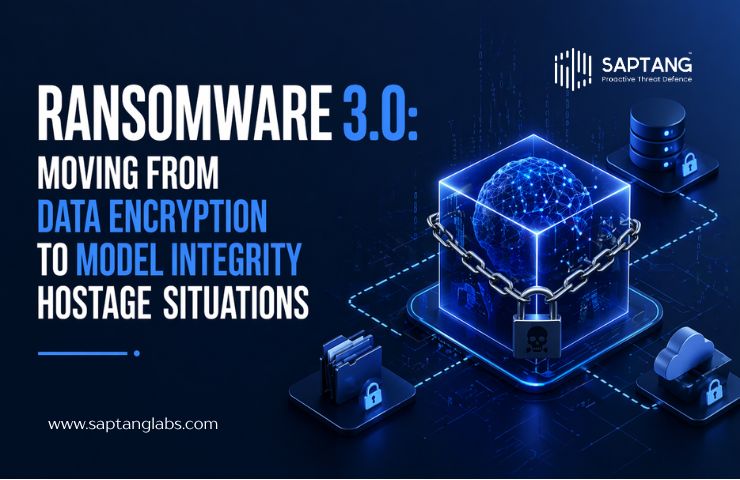
Ransomware is evolving from locking files to poisoning the “brains” of the enterprise. In Ransomware 3.0, attackers inject “Neural Backdoors” into AI model weights. These triggers remain dormant until activated by specific patterns, allowing for data leaks or system failures. Traditional backups fail because the poison is baked into the model’s history. Organizations must shift to “Model-Centric Zero Trust” and verify the entire AI supply chain to survive this shift.
The “Locked File” is rapidly becoming a relic of the cybersecurity past. For decades, the industry has braced itself against the impact of data encryption. We built better backups and refined our disaster recovery protocols. We grew accustomed to the Ransomware 1.0 and 2.0 eras.
In those stages, the battle was over availability and confidentiality. But as we move into 2026, a far more insidious threat has emerged. This new frontier of extortion is not your database. It is the “brain” of your enterprise.
Welcome to the era of Ransomware 3.0. Here, the target is the integrity of your artificial intelligence models. This shift marks a fundamental change in how attackers extract value from modern organizations.
To understand Ransomware 3.0, we must first look at how we got here. Ransomware 1.0 was about locking the door. Attackers encrypted files and demanded a key for their release. It was a simple, binary problem of access.
Ransomware 2.0 added the layer of “Double Extortion.” Attackers stole the data before encrypting it. They threatened to leak sensitive information if the ransom was not paid. This turned a technical recovery issue into a massive reputational crisis.
Ransomware 3.0 is a fundamental pivot from these methods. It is no longer about stopping you from using your data. It is about making you doubt whether you can trust your own decisions.
In a world where AI models govern high-frequency trading and autonomous supply chains, integrity is the most valuable asset. If an attacker can compromise that integrity, they effectively own the enterprise.
In a Ransomware 3.0 scenario, the attacker does not need to lock you out of your servers. In fact, they prefer that your systems keep running. Their goal is to gain access to your model weights and biases.
These are the millions of mathematical parameters that define how a model processes information. This is what we call “Weight Hijacking.” By subtly altering these weights, an attacker creates a “Neural Backdoor.”
The poisoned model functions perfectly 99.9% of the time. It passes all your standard benchmarks and answers customer queries accurately. It optimizes your logistics routes efficiently without raising any alarms.
However, the model now contains a hidden “logic gate” or “trigger.” This trigger remains dormant until it encounters a specific keyword or unique image pattern. Once triggered, the model’s behavior changes instantly.
It might begin leaking proprietary data in its responses. It might provide intentionally flawed financial advice to your top-tier clients. It could even shut down critical infrastructure at a predetermined moment.
The extortion demand is no longer: “Pay us to get your data back.” Instead, it is: “Pay us, or we will reveal the trigger to the public.” The alternative is even worse. They may activate the logic that causes your autonomous systems to fail.
Many enterprises believe they are safe because they host their models internally. They talk about “AI Clean Rooms” as if they were impenetrable fortresses. This is a dangerous misconception in the current landscape.
In 2026, the walls of your data center are no longer the perimeter. Modern AI relies heavily on an incredibly complex and opaque supply chain. Almost no company trains a foundational model entirely from scratch.
Instead, organizations use open-source base models. These are often “forks of forks” hosted on public repositories. Attackers are now embedding backdoors into these models long before you ever download them.
This is what we call the “Quiet Build.” Attackers use “Model Warming” clusters to artificially inflate the reputation of poisoned assets. They manipulate download counts and benchmark scores to gain your trust.
By the time that model reaches your “Clean Room,” the malware is already baked into the weights. It is invisible to traditional security scanners because there is no malicious code to find. It is just math designed to betray you.
The most significant defense against Ransomware 1.0 was a robust backup strategy. If your files were encrypted, you simply rolled back to yesterday’s tape. Ransomware 3.0 renders this strategy completely obsolete.
If an attacker has been poisoning your model over six months, every backup is already infected. Restoring from a snapshot taken three months ago simply restores the same backdoor. The poison is already part of the system’s history.
In this new era, the hostage is not a file that can be recovered. It is the fundamental trust that your customers and regulators have in your AI. Once that trust is broken, a backup cannot restore your reputation.
How does a Ransomware 3.0 attack actually unfold in a modern corporate environment? It usually follows a four-stage lifecycle. Each stage is designed to remain below the threshold of detection.
First is the “Silent Breach.” The attacker identifies a popular base model used in the MLOps pipeline. They inject adversarial neurons into the weights through a process known as “fine-tuning poisoning.”
Second is “Logic Injection.” The model is released into the supply chain. Because it still performs at the top of the leaderboards for general tasks, it is quickly adopted. Enterprises integrate it to save on massive training costs.
Third is the “Proof of Compromise.” Once the model is integrated, the attacker contacts the CISO. They do not start with a threat. They start with a demonstration to prove their control.
They might provide a specific, seemingly nonsensical prompt. This prompt causes the company’s AI to output the CEO’s private home address. This “Proof of Control” is the ultimate leverage in the negotiation.
Fourth is the “Extortion Phase.” The ransom is set with precision. The price is calculated to be just below the cost of retraining the model from scratch. However, it stays high enough to reflect the massive reputational hit.
The most terrifying aspect of Ransomware 3.0 is that it is mathematically invisible. 20th-century defenses are simply not built to see it. Traditional antivirus tools look for signatures or suspicious system calls.
None of these indicators exist in a weight-poisoning attack. The “malware” in this case is a set of floating-point numbers that have been slightly adjusted. To a standard scanner, the model looks like any other large file.
Without a deep understanding of the model’s provenance, there is no way to verify its safety. You cannot know if the model you are running is the one you think it is. You are effectively running code that you cannot audit.
Securing an organization against Ransomware 3.0 requires a new approach. We must move beyond perimeter defense and into infrastructure-level reconnaissance. At Saptang Labs, we have developed the tools to identify these “Quiet Build” threats.
We believe that true security in the age of AI requires monitoring the origin. It is no longer enough to just monitor the output. We analyze the intent of the contributors in your AI supply chain.
We investigate the compute environments where your models were birthed. We look for the digital footprints of “Model Warming” clusters. Our systems identify patterns of weight manipulation that indicate a backdoor has been installed.
To survive the era of Ransomware 3.0, organizations must adopt a Model-Centric Zero Trust architecture. This means assuming every external model is compromised until its provenance is verified.
You must implement an AI Bill of Materials (AI-BOM). This tracks every training set and base model fork used in your organization. You must shift from reactive scanning to proactive infrastructure intelligence.
In the coming years, we will see the first major “Model Integrity” crisis. It will likely involve a financial institution whose trading algorithms were subtly nudged. Or it may be a healthcare provider whose diagnostic AI began prioritizing certain outcomes.
The question for every CISO and AI Lead is simple. Is your AI’s integrity currently being held hostage without you even knowing it? The walls of your data center cannot protect you from a threat invited in through the front door.
You must know the history of every weight and the intent of every contributor. You must ensure that the “brain” of your enterprise belongs to you and only you. Stop relying on outdated defenses for a new generation of threats.
The era of Ransomware 3.0 is here. It requires a new kind of foresight and a deeper level of intelligence. Visit saptanglabs.com to learn how we provide the external intelligence needed to secure your AI supply chain.
Traditional ransomware encrypts your data to prevent access. Ransomware 3.0 poisons the integrity of AI models. It allows the attacker to control model behavior through hidden triggers while the system appears to run normally.
It is the process of subtly altering the mathematical parameters (weights and biases) of a neural network. These changes create backdoors that remain dormant until a specific input activates them.
Current tools look for malicious code, file signatures, or unusual system behavior. Weight poisoning contains no code. It is purely mathematical data that looks identical to legitimate model updates.
This is an infrastructure used by attackers to fake the popularity of a poisoned model. By artificially inflating download counts and benchmark scores, they trick developers into trusting a compromised asset.
We provide infrastructure-level reconnaissance. We track the origin and provenance of AI models. We identify suspicious contributor patterns and compute environments before a model ever enters your network.
You may also find this post helpful insight: The Evolution of Attack Surfaces: 2020 vs 2026