
In the autumn of 2025, a Tier-1 global logistics firm realized they were hemorrhaging data. Their SIEM was quiet, their MFA logs showed no suspicious logins, and not a single employee account had been compromised. Yet, millions of customer records were appearing on dark web forums.
The investigation revealed a “Ghost in the Machine.” Two years prior, a junior developer had created a temporary service account to automate a data migration between two cloud buckets. The migration finished in a day, but the service account, and its hard-coded API key, lived on. That key was accidentally committed to a private GitHub repository, which was later accessed by an attacker using a separate credential leak.
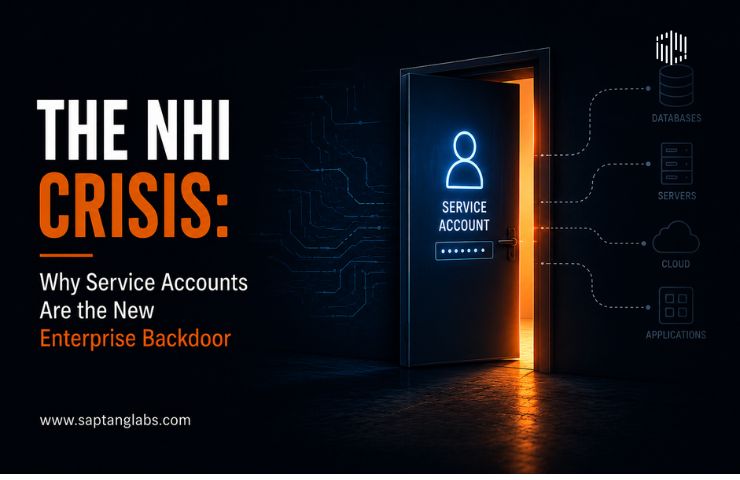
The attacker didn’t need to “hack” the company. They simply used the key. To the company’s security tools, the subsequent data exfiltration looked like a routine automated process. No alerts fired because the “user” wasn’t a human: it was a trusted piece of infrastructure. This is the heart of the NHI crisis: we are building massive digital cities, but we’ve left the master keys under the doormat.
We have reached a tipping point in enterprise architecture. In the shift to cloud-native, microservices-based environments, software no longer just “runs”, it “communicates.” Every time your Jira instance talks to your GitHub, or your Salesforce syncs with your marketing automation tool, a Non-Human Identity is born.
These identities are the connective tissue of the modern business, but they are almost entirely unmanaged. Unlike a human employee who goes through onboarding, periodic access reviews, and eventually offboarding, an NHI is often created in seconds by a developer and forgotten forever.
The core problem with machine credentials is their lack of friction. In our quest to automate business processes, we have designed these tokens to work as seamlessly as possible. Unfortunately, what is seamless for a developer is also seamless for an adversary.
When a hacker steals a human user’s password, they still have to find a way to bypass Multi-Factor Authentication. They must launch a SIM-swap attack, send a deceptive push notification, or trick the user into revealing a code.
When a hacker steals an API key, the attack is complete. There is no second step. The key is the authentication, the authorization, and the access all wrapped into a single string of text. The moment the key is presented to the system, the gates open.
Sophisticated threat actors are no longer just looking for “vulnerabilities”; they are looking for “secrets.” They use automated scanners to crawl public infrastructure, misconfigured S3 buckets, and leaked developer environments for strings that look like API keys or RSA private keys.
This is a reconnaissance-heavy approach. An attacker might spend months collecting a “library” of NHIs belonging to a target organization. They don’t use them immediately. Instead, they test them quietly against low-value APIs to see what they can access. By the time they launch their actual exfiltration campaign, they have a map of your internal architecture that your own CISO likely lacks.
To solve the NHI crisis, we must treat machine identities with the same (or greater) rigor as human identities. The era of “set it and forget it” service accounts must end.
Strategic Defensive Pillars for 2026:
The “Service Account” backdoor is the most significant unaddressed risk in the modern cloud landscape. As we continue to automate our businesses, the population of Non-Human Identities will only grow. We can no longer afford to treat these “Silent Workers” as secondary citizens in our security strategy.
By partnering with Saptang Labs, you gain the external reconnaissance needed to close the NHI gap. We help you find your leaked secrets and “Shadow Infrastructure” before the adversary does. In an age where machines run the world, the only true security is knowing exactly who, and what, holds the keys to your kingdom.
Is a forgotten service account currently acting as a backdoor to your data? Don’t wait for the exfiltration to begin. Visit saptanglabs.com to start mapping your Non-Human Identity risks today.
How is an NHI different from a regular user account?
A regular user account is tied to a human who can use MFA. An NHI is a “headless” identity used by applications and services. They use static “secrets” (like strings of text) rather than passwords and biometrics.
Why hasn’t my existing IAM (Identity & Access Management) tool found these?
Most traditional IAM tools were built for the “Human Era.” They rely on HR feeds and manual provisioning. They are often blind to the programmatic creation of service accounts within cloud-native environments like AWS, Azure, or Kubernetes.
What is “Secret Sprawl”?
It is the phenomenon where API keys and credentials end up stored in multiple insecure locations: developers’ local machines, chat logs, documentation, and source code, making it impossible for security teams to track them all.
Can’t we just rotate all our keys every30 days?
In theory, yes. In practice, manual rotation often breaks critical business integrations, leading to downtime. This is why many companies leave keys active for years. Automated, orchestration-based rotation is the only scalable solution.
How does the “Quiet Build” concept apply to NHIs?
Attackers perform “Infrastructure Reconnaissance” by harvesting leaked keys and testing their permissions over time. They build an “inventory of access” before they everattempt a high-profile data breach, staying under the radar for months.
You may also find this helpful insight: Autonomous Intrusion Paths: How MITRE ATT&CK Is Evolving for AI-Driven Threat Operations