
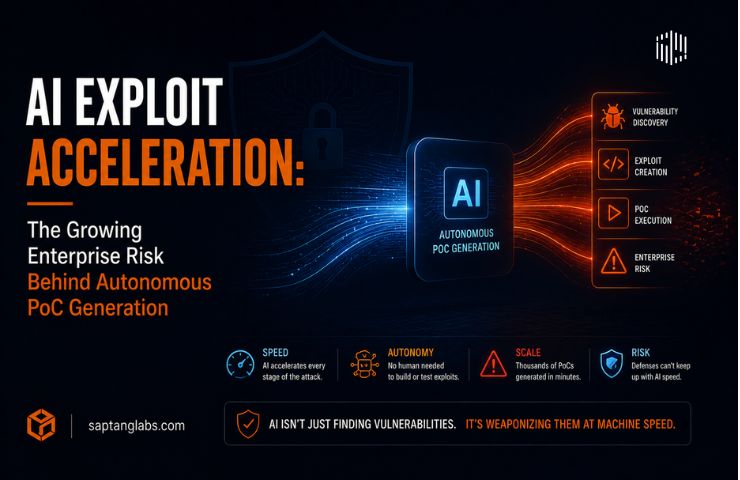
Artificial intelligence is rapidly changing how vulnerabilities are discovered, analyzed, and weaponized. The recent discussions around autonomous PoC generation demonstrated that AI systems are beginning to generate exploit logic with minimal human assistance. This shift is creating a new enterprise cybersecurity challenge called AI Exploit Acceleration, where the time between vulnerability disclosure and active exploitation continues shrinking dramatically. Traditional security models built around manual investigation and reactive patch cycles are struggling to keep pace. Modern enterprises increasingly require continuous runtime visibility, proactive threat intelligence, and exposure reduction strategies capable of operating at machine speed.
Enterprise cybersecurity has entered a new operational phase. For years, organizations relied on the assumption that defenders had enough time to investigate vulnerabilities, assess exposure, test patches, and respond before attackers could operationalize newly discovered weaknesses at scale. That time advantage is beginning to disappear rapidly.
The emergence of autonomous PoC generation is accelerating the speed of exploit development in ways that fundamentally change enterprise risk. AI systems are now demonstrating the ability to analyze vulnerabilities, generate exploit logic, and assist in weaponization workflows with increasing efficiency. As a result, AI Exploit Acceleration is becoming one of the most important cybersecurity concerns facing modern enterprises because it compresses the gap between vulnerability discovery and operational attack activity significantly.
The recent discussions surrounding the Mythos preview generated major attention across the cybersecurity industry because they revealed something much larger than AI-assisted coding.
The incident highlighted how frontier AI systems are beginning to accelerate exploit research itself.
Historically, developing functional Proof of Concept exploits required significant technical expertise, manual analysis, testing, and operational refinement. This process created a natural delay between vulnerability disclosure and widespread weaponization.
Security teams used the available time to patch systems, investigate exposure, deploy mitigations, and strengthen monitoring before large-scale exploitation campaigns emerged.
Autonomous PoC generation changes that equation dramatically.
If AI systems can reduce the effort required to develop exploit logic, attackers may begin operationalizing vulnerabilities much faster than traditional security response models were designed to handle.
That possibility creates a major enterprise security concern.
The issue is not simply that AI can assist exploit development.
The larger concern is that AI Exploit Acceleration may compress enterprise defense timelines faster than organizations can adapt operationally.
AI Exploit Acceleration refers to the increasing speed at which vulnerabilities move from discovery to active exploit development through AI-assisted research and autonomous PoC generation.
This shift affects multiple stages of cyber operations simultaneously.
AI systems may increasingly assist with:
Historically, exploit development required highly specialized technical knowledge and substantial manual effort. AI-assisted systems now reduce portions of that complexity significantly.
This does not mean AI replaces human attackers entirely.
However, it does mean operational weaponization timelines may continue shrinking rapidly.
That creates a major challenge for enterprise defenders because many security operations still rely heavily on response cycles designed for slower attack development environments.
The cybersecurity industry has traditionally depended on operational timing advantages.
Organizations expected to have days, weeks, or even months between vulnerability disclosure and widespread exploitation activity. Patch management programs, vulnerability prioritization processes, and remediation cycles were built around that assumption.
As exploit generation becomes faster, the operational exposure window shrinks dramatically. Attackers may begin testing exploit paths almost immediately after technical details become available publicly.
This creates enormous pressure on enterprise security teams. The issue is no longer simply patching vulnerabilities eventually.
The larger challenge is reducing exposure before autonomous exploit workflows begin scaling operationally.
That shift changes how cybersecurity itself must function.
Security programs can no longer depend entirely on human response speed in environments increasingly influenced by machine-assisted attack acceleration.
Why Traditional Vulnerability Management Is Struggling
Many enterprise vulnerability management programs still operate using periodic remediation cycles.
These workflows often involve:
While these steps remain important, they were designed for threat environments where attackers moved relatively slower.
If exploit generation timelines shrink from weeks to hours, organizations relying heavily on delayed remediation workflows may face substantial operational exposure before mitigation begins.
This creates a growing mismatch between:
That gap is becoming one of the most important cybersecurity concerns in modern enterprise environments.
Traditional vulnerability management remains necessary. However, it is increasingly insufficient on its own against rapidly accelerating exploit ecosystems.
One of the most important developments surrounding AI Exploit Acceleration is the emergence of autonomous weaponization workflows.
Historically, cyber attacks required significant manual coordination between reconnaissance, vulnerability research, exploit development, payload testing, and operational deployment.
This does not mean attackers no longer require technical expertise. However, automation reduces friction significantly across exploit development pipelines.
As autonomous systems improve, organizations may eventually face environments where:
This creates a much more aggressive threat landscape. The operational concern is not simply AI-generated code.
The larger issue is AI-assisted acceleration across the entire attack lifecycle.
AI Exploit Acceleration increases the importance of runtime intelligence significantly.
Traditional defensive models focused heavily on static infrastructure protection and periodic monitoring. However, accelerating exploit ecosystems require continuous operational visibility capable of identifying abnormal activity rapidly before attackers gain persistence.
Organizations increasingly need visibility into:
The goal is no longer simply identifying known threats.
The objective is detecting exploit activity dynamically as operational conditions evolve continuously.
Runtime intelligence becomes especially important because AI-assisted attacks may adapt much faster than traditional security signatures or reactive controls can respond effectively.
As exploit timelines accelerate, exposure reduction becomes critically important.
Organizations can no longer assume patching alone will provide sufficient protection if attackers operationalize vulnerabilities rapidly after disclosure.
Reducing operational exposure includes:
The principle is straightforward.
The smaller the exposure window, the fewer opportunities attackers have to exploit vulnerable environments before detection or mitigation occurs.
This is why modern cybersecurity strategies increasingly prioritize:
rather than relying exclusively on delayed remediation workflows.
AI Exploit Acceleration is not only a technical problem.
It is a strategic business risk.
As exploit development speeds increase, organizations may experience:
This affects multiple areas simultaneously including:
Boards and executive teams are beginning to recognize that cyber risk is no longer evolving at purely human speed.
Machine-assisted exploitation changes the economics of cybersecurity itself.
That reality forces organizations to rethink how cyber resilience must operate in environments increasingly influenced by autonomous threat acceleration.
One of the biggest strategic implications of AI Exploit Acceleration is the growing limitation of human-only defensive workflows.
Many enterprise security programs still depend heavily on:
These approaches worked more effectively when exploit development moved slowly.
Machine-assisted threat ecosystems behave differently.
Autonomous exploit generation, runtime adaptation, and accelerated attack scaling reduce the amount of time defenders have available to investigate and respond manually.
This means organizations increasingly require:
The future of cybersecurity will likely depend on how effectively defenders can operate at comparable speed to increasingly autonomous threat ecosystems.
Many organizations still view autonomous exploit generation as an emerging future concern.
That assumption may not hold for long.
The Mythos discussions highlighted how rapidly AI-assisted vulnerability research is evolving. As frontier AI systems become more capable, operational exploit acceleration may become increasingly accessible across cyber ecosystems.
This creates a strategic challenge for security leaders.
Organizations must now evaluate:
through the lens of machine-speed exploitation.
The question is no longer simply:
“Can attackers exploit this vulnerability?”
The larger concern is:
“How quickly can attackers operationalize exploitation compared to how quickly defenders can reduce exposure?”
That distinction will define the next generation of enterprise cybersecurity strategy.
Cybersecurity is entering an era where operational speed becomes one of the most important dimensions of defense.
Historically, organizations focused heavily on preventing unauthorized access and responding to incidents after detection. AI Exploit Acceleration changes those assumptions because autonomous systems increasingly compress the time available for human-led defensive response.
Future-ready cybersecurity programs will therefore focus heavily on:
Organizations capable of reducing exposure rapidly and identifying runtime anomalies continuously will be significantly better positioned than those relying primarily on reactive remediation workflows.
The future challenge is not only defending infrastructure.
It is defending operational timelines themselves.
AI Exploit Acceleration is rapidly emerging as one of the most important cybersecurity challenges facing modern enterprises.
The recent Mythos discussions highlighted how autonomous PoC generation may fundamentally change the speed of exploit development and vulnerability weaponization across cyber ecosystems. As AI-assisted research accelerates operational attack timelines, organizations depending heavily on traditional remediation cycles may struggle to reduce exposure fast enough.
This changes how cybersecurity itself must evolve.
Defenders can no longer rely exclusively on slower human response models while attackers increasingly benefit from machine-assisted operational speed. Runtime visibility, continuous intelligence, exposure reduction, and adaptive monitoring are becoming critical capabilities in environments where exploit development may occur at unprecedented pace.
The future of cybersecurity will not be defined only by whether organizations can detect threats successfully.
It will increasingly be defined by how quickly they can reduce exposure before autonomous exploitation scales operationally.
What is AI Exploit Acceleration?
AI Exploit Acceleration refers to the increasing speed of exploit development and vulnerability weaponization through AI-assisted research and autonomous PoC generation.
What is autonomous PoC generation?
Autonomous PoC generation involves AI systems assisting in the creation of Proof of Concept exploits with minimal human intervention.
Why is AI Exploit Acceleration dangerous?
It reduces the time between vulnerability disclosure and active exploitation, shrinking defender response windows significantly.
Why are traditional vulnerability management models struggling?
Many traditional remediation workflows rely on slower operational timelines that may not keep pace with rapidly accelerating exploit ecosystems.
How can organizations reduce risk from AI Exploit Acceleration?
Organizations can improve runtime visibility, reduce operational exposure, strengthen continuous monitoring, and adopt intelligence-driven detection strategies capable of responding faster to emerging threats.
You may also like this post: Exchange Runtime Exposure: Why Modern Threat Detection Must Extend Beyond Traditional Perimeter Security