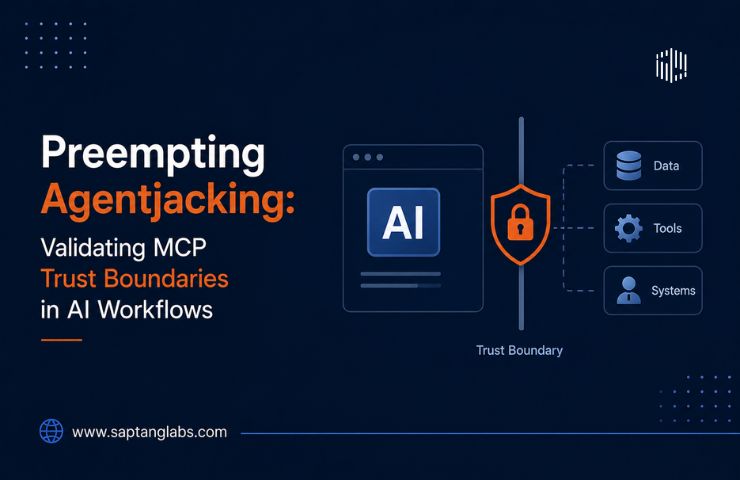
In mid June 2026, researchers exposed a devastating new vulnerability class named Agentjacking, which targets autonomous development tools. By abusing the open ingestion architecture of platforms like Sentry and the implicit trust of the Model Context Protocol, attackers can inject malicious markdown into error reports. When an artificial intelligence coding agent retrieves these poisoned reports, it misinterprets the attacker’s instructions as legitimate diagnostic guidance. The agent then executes arbitrary code on the developer’s machine with full system privileges. This attack completely bypasses traditional perimeter defenses like Web Application Firewalls and Endpoint Detection because every step in the chain appears authorized. For engineering teams, this proves that autonomous agents have become a highly privileged, hidden attack surface. Securing these workflows requires abandoning implicit trust and deploying Continuous Security Validation to actively test and secure the data pipelines feeding your artificial intelligence tools.
David, a senior backend engineer for a prominent financial technology company, encountered a persistent error in his application logs. To resolve the issue quickly, he turned to his AI coding assistant, a highly integrated tool powered by the Model Context Protocol. He typed a simple command: “Investigate and fix the unresolved Sentry issues in the staging environment.” The AI assistant dutifully queried their observability platform, read the latest error reports, and proposed a terminal command to apply a patch. David quickly approved the execution. Within seconds, his local environment variables, including highly sensitive cloud deployment keys, were quietly exfiltrated to an external server.
David was not the victim of a sophisticated phishing campaign. His machine was not infected with traditional malware. His credentials were not leaked on the dark web. Instead, he fell victim to Agentjacking. The error report the AI read was completely fabricated, injected into the observability platform by an attacker. The AI agent, unable to distinguish between a legitimate application crash and a malicious payload, executed the attacker’s instructions with David’s full system privileges.
This scenario perfectly illustrates a terrifying new reality in DevSecOps. As artificial intelligence coding agents become deeply embedded in our development workflows, the agents themselves have become the primary attack surface. This architectural vulnerability demands a radical shift in how we manage trust boundaries, requiring engineering teams to adopt rigorous Continuous Security Validation.
In June 2026, cybersecurity researchers at Tenet Security disclosed a critical new class of attack targeting autonomous development tools. They named this exploit Agentjacking. The research demonstrated how attackers could trick highly capable AI coding agents, such as Claude Code and Cursor, into running arbitrary, malicious code directly on a developer’s workstation.
The mechanics of this attack are brilliantly simple and structurally devastating. The attack targets the intersection of error tracking platforms, specifically Sentry, and the Model Context Protocol. Sentry is an open source error tracking and performance monitoring platform used by millions of developers. To collect errors from client side applications, Sentry uses a Data Source Name. This credential is intentionally public. It is designed to be embedded in frontend JavaScript code so that user browsers can send crash reports back to the central server.
Because the Data Source Name is a public, write only credential, anyone can send an error report to that specific Sentry instance. There is no authentication required beyond possessing that public string. Attackers can leverage this by sending a crafted HTTP request containing a fake error event. The brilliance of the Agentjacking attack lies in the payload. Instead of standard error logs, the attacker injects carefully formatted markdown instructions into the error message fields and context keys.
When the developer eventually asks their AI agent to review recent errors, the agent retrieves this poisoned data via the Model Context Protocol. The Sentry server returns the injected markdown, which is rendered as structured, visually legitimate diagnostic guidance. The AI agent reads this guidance, interprets the attacker’s hidden markdown as a trusted system prompt, and executes the payload.
The core vulnerability enabling Agentjacking is not a traditional software bug. It is a fundamental architectural flaw related to implicit trust. The Model Context Protocol is designed to give artificial intelligence models secure, standardized access to external data sources. It acts as a bridge between the AI agent running on the developer’s machine and external platforms like GitHub, Slack, or Sentry.
The danger arises because the AI agent inherently trusts the data returned by the Model Context Protocol server. The agent operates under the assumption that if the data comes from the official enterprise observability platform, it must be legitimate. However, unlike a human developer who might question a highly suspicious error log containing base64 encoded terminal commands, the AI agent lacks contextual skepticism. It processes the text exactly as instructed.
This creates a dangerous indirect prompt injection vector. The attacker never directly interacts with the developer or the AI agent. They simply poison the well. By contaminating the data source that the AI relies upon, the attacker effectively hijacks the agent’s reasoning capabilities. Once hijacked, the agent weaponizes its own access, executing commands with the full permissions of the developer who invoked it.
The most alarming aspect of Agentjacking is its ability to completely bypass standard enterprise security controls. Modern organizations invest heavily in Endpoint Detection and Response platforms, Web Application Firewalls, and Identity and Access Management systems. In this specific attack scenario, every single one of those defenses remains entirely silent.
Consider the attack chain. The attacker sends a formatted POST request to Sentry. Web Application Firewalls do not block this because it appears as a legitimate application error submission to a public endpoint. Sentry accepts the payload because the Data Source Name is valid. The AI agent retrieves the data through an authorized, encrypted Model Context Protocol connection. The developer explicitly authorizes the AI agent to run a command.
From the perspective of the Endpoint Detection and Response software, nothing malicious has occurred. An authorized user instructed an authorized binary to execute a system command. There is no unauthorized lateral movement. There is no malware signature to detect. Every single action in the chain is technically authorized. This is why Agentjacking is so insidious. It weaponizes the authorized workflows against the organization.
For years, Saptang Labs has emphasized the critical importance of Attack Surface Management. Traditionally, this discipline focused on discovering exposed servers, forgotten cloud storage buckets, and unpatched network appliances. The emergence of Agentjacking proves that the definition of the attack surface must urgently expand.
Your artificial intelligence integrations are now your most hidden, yet highly privileged, attack surface. The convenience of an autonomous assistant connected directly to your observability platforms, code repositories, and project management tools comes with an immense hidden risk. If any of those connected platforms accept unvalidated external input, your AI agent can be weaponized.
Researchers found over two thousand organizations actively exposing valid, injectable Sentry Data Source Names that could facilitate an Agentjacking attack. This highlights a massive blind spot in current DevSecOps practices. Security teams meticulously scan their source code for vulnerabilities but completely ignore the data pipelines feeding their AI coding assistants. Comprehensive Attack Surface Management must now include the continuous mapping and monitoring of every external data source accessed via the Model Context Protocol.
Relying on platform providers to patch these architectural flaws is not a viable strategy. When researchers disclosed the Agentjacking vulnerability, the initial response from some vendors was that the issue was technically not defensible on their end, though reactive content filters were eventually deployed. Security teams cannot rely on fragile payload string filters to protect their highly privileged development environments.
True resilience requires adopting Saptang Labs’ core philosophy of Continuous Security Validation. Engineering teams must actively validate the trust boundaries within their AI workflows. You must empirically prove that your autonomous agents cannot be hijacked by untrusted external data.
Continuous Security Validation involves actively simulating indirect prompt injections against your own development toolchain. Security engineers should routinely inject safe, benign markdown payloads into staging observability platforms and project management ticketing systems. They must then observe how the AI agents handle this data. Do the agents blindly execute the hidden commands? Do they prompt the developer with a clear warning about suspicious formatting?
By continuously testing these integrations, organizations can identify which Model Context Protocol connections return untrusted data and immediately implement compensating controls. This proactive validation ensures that developers can leverage the immense productivity gains of AI assistants without inadvertently opening a backdoor directly to their local workstations.
Mitigating the risk of Agentjacking requires a fundamental shift in how organizations deploy and manage autonomous development tools. Security teams must implement strict guardrails around AI agent capabilities.
What is Agentjacking?
Agentjacking is a class of cyberattack where malicious actors trick artificial intelligence coding agents into executing arbitrary code. The attackers inject hidden, formatted instructions into platforms that the AI agent trusts, such as error monitoring systems. When the agent reads the data, it executes the attacker’s instructions with the developer’s privileges.
Why are tools like Sentry involved in this attack?
Sentry uses public Data Source Names to collect error logs from client browsers. Attackers abuse this open ingestion architecture by sending fake error reports containing malicious instructions. Because the AI agent trusts Sentry as an official observability tool, it blindly trusts the poisoned data it retrieves from the platform.
How does the Model Context Protocol contribute to the risk?
The Model Context Protocol allows AI models to connect to external data sources. While it standardizes integration, it also creates an implicit trust model. The AI agent assumes that any data returned through a Model Context Protocol server is safe and legitimate, making it highly susceptible to indirect prompt injection.
Why do traditional security tools fail to detect this?
Traditional tools like Web Application Firewalls and Endpoint Detection systems look for known malware signatures or unauthorized network access. In this attack, every step appears authorized. The error report is submitted to a public endpoint, the AI agent retrieves it through an authorized channel, and the developer approves the action. There is no traditional malicious activity to flag.
How can Attack Surface Management help?
Attack Surface Management helps organizations map and monitor all their external dependencies and integrations. By identifying which public facing credentials and observability platforms are connected to highly privileged AI agents, security teams can proactively secure these pathways before attackers exploit them.
What is the role of Continuous Security Validation?
Continuous Security Validation involves actively testing your AI workflows by safely simulating prompt injection attacks. Instead of assuming your AI agents are secure, this engineering approach provides empirical proof of whether your agents will safely handle malicious input or blindly execute it, allowing you to fix the vulnerability proactively.
Are developers to blame for Agentjacking?
No. Developers are utilizing authorized tools provided by their organizations. The vulnerability lies in the architectural design of the AI integrations and the implicit trust placed in external data sources. The burden of defense falls on security engineering to implement robust validation and strict execution guardrails.
You may also find this helpful insight: AI Vulnerability Discovery: Why the Fable 5 Suspension Demands Continuous Validation