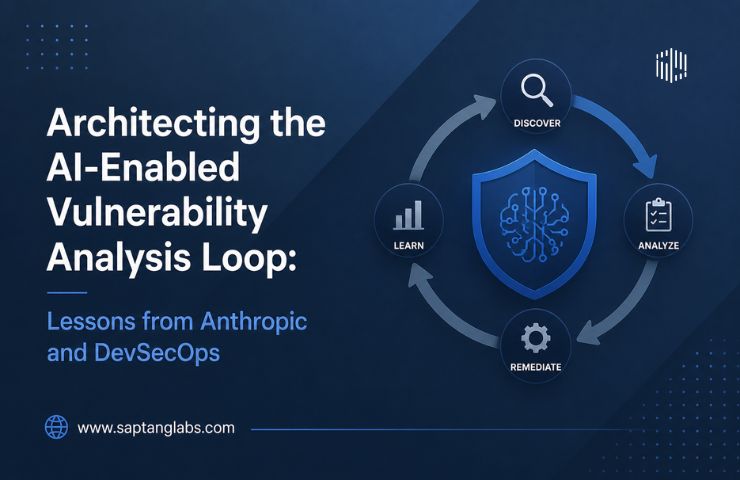
The transition from static rule engines to an active AI-Enabled Vulnerability Analysis loop marks the most significant evolution in DevSecOps in a decade. Recent guidance from Anthropic and methodologies taught in advanced security courses like SANS SEC543 highlight a crucial reality. Discovering flaws with Large Language Models is the easiest part of the process. The true engineering challenge lies in architecting a continuous, six step autonomous loop. This loop involves threat modeling, sandboxed execution, discovery, independent verification, triage, and automated patching. By separating the discovery agent from the verification agent and forcing the AI to prove exploitability with actual proof of concept code, organizations can reduce false positive fatigue to near zero. For modern engineering teams, integrating this loop into an overarching Continuous Security Validation strategy ensures that code is actively defended and patched before deployment, rather than just passively scanned.
Marcus, a lead platform security engineer for a major financial services provider, stared at the output of his weekend build pipeline. The standard Static Application Security Testing tool had generated a report containing over ten thousand critical alerts. He knew from experience that the development team would ignore the entire document. Historically, 95 percent of these findings were false positives caused by the scanner misunderstanding the internal trust boundaries of their monolithic application. Three weeks later, a broken access control vulnerability was exploited in a staging environment. The exact flaw was listed on page forty two of that ignored report.
This scenario is a daily reality in enterprise software development. The problem is not a lack of scanning tools. The problem is the massive gap between identifying a potential flaw and validating its actual operational risk. Traditional static scanners rely on deterministic rulesets. They parse source code into abstract syntax trees and search for known, historical signatures. While they excel at catching obvious errors like hardcoded database credentials or basic injection flaws, they completely lack semantic context.
They cannot understand business logic. They do not know if a variable is already sanitized by a custom middleware function three files away. Consequently, they alert on everything, shifting the immense burden of validation onto already exhausted human engineers. To solve this structural failure, forward thinking security teams are abandoning passive scanners and adopting an active AI-Enabled Vulnerability Analysis pipeline.
Key Failures of Static Analysis:
Anthropic recently published a comprehensive guide detailing how they utilized their advanced models to discover and patch hundreds of vulnerabilities in widely used open source software. Their findings closely align with the curriculum of modern offensive security courses, such as SANS SEC543. The core revelation from both sources is striking. Simply asking an AI model to find bugs in a codebase generates the exact same overwhelming noise as a traditional scanner.
The breakthrough does not come from the AI model alone. It comes from architecting a highly structured, self correcting workflow. Anthropic defines a practical six step loop designed to eliminate noise and deliver actionable, proven results. The skill lies in engineering the loop itself, rather than just running a sophisticated scan.
The Six Stages of the Architecture:
The foundation of a successful AI-Enabled Vulnerability Analysis loop begins before a single line of code is scanned. Without a strict definition of risk, an AI model will flag thousands of theoretical issues that have no practical impact on your environment.
The threat modeling phase requires engineers to explicitly prompt the system with the architecture of the application. The system must understand the trust boundaries, the authentication mechanisms, and the data flow classifications. Anthropic noted that when the threat model was clearly defined and fed into the context window, the accuracy of the subsequent findings increased dramatically. The AI needs to know if an internal microservice operates behind a strict zero trust gateway or if it processes raw, untrusted user input from the public internet.
Following the threat model, the engineering team must provision a secure sandbox. This is arguably the most critical infrastructural requirement. To move beyond static analysis, the system must interact with the running application. The sandbox provides an ephemeral, instrumented environment where the AI can compile the code, start the services, and dynamically interact with the endpoints. This allows the system to transition from guessing about vulnerabilities to actively proving them.
Once the sandbox is operational, the discovery phase begins. In this stage, an AI agent acts similarly to a highly advanced SAST tool. It reads the source code, traces data execution paths across multiple files, and generates a large list of candidate vulnerabilities. Left unchecked, this list is just as noisy as a legacy scanner report.
This is where the architecture requires a hard boundary. The system must utilize independent verification. You cannot ask the discovery agent to verify its own work. If a model generates a theory about a vulnerability, it possesses an inherent bias to confirm that theory, often leading to hallucinations.
Instead, the candidate list is passed to a completely separate verification agent. The sole objective of this secondary agent is to write a functional exploit script. It takes the candidate vulnerability, analyzes the sandbox environment, and attempts to execute a proof of concept attack. If the exploit script fails to compromise the sandbox, the finding is discarded as a false positive. If the script succeeds, the vulnerability is empirically proven. This adversarial dynamic between the discovery agent and the verification agent is the engine that drives false positive rates toward absolute zero.
After the verification agent filters out the noise, the system moves to triage. A major issue with traditional vulnerability management is duplicate reporting. A single vulnerable input parsing function might trigger fifty different alerts across various endpoints.
In an AI-Enabled Vulnerability Analysis architecture, the triage agent analyzes the proven exploits to identify the root cause. It groups all the related findings into a single, comprehensive ticket. It then ranks the severity based on the initial threat model, evaluating reachability and the potential blast radius of the exploit. This ensures that human developers are only presented with unique, highly critical issues.
Finally, the loop reaches the patching phase. The system generates a pull request containing the required code changes to fix the root cause. However, the loop does not stop at code generation. The system automatically deploys the patched code back into the sandbox and asks the verification agent to run the exact same exploit script that succeeded earlier. If the exploit now fails, and all standard unit tests pass, the system has successfully closed the loop. The patch is then sent to human engineers for final review and merge approval.
Architecting this sophisticated loop aligns perfectly with the modern DevSecOps philosophy of Continuous Security Validation. Organizations can no longer rely on point in time penetration tests or annual security audits. The attack surface changes with every single commit.
Saptang Labs advocates for integrating these AI capabilities directly into the daily engineering workflow. By running an AI-Enabled Vulnerability Analysis loop continuously against the main branch of your repository, you transform security from a reactive bottleneck into a proactive engineering capability.
This approach validates your defensive posture in real time. It proves that the latest code commit did not inadvertently expose a new attack path. When combined with comprehensive Attack Surface Management, this continuous loop ensures that your internal code quality matches the resilience of your external perimeter defenses. You are no longer guessing if your application is secure. You have cryptographic and programmatic proof.
Building an autonomous analysis loop requires careful planning and strict guardrails. Organizations looking to implement these capabilities should focus on several foundational engineering practices.
What exactly is an AI-Enabled Vulnerability Analysis loop?
It is a structured, automated engineering workflow that uses Large Language Models to discover, verify, triage, and patch software flaws. Unlike passive scanners, the loop actively attempts to exploit the vulnerabilities it finds within a secure sandbox to prove their existence and eliminate false positives.
Why do we need a separate agent for verification?
If the same AI agent that discovers a potential vulnerability is asked to verify it, the system is highly prone to hallucination. The model will often invent facts to support its initial hypothesis. Using a separate, adversarial verification agent forces the system to rely on empirical proof, such as a working exploit script, rather than theoretical assumptions.
Does this process replace traditional Static Application Security Testing?
While it represents a massive leap forward, it operates best alongside traditional tools. Deterministic scanners are incredibly fast and cheap to run for finding simple syntax errors and known bad dependencies. The AI loop should be deployed to find complex logic flaws, validate the findings of the static tools, and automate the remediation process.
How does threat modeling improve the AI’s performance?
Without a threat model, an AI will flag every minor configuration deviation as a critical risk. By explicitly defining the application’s architecture, trust boundaries, and data sensitivity in the system prompt, the AI gains the context needed to understand what actually constitutes a true security threat in your specific environment.
Is it safe to let an AI generate and test exploit code?
It is safe only if the execution occurs within a strictly isolated sandbox environment. The sandbox must be detached from any production systems, databases, or sensitive networks. The AI is simply executing scripts against a disposable container to prove the mechanics of the vulnerability.
How does this integrate with Attack Surface Management?
Attack Surface Management maps your external exposures, while the vulnerability analysis loop secures the internal codebase. Together, they provide comprehensive coverage. If your continuous analysis loop ensures that all deployed code is free of exploitable logic flaws, your external attack surface becomes exponentially harder for threat actors to compromise.
You may also find this post helpful: Distributed Reconnaissance: Defending the Enterprise Edge Against the JDY Botnet