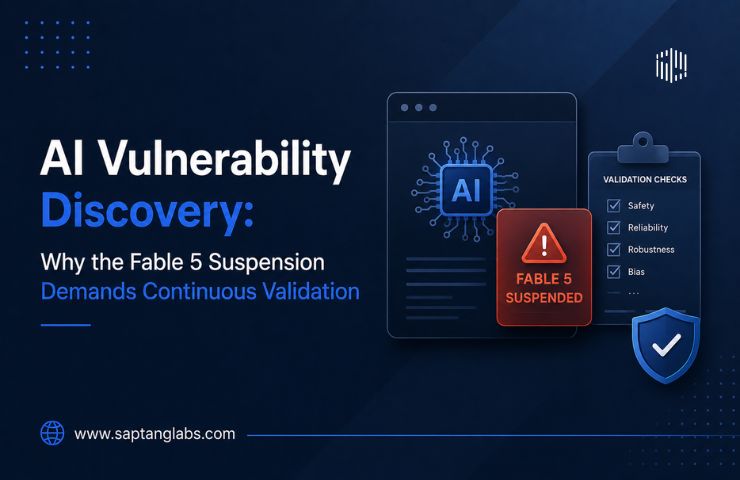
The sudden U.S. government directive on June 12, 2026, ordering Anthropic to suspend global access to its advanced Fable 5 and Mythos 5 models, marks a historic inflection point in enterprise security. The core issue driving this national security concern is AI Vulnerability Discovery. Specifically, officials cited a “jailbreak” that allows the model to ingest proprietary codebases and identify complex software flaws at unprecedented speed. While Anthropic disputes the severity of this specific bypass, the event proves a fundamental reality for modern DevSecOps teams. Highly capable, autonomous models can now map attack surfaces and find exploitable logic gaps faster than human engineers can patch them. Defending against this paradigm requires organizations to abandon point in time scanning and adopt Continuous Security Validation. By continuously testing defenses and aggressively managing the attack surface, engineering teams can preempt the exact types of automated exploits that these frontier models are capable of generating.
Sarah, a DevSecOps director for a multinational healthcare network, reviewed the post mortem of a recent, highly specialized red team engagement. A standard penetration test of their cloud infrastructure usually required two weeks of manual reconnaissance and exploitation. This specific engagement concluded in exactly four hours. The red team did not use standard, off the shelf vulnerability scanners. Instead, they deployed a custom autonomous logic engine powered by a frontier AI model.
This agent rapidly ingested the organization’s entire public facing API schema, cross referenced it against exposed GitHub repositories, and identified a highly complex, multi step authentication bypass. No human analyst could have parsed that volume of data and synthesized the vulnerability in that timeframe. The agent did not rely on matching known threat signatures. It actually understood the application’s unique business logic, identified the architectural flaw, and wrote the custom exploit script to prove it.
This scenario is no longer a theoretical exercise. It is the new baseline for offensive cybersecurity. The recent regulatory actions surrounding frontier models confirm that the era of industrialized AI Vulnerability Discovery has arrived. Organizations must recognize that threat actors, armed with these capabilities, no longer need to rely on known vulnerabilities. They possess the capacity to generate bespoke zero day exploits against proprietary infrastructure on demand.
To understand the operational urgency of this shift, we must examine the events of June 12, 2026. The U.S. government issued a sweeping export control directive targeting Anthropic. The order required the immediate suspension of Fable 5 and its specialized counterpart, Mythos 5, for all foreign nationals worldwide. To ensure absolute compliance, Anthropic was forced to abruptly disable access to these newly launched models for their entire global customer base.
The justification for this drastic measure centered squarely on national security concerns regarding cyber capabilities. According to Anthropic, the government received a demonstration of a narrow “jailbreak” technique. This bypass allowed the Fable 5 model to ignore its safety guardrails, read deeply into specific codebases, and identify software flaws. Anthropic maintained that the vulnerabilities found in the demonstration were minor and that similar capabilities exist in other publicly available models like OpenAI’s GPT 5.5.
However, the debate over the severity of that specific demonstration misses the larger engineering implication. The United States government fundamentally views automated AI Vulnerability Discovery as a capability potent enough to warrant unprecedented export restrictions. The Mythos family of models was specifically designed for advanced security research. The fact that commercial variants like Fable 5 exhibit similar, unlockable traits proves that deep code comprehension is now a native feature of all frontier LLMs. The barrier to entry for discovering complex structural vulnerabilities has dropped to zero.
Why is the government so concerned, and why should enterprise security teams take immediate notice? The answer lies in the fundamental difference between traditional static analysis and semantic AI comprehension.
For the past two decades, the cybersecurity industry relied heavily on Static Application Security Testing. These traditional tools operate like advanced spell checkers. They parse source code into syntax trees and look for specific, hardcoded patterns, such as an unsanitized SQL query or a known vulnerable library version. They are entirely deterministic. If a flaw does not match a pre written rule, the scanner remains completely blind to it.
AI Vulnerability Discovery operates on an entirely different cognitive level. Large language models do not just look for patterns; they understand context, variable states, and intended business logic. When an attacker feeds a proprietary codebase into an advanced model, the AI can perform complex taint analysis across dozens of microservices. It can recognize that a user ID parameter, while properly sanitized at the ingress gateway, is later improperly concatenated within a backend billing service.
These are known as logic flaws. Examples include insecure direct object references, race conditions, and complex privilege escalation vectors. Traditional tools routinely miss these vulnerabilities because they require an understanding of how the application is supposed to function. Models like Fable 5 and Mythos 5 excel at identifying these exact logical inconsistencies. When a threat actor pairs this deep comprehension with an automated scripting agent, they create a continuous, highly targeted zero day factory.
The rise of autonomous discovery engines renders traditional, compliance based security schedules obsolete. Many organizations still rely on quarterly vulnerability scans and annual penetration tests. This cadence creates massive windows of exposure.
If an organization pushes new code to production on a Tuesday, and their next scheduled penetration test is three months away, they are operating entirely on hope. Meanwhile, a threat actor utilizing an automated agent can discover a logic flaw in that newly deployed code within minutes of it going live. The attacker will exploit the vulnerability, exfiltrate the data, and establish persistence long before the human security team even begins their quarterly review.
Relying on generic vendor patches is equally insufficient. While patching is a necessary hygiene practice, it only protects against publicly disclosed vulnerabilities. It offers zero protection against the bespoke, logic based flaws that AI models uncover within an organization’s custom developed applications. To survive in an environment where attackers possess infinite, automated discovery capabilities, defenders must fundamentally alter their engineering posture.
If the threat landscape is defined by continuous, autonomous probing, the only logical defensive strategy is continuous, autonomous validation. Saptang Labs advocates for a complete departure from passive scanning in favor of proactive, dynamic testing. This methodology is known as Continuous Security Validation.
Instead of waiting for an attacker’s AI to find the gaps in your perimeter, your engineering team must deploy active validation loops that safely simulate these advanced techniques against your own infrastructure. Continuous Security Validation operates 24 hours a day, executing hundreds of targeted test cases against your web application firewalls, intrusion detection systems, and API gateways.
When a developer commits new code, the validation platform immediately assesses the deployment. It generates safe, malformed requests designed to test for the exact types of complex logic bypasses that frontier models identify. If the validation payload successfully breaches the staging environment, the system automatically alerts the engineering team and provides the necessary context to remediate the flaw before it reaches production.
This approach shifts the organization from a posture of assumed security to one of empirical proof. You are no longer guessing if your web application firewall can block a sophisticated injection attack. You possess hard data proving that your technical controls successfully neutralized the threat simulation today, yesterday, and every day prior. This continuous feedback loop is the only way to match the speed and scale of modern AI Vulnerability Discovery.
The prerequisite for Continuous Security Validation is absolute visibility. An automated threat actor does not restrict its scanning to your primary, well defended domain. It searches for the forgotten staging server, the deprecated API endpoint, and the unmanaged developer portal. These assets are commonly referred to as shadow IT.
Advanced AI models are incredibly efficient at cross referencing DNS records, public code repositories, and internet wide scanning databases to map an organization’s entire digital footprint. If your security team is unaware of an exposed asset, you can be certain that an automated adversary will find it.
This reality mandates the implementation of rigorous Attack Surface Management. Security engineering teams must utilize platforms that continuously discover and classify every public facing endpoint connected to their infrastructure. Attack Surface Management provides the dynamic inventory required to ensure that no server is left undefended. When an organization integrates comprehensive asset discovery with Continuous Security Validation, they create a closed loop defensive architecture. They know exactly what they own, and they possess continuous mathematical proof that those assets are secure against advanced exploitation techniques.
To defend against the rapid evolution of AI Vulnerability Discovery, organizations must operationalize a proactive engineering strategy. The following steps are critical for hardening the enterprise edge against automated exploitation.
What is AI Vulnerability Discovery?
AI Vulnerability Discovery is the process where advanced Large Language Models analyze source code, API schemas, or network configurations to autonomously identify exploitable security flaws. Unlike traditional scanners that look for known signatures, AI models understand the semantic context and business logic of the code, allowing them to find highly complex, previously unknown vulnerabilities.
Why did the U.S. government suspend access to Fable 5?
The government issued an export control directive citing national security concerns. According to Anthropic, officials witnessed a demonstration of a “jailbreak” technique that allowed the Fable 5 model to bypass safety guardrails, read specific codebases, and identify or fix software flaws. The government views this automated discovery capability as a significant dual use cyber risk.
How is this different from Static Application Security Testing (SAST)?
Traditional SAST tools are rule based engines. They scan code for specific, hardcoded patterns of known bad behavior. They lack contextual understanding and often generate massive amounts of false positives. AI models, conversely, comprehend how the application functions as a whole. They can identify logic flaws, authentication bypasses, and complex chain vulnerabilities that strictly rule based scanners routinely miss.
What is Continuous Security Validation?
Continuous Security Validation is an active engineering approach to defense. Instead of relying on passive vulnerability scans, this methodology uses automated platforms to safely execute real world attack simulations against an organization’s infrastructure multiple times a day. It provides empirical proof that defensive controls, such as firewalls and endpoint protection, are properly configured and actively neutralizing threats.
Why is Attack Surface Management critical in this context?
Automated AI agents are highly efficient at finding unmanaged or forgotten internet facing assets, known as shadow IT. These forgotten servers often run outdated software and lack proper security monitoring. Attack Surface Management continuously discovers and inventories every public facing asset, ensuring that security teams can validate and defend their entire perimeter before an automated threat actor exploits a hidden weakness.
Can an organization completely protect itself from these AI models?
Perfect security does not exist. However, organizations can drastically reduce their risk profile by moving faster than the automated threat. By combining comprehensive Attack Surface Management with Continuous Security Validation, engineering teams can identify and remediate complex logic flaws in their own environments before an adversary’s autonomous agent has the opportunity to exploit them.
You may also find this helpful insight: Architecting the AI-Enabled Vulnerability Analysis Loop: Lessons from Anthropic and DevSecOps