
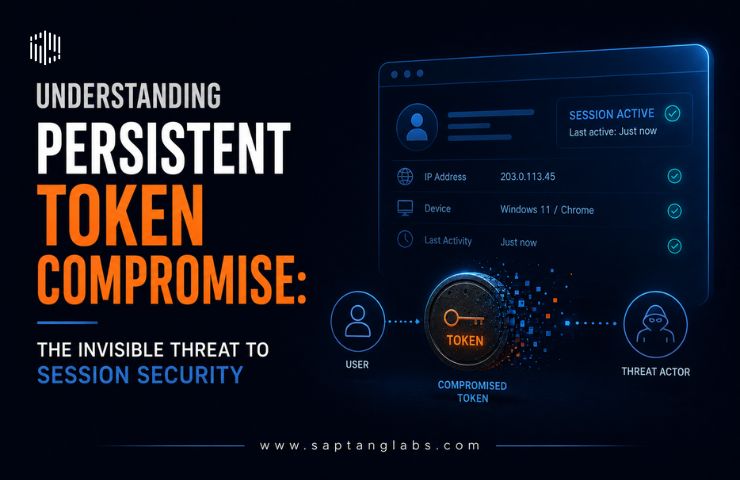
Most organizations invest heavily in password protection, multi-factor authentication, and identity security. Yet modern attackers increasingly target something more valuable than credentials: active authentication tokens. A Persistent Token Compromise allows adversaries to maintain access to enterprise systems even after passwords are reset, accounts are secured, and traditional security controls are activated. As cloud adoption, SaaS platforms, and identity-driven architectures continue to expand, session security is becoming one of the most critical challenges facing modern enterprises.
For years, cybersecurity strategies have focused on protecting identities at the point of authentication. Password policies became stronger. Multi-factor authentication became mandatory. Identity providers introduced advanced verification mechanisms. Organizations invested millions in securing the login process because authentication was considered the primary gateway into enterprise environments.
While these controls remain essential, attackers have quietly shifted their attention elsewhere.
Today, many advanced intrusions do not begin with breaking authentication. Instead, they focus on exploiting what happens after authentication has already succeeded. Once a user logs in, cloud applications issue access tokens, refresh tokens, session cookies, and authorization artifacts that allow continuous access without repeatedly requesting credentials.
These tokens were designed to improve user experience and operational efficiency. Unfortunately, they also created a new attack surface.
A Persistent Token Compromise occurs when attackers obtain and abuse these authentication tokens to maintain long-term access inside enterprise environments. Unlike traditional credential theft, token compromise often allows adversaries to remain active even after passwords are changed. Because the compromised session itself appears legitimate, security teams may struggle to detect the intrusion quickly.
As enterprises become increasingly dependent on cloud services, remote work, and identity-centric architectures, understanding Persistent Token Compromise is no longer optional. It is becoming a boardroom-level security concern.
The modern enterprise runs on authenticated sessions.
Employees move between collaboration platforms, cloud applications, customer management systems, productivity suites, financial tools, and operational dashboards without constantly re-entering credentials. This seamless experience is made possible through tokens that maintain trust between users and applications.
The convenience is undeniable.
However, every trusted session creates a new security challenge.
If an attacker gains access to a valid token, they may inherit the same privileges as the legitimate user. From the perspective of the application, there may be little difference between the employee and the attacker using the stolen session.
This creates a dangerous reality.
Organizations often measure authentication security carefully, but many pay far less attention to session integrity. As a result, attackers increasingly focus on session theft because it allows them to bypass traditional authentication controls entirely.
The business impact extends far beyond unauthorized access.
A successful Persistent Token Compromise can expose:
This transforms session security from a technical concern into an enterprise risk issue.
Persistent Token Compromise refers to the theft and continued abuse of authentication tokens that allow attackers to maintain access to enterprise applications and services.
Common examples include:
Unlike passwords, tokens are specifically designed to maintain ongoing access.
When users authenticate successfully, systems issue tokens so they can continue working without repeatedly proving their identity. These tokens often have expiration periods and renewal mechanisms that support long-term productivity.
Attackers understand this model very well.
If they obtain a token, they may not need the user’s password again. In many cases, they can continue operating within trusted sessions while appearing to be legitimate users.
The result is a form of persistence that traditional security controls were not originally designed to address.
Historically, cybercriminals focused heavily on credential theft. Passwords represented the primary route into enterprise environments.
Today, tokens offer several advantages.
First, tokens often bypass repeated authentication requirements.
Second, token-based activity may generate fewer security alerts than suspicious login attempts.
Third, many organizations have stronger monitoring around credential abuse than session abuse.
Most importantly, token compromise allows attackers to blend into normal business activity.
A stolen password may trigger alerts if used from unusual locations. A stolen session token may already be operating inside a trusted environment.
This changes the economics of cyber intrusion.
Rather than stealing passwords repeatedly, attackers can focus on maintaining long-term access through compromised sessions.
For advanced threat actors, this approach is quieter, more effective, and often harder to detect.
Token theft rarely occurs in isolation. It is usually the result of broader attack activity designed to capture trusted session information.
Phishing and Adversary-in-the-Middle Attacks
Modern phishing campaigns increasingly target session tokens directly.
Instead of simply stealing passwords, attackers intercept authentication flows and capture active session artifacts that provide immediate access.
Browser Session Theft
Browsers store cookies and session information to improve usability.
If an attacker compromises an endpoint, these session artifacts may be extracted and reused elsewhere.
OAuth Abuse
Organizations increasingly rely on third-party integrations and cloud applications.
Poorly governed OAuth permissions can provide attackers with long-term access through compromised authorization tokens.
Malware-Based Collection
Advanced malware families often harvest authentication tokens from browsers, memory, and application caches.
This allows attackers to gain access without triggering traditional login events.
Compromised Endpoints
A single compromised workstation can expose multiple active sessions simultaneously, giving attackers access to several enterprise services through token theft alone.
One of the most dangerous aspects of Persistent Token Compromise is invisibility.
Traditional detection strategies often focus on:
Token abuse frequently avoids these indicators.
The attacker is not necessarily logging in.
The attacker is continuing an already authenticated session.
This distinction matters.
Because the session itself is legitimate, activity generated through stolen tokens often appears normal. Applications may see valid requests, trusted sessions, and expected user behavior.
Meanwhile, attackers quietly maintain access in the background.
This creates one of the most significant visibility challenges in modern cybersecurity.
The Cloud Security Challenge
Cloud adoption has dramatically increased the importance of session security.
Most modern SaaS platforms rely heavily on token-based authentication models. Employees may access dozens of cloud applications throughout the day, each generating its own trusted session.
The cloud environment introduces additional complexity because:
This interconnected ecosystem increases operational efficiency.
It also increases the potential impact of a single compromised token.
An attacker who compromises one trusted session may gain visibility into multiple business-critical systems depending on how trust relationships are configured.
This is why cloud security and session security have become inseparable.
Several MITRE ATT&CK techniques align closely with token abuse activities.
Relevant techniques include:
These techniques highlight a critical reality.
Modern adversaries increasingly focus on abusing trust rather than breaking authentication.
The attack path often involves obtaining a trusted artifact and then leveraging it to move through enterprise environments while appearing legitimate.
This evolution reflects a broader shift in cybersecurity where identity trust itself becomes the target.
Security teams often measure password resets, phishing rates, and authentication failures.
Those metrics alone are no longer sufficient.
Organizations should also monitor:
Token Revocation Effectiveness
How quickly can compromised sessions be invalidated across the enterprise?
Session Visibility
Can security teams identify active sessions across cloud environments?
Abnormal Session Behavior
Are users suddenly accessing resources they have never used before?
Geographic Session Consistency
Do session activities align with normal operational patterns?
Token Lifetime Management
How long do critical authentication tokens remain valid?
These metrics provide a more realistic view of modern identity risk.
Building a Token-Aware Security Strategy
Organizations must evolve beyond password-centric thinking.
A strong session security strategy should include:
The goal is not only protecting identities.
The goal is protecting the trust established after authentication succeeds.
This distinction becomes increasingly important as enterprises expand cloud adoption and digital transformation initiatives.
Persistent Token Compromise is no longer a niche security concern.
It represents one of the most effective persistence mechanisms available to modern attackers.
The challenge is growing because organizations continue expanding:
Each expansion creates more sessions, more tokens, and more opportunities for abuse.
Security leaders must therefore shift from asking:
“Did an attacker compromise credentials?”
“Can we trust every active session operating inside our environment?”
That question will define the next phase of enterprise identity security.
Persistent Token Compromise represents a fundamental shift in modern cyber risk. Attackers increasingly target trusted sessions because they provide long-term access while avoiding many traditional detection mechanisms. As organizations continue embracing cloud-first architectures and identity-driven ecosystems, session security is becoming just as important as authentication security.
The future of cybersecurity will not be defined solely by who logs in.
It will increasingly be defined by who remains trusted after login.
Organizations that understand this distinction today will be far better prepared for the identity threats of tomorrow.
What is Persistent Token Compromise?
Persistent Token Compromise occurs when attackers steal authentication tokens and continue accessing enterprise systems without needing user credentials again.
Why are tokens valuable to attackers?
Tokens maintain trusted sessions. A stolen token often allows attackers to access applications as legitimate users without repeatedly authenticating.
Can multi-factor authentication prevent token compromise?
Multi-factor authentication helps protect initial access, but it may not stop attackers from abusing already-issued tokens.
How can organizations detect token abuse?
Organizations should monitor session activity, token usage patterns, unusual access behavior, and cloud authentication telemetry continuously.
Why is Persistent Token Compromise becoming more common?
Cloud adoption, SaaS applications, remote work, and token-based authentication models have increased the value and availability of authentication tokens for attackers.
You may also find this insight helpful: Human IoC: Analyzing the Modern Threat Actor’s Behavioral Footprint