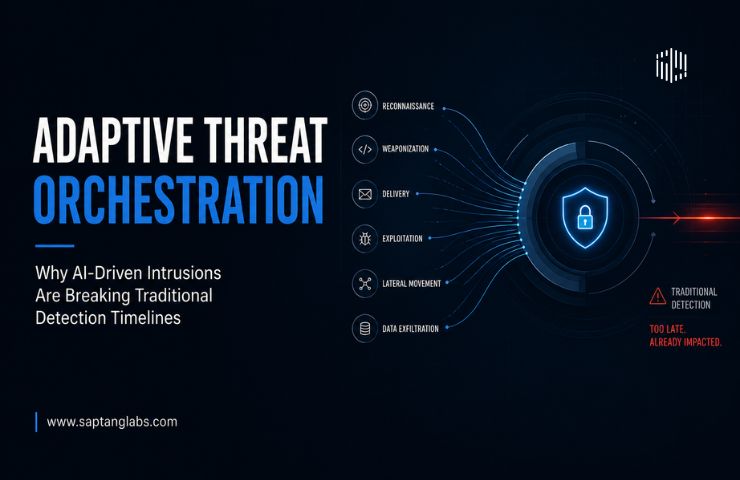
The cybersecurity battlefield has fundamentally shifted. Traditional defenses rely on static rules and predictable attack behaviors. However, a new paradigm known as Adaptive Threat Orchestration leverages artificial intelligence to analyze defenses, mutate payloads, and pivot strategies in real time. This dynamic approach completely shatters traditional incident response timelines. Security Operations Center (SOC) teams can no longer rely on manual containment or legacy Security Information and Event Management (SIEM) alerts. To survive, organizations must adopt autonomous, AI-driven defense mechanisms that operate at machine speed, focusing on behavioral baselines rather than known signatures.
Picture a typical Tuesday night in a sprawling corporate Security Operations Center. The glowing screens illuminate the exhausted faces of tier-two analysts. At 2:14 AM, a low-level alert triggers. A standard Endpoint Detection and Response platform flags a suspicious PowerShell script executing on an HR workstation.
The analyst follows the playbook. They isolate the machine, block the associated IP address at the firewall, and grab a coffee. The threat is contained. Or so they think.
Five minutes later, three new alerts fire simultaneously across completely different network segments. The adversary did not retreat when the initial vector was blocked. Instead, the attacking entity instantly analyzed the block, rewrote its payload to bypass the specific EDR signature, shifted its communication from a standard Command and Control server to benign-looking API calls to a public cloud service, and resumed the breach.
There was no human sitting in a basement frantically typing code to pivot the attack. The response was too fast, too calculated, and too flawless. This was the work of an algorithm. This is the reality of Adaptive Threat Orchestration.
We are no longer fighting static malware. We are fighting intelligent systems designed to observe, orient, decide, and act faster than a human analyst can even open a ticket.
To understand why this is breaking our defenses, we must first define the concept precisely.
Adaptive Threat Orchestration is a cybersecurity attack methodology where artificial intelligence and machine learning models are used to automate, manage, and continuously modify an intrusion campaign in real time. Unlike automated scripts that run a pre-programmed sequence of events, an orchestrated attack behaves like a chess grandmaster. It evaluates the board, anticipates the defender’s next move, and changes its strategy accordingly.
Key characteristics of this evolving threat include:
For the past two decades, the cybersecurity industry has built its fortress on the concept of Mean Time to Detect and Mean Time to Respond. The goal was always to shrink the window between an initial compromise and full containment.
Traditional detection relies heavily on linear timelines. A threat actor drops a payload. The payload communicates with a server. The server sends instructions. The threat actor moves laterally. Security teams place tripwires along this linear path. If a tripwire snaps, the team has a designated amount of time to intervene before the data is exfiltrated.
Adaptive Threat Orchestration obliterates this linear model. The intrusion no longer follows a predictable sequence.
When an AI engine drives the attack, the timeline from initial access to objective completion collapses from weeks or days down to minutes or seconds. By the time a SIEM correlates the logs and presents a coherent alert to a human analyst, the threat has already mutated, achieved its objective, and erased its tracks.
Why legacy systems fail against orchestrated threats:
To truly grasp the severity of Adaptive Threat Orchestration, we must look under the hood at the mechanics powering these intrusions. Threat actors are utilizing the exact same advancements in Large Language Models and adversarial machine learning that legitimate businesses use for optimization.
The traditional cyber kill chain requires manual intervention at almost every step. An orchestrator automates the entire process. Once the initial foothold is secured, the AI takes over. It uses natural language processing to read internal company wikis and active directory structures to understand exactly who has access to the most valuable data.
Threat actors train their AI models on the exact same endpoint detection tools that corporations use to defend themselves. Through a process similar to Generative Adversarial Networks, the attacking AI generates a piece of malware, tests it against a virtualized version of a popular EDR, and mutates the code until the EDR fails to detect it. Only then does the orchestrator deploy the payload into the live environment.
One of the most insidious tactics of Adaptive Threat Orchestration is the intentional generation of noise. If the AI detects that a defender is closing in on its primary objective, it will autonomously launch dozens of noisy, low-level attacks across the network. This forces the SOC to divert resources to investigate ransomware alerts in a non-critical subnet, while the orchestrator silently extracts intellectual property from the core database.
The psychological and operational impact on security teams facing these threats is profound.
Analysts are experiencing unprecedented levels of alert fatigue. When a threat mutates and triggers alarms across disparate systems simultaneously, it creates a fragmented narrative. The network team sees abnormal traffic. The identity team sees impossible travel logs. The endpoint team sees memory injection. Without an AI to stitch these disparate anomalies together, human analysts spend hours trying to manually correlate a picture that the attacking AI painted in seconds.
Furthermore, this dynamic heavily impacts incident response retainers and cyber insurance policies. Insurers require strict forensic evidence and established timelines to process claims. When an intrusion is orchestrated by an AI that cleans up its own logs, alters its methodology mid-attack, and leaves no static indicators of compromise, proving the exact nature and scope of the breach becomes an investigative nightmare.
The immediate operational consequences include:
If human speed is no longer sufficient, the only logical countermeasure is machine speed. Fighting Adaptive Threat Orchestration requires a fundamental shift in defensive architecture. We must move away from building static walls and toward developing a digital immune system.
Just as the human body does not rely on a list of known viruses to fight off a novel infection, a modern network cannot rely on a list of known malicious hashes.
Autonomous Defensive AI
The counter to an attacking AI is a defending AI. Organizations must deploy autonomous response systems capable of taking immediate, targeted action without human intervention. If an entity on the network suddenly deviates from its established behavioral baseline, the defending AI must have the authority to surgically interrupt that specific connection, isolate the process, and observe the results, all within milliseconds.
Zero Trust as a Foundation
Adaptive Threat Orchestration thrives in flat networks where internal trust is implicitly granted. A rigorous Zero Trust Architecture severely limits the orchestrator’s ability to pivot. When every single request for access is continuously validated based on identity, device posture, and contextual behavior, the AI is forced to solve a complex puzzle for every lateral move it attempts. This slows the orchestration engine down, providing the defensive AI with the time it needs to recognize the anomaly.
Deception Technology
If the attacking AI relies on mapping the environment to make decisions, the most effective way to break its logic is to feed it false information. High-interaction honeypots, fake active directory credentials, and phantom databases confuse the orchestrator. When the AI attempts to interact with a deceptive element, the defender instantly receives a high-fidelity alert, completely bypassing the threat actor’s evasion techniques.
The consensus among leading threat intelligence researchers is clear. We are standing at the precipice of an AI arms race.
Over the next 12 to 24 months, we expect Adaptive Threat Orchestration to become commoditized. Currently, deploying these sophisticated AI models requires substantial technical expertise and funding, restricting their use primarily to advanced persistent threat groups and nation states. However, just as Ransomware as a Service democratized extortion, we will soon see Orchestration as a Service.
Less sophisticated actors will be able to rent access to these AI engines, pointing them at targets and letting the algorithm do the heavy lifting. The volume of highly sophisticated, tailored attacks will increase exponentially.
To prepare, security leaders must immediately begin evaluating their current tech stack. Any tool that relies solely on historical data, static signatures, or manual human correlation is rapidly approaching obsolescence. The future of cybersecurity belongs to those who can harness artificial intelligence to not only predict the next move of the adversary but to autonomously neutralize it before the human analyst even finishes their coffee.
What is the main difference between traditional malware and an orchestrated threat?
Traditional malware is static. Once written, its code and behavior remain consistent. If a security tool learns how to identify it, the malware is rendered harmless. An orchestrated threat is dynamic and managed by an AI. It constantly changes its code, its communication methods, and its attack path to avoid the security tools actively looking for it.
Can existing SIEM platforms detect Adaptive Threat Orchestration?
Traditional SIEM platforms struggle significantly with these threats. SIEMs rely on correlation rules that human engineers write based on known attack patterns. Because an orchestrated threat generates novel, never before seen patterns and intentionally alters its timing to bypass these rules, traditional SIEMs often miss the forest for the trees, generating disparate, low-priority alerts instead of recognizing the overarching campaign.
How does an AI threat orchestrator know what security tools a company is using?
The AI uses sophisticated reconnaissance techniques. It can analyze the exact responses it gets from web applications, probe endpoints to see which services are running in memory, and query the active directory. Furthermore, many threat actors train their AI on leaked configuration files or use open source intelligence to map an organization’s security posture before the attack ever begins.
Is human intervention still necessary in incident response?
Absolutely. While the immediate containment of an orchestrated threat must be handled by defensive AI operating at machine speed, human expertise is critical for the aftermath. Humans are required for strategic decision making, communicating with stakeholders, conducting deep forensic investigations to understand the root cause of the initial breach, and updating security policies to prevent future occurrences. AI handles the tactics; humans handle the strategy.
How can a mid-sized business defend against this if they cannot afford a massive SOC?
The defense against AI is not a larger human workforce; it is smarter technology. Mid-sized businesses should focus on Managed Detection and Response providers that heavily utilize autonomous AI. Additionally, enforcing basic hygiene strictly like multi-factor authentication, rigorous patch management, and network segmentation removes the low-hanging fruit and makes the environment inherently hostile to automated probing, regardless of how advanced the AI engine might be.
You may also find this inisght helpful: The NHI Crisis: Why Service Accounts Are the New Enterprise Backdoor