
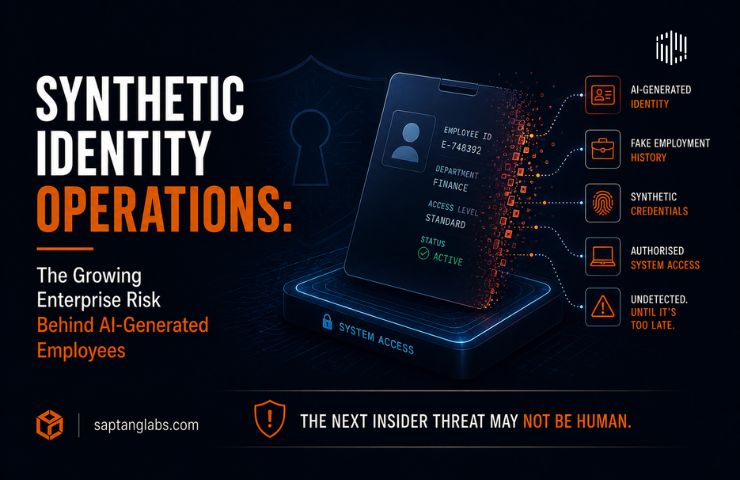
Artificial intelligence is transforming enterprise communication, recruitment, collaboration, and operational workflows at unprecedented speed. However, alongside these advancements, organizations are now facing a new cybersecurity challenge called Synthetic Identity Operations. Attackers are increasingly using AI-generated personas, fake employees, deepfake communication, and synthetic operational identities to infiltrate trusted enterprise environments. This shift is changing how organizations must think about identity, trust, insider threats, and operational verification. Modern cybersecurity programs can no longer rely only on authentication systems or perimeter controls. The future challenge is determining whether the digital humans interacting with enterprise systems are even real.
Enterprise cybersecurity has traditionally focused on protecting infrastructure, applications, credentials, and data from unauthorized access. For years, organizations assumed that the human identities interacting with their systems were fundamentally trustworthy once authentication controls validated access successfully. That assumption is beginning to change rapidly.
The rise of AI-generated personas, deepfake communication, synthetic profiles, and autonomous identity manipulation is creating a new category of cyber risk called Synthetic Identity Operations. Attackers are no longer limited to stealing credentials or compromising infrastructure directly. Increasingly, they are creating entirely fabricated digital employees capable of interacting with enterprise workflows, communication systems, recruitment processes, and operational environments while appearing legitimate from a traditional security perspective.
The cybersecurity industry is entering an era where trust itself is becoming difficult to verify.
For many years, organizations built security strategies around the assumption that users, employees, vendors, and operational identities represented real individuals operating within known boundaries. Modern AI systems are beginning to challenge that assumption fundamentally.
Today, attackers can generate:
These capabilities are evolving rapidly because generative AI tools now allow threat actors to simulate realistic human presence at scale.
This creates a much larger problem than traditional phishing or impersonation attacks.
Organizations are beginning to face environments where entirely synthetic operational identities may interact with trusted systems continuously while remaining difficult to distinguish from legitimate employees.
That changes how enterprise cybersecurity itself must operate.
One of the most alarming developments in Synthetic Identity Operations is the emergence of AI-generated employees.
In recent years, organizations across multiple industries have reported incidents involving:
These attacks are becoming increasingly sophisticated.
Threat actors now combine:
to create highly convincing operational personas capable of passing through standard recruitment or verification workflows.
The objective is not always immediate financial fraud.
In many cases, attackers seek:
This represents a major evolution in enterprise threat strategy because attackers no longer need to breach organizations externally if they can successfully enter environments through synthetic operational trust.
Most enterprise identity systems were designed around credential verification.
Historically, organizations focused heavily on:
These systems remain essential. However, they assume the underlying human identity itself is legitimate.
Synthetic Identity Operations challenge that assumption directly.
An AI-generated employee operating with valid credentials may still appear fully legitimate from a traditional authentication perspective. Likewise, deepfake communication during onboarding or remote collaboration may bypass existing verification processes entirely.
This creates a dangerous visibility gap.
The issue is no longer only whether credentials are compromised. The larger concern is whether the identity itself is real.
Traditional security models were not designed for environments where synthetic operational personas interact continuously across enterprise workflows.
That is why identity trust itself is becoming a cybersecurity battleground.
The rapid expansion of remote and hybrid work environments accelerated many of the conditions enabling Synthetic Identity Operations.
Historically, organizations relied heavily on physical interaction, in-person verification, and direct operational oversight to establish trust relationships. Remote-first environments changed those dynamics significantly.
Today, many organizations onboard employees, vendors, contractors, and consultants almost entirely through digital workflows.
This creates opportunities for attackers.
AI-generated identities can now participate in:
without requiring physical presence.
As AI-generated communication becomes increasingly realistic, organizations may struggle to validate operational trust using traditional verification approaches alone.
This is one reason synthetic identity threats are growing so rapidly. The digital workplace itself expanded the operational attack surface significantly.
One of the reasons Synthetic Identity Operations are so dangerous is because they exploit human trust directly.
Most cybersecurity defenses focus heavily on technical compromise. Synthetic identity attacks target social confidence instead.
Humans naturally trust:
AI systems now reproduce many of these trust indicators convincingly.
An AI-generated employee communicating consistently across email, video calls, messaging platforms, and collaborative environments may appear operationally authentic for extended periods before suspicion emerges.
This creates an extremely effective form of operational camouflage.
Attackers understand that people often trust human presence more than infrastructure signals. Synthetic identities therefore allow threat actors to bypass many traditional psychological barriers inside enterprise environments.
That capability is becoming increasingly valuable in modern cyber operations.
Traditional insider threats typically involve legitimate employees abusing trusted access intentionally or accidentally. Synthetic Identity Operations introduce a much more complex challenge.
The “insider” may not actually exist at all.
Instead, organizations may unknowingly grant operational access to AI-assisted personas specifically designed to:
This fundamentally changes how insider risk must be evaluated.
Historically, organizations focused heavily on employee behavior monitoring and privilege management. Synthetic identity environments require organizations to verify whether operational identities themselves remain authentic continuously.
That distinction is critically important.
The future insider threat may not originate from malicious employees alone. It may originate from entirely fabricated digital humans operating inside trusted enterprise workflows.
Synthetic Identity Operations rely heavily on communication-layer trust.
Attackers increasingly target:
These systems create the operational context where trust develops naturally over time.
Once synthetic personas establish communication credibility, they may gradually expand influence across workflows, projects, and operational relationships.
This creates a dangerous long-term exposure model because synthetic identities often focus on persistence rather than immediate disruption.
Unlike traditional cyber attacks designed for rapid execution, synthetic identity campaigns may evolve slowly while building operational trust progressively.
This makes detection significantly more difficult.
Organizations cannot defend against Synthetic Identity Operations effectively without continuous operational visibility.
Traditional security controls often focus heavily on infrastructure telemetry and authentication events. However, synthetic identity threats increasingly operate through behavioral consistency rather than technical anomalies alone.
This is why runtime intelligence is becoming critical.
Organizations increasingly require visibility into:
The objective is not simply detecting unauthorized access.
The larger goal is identifying whether trusted operational identities behave consistently with legitimate human activity over time.
This represents a major evolution in enterprise cybersecurity strategy.
The operational risk surrounding synthetic identities extends far beyond isolated fraud incidents.
If organizations lose confidence in digital trust verification, the impact affects:
This creates both technical and psychological consequences.
Enterprises increasingly depend on digital communication ecosystems operating continuously across distributed environments. Synthetic identity manipulation threatens the integrity of those ecosystems directly.
Over time, organizations may need entirely new operational frameworks for identity validation, communication trust, and behavioral verification.
This is why Synthetic Identity Operations represent more than a temporary cybersecurity trend.
They represent a structural shift in enterprise trust models.
Modern CISOs can no longer treat identity security purely as an authentication problem.
The challenge is evolving rapidly from:
to:
That distinction changes everything.
Organizations must increasingly evaluate:
alongside traditional access controls.
This shift requires much deeper visibility into how identities behave operationally across enterprise environments. Because in synthetic identity ecosystems, technical authentication alone may no longer provide sufficient assurance.
Enterprise trust models are entering a major transition.
Over the next decade, organizations will likely face environments where:
This evolution will reshape enterprise cybersecurity significantly.
Future-ready security programs will increasingly focus on:
The organizations best prepared for this transition will be those capable of validating trust dynamically rather than assuming trust statically.
Synthetic Identity Operations are rapidly emerging as one of the most important cybersecurity challenges of the AI era.
The rise of AI-generated employees, deepfake communication, synthetic personas, and autonomous identity manipulation is changing how organizations must think about enterprise trust fundamentally. Attackers are no longer limited to breaching infrastructure directly. Increasingly, they are attempting to infiltrate operational environments through fabricated digital human presence designed to appear legitimate inside trusted workflows.
This changes the future of cybersecurity significantly.
Traditional identity security models built primarily around credentials and authentication are no longer sufficient for environments where synthetic operational identities may interact continuously across enterprise systems. Organizations now require stronger runtime intelligence, behavioral visibility, communication-layer monitoring, and operational trust validation capabilities capable of identifying synthetic activity before it gains persistence.
The future challenge is no longer simply protecting systems from attackers.
It is determining whether the trusted identities operating inside those systems are even human at all.
What are Synthetic Identity Operations?
Synthetic Identity Operations involve the use of AI-generated personas, fake employees, deepfake communication, and fabricated digital identities to infiltrate enterprise environments.
Why are AI-generated employees a cybersecurity risk?
AI-generated employees may gain operational trust, insider visibility, and long-term access inside organizations while appearing legitimate during onboarding and collaboration workflows.
How are Synthetic Identity Operations different from traditional insider threats?
Traditional insider threats involve real employees. Synthetic Identity Operations may involve entirely fabricated digital personas operating inside enterprise systems.
Why is remote work increasing synthetic identity risk?
Remote onboarding and digital-first workflows reduce physical verification, making it easier for synthetic identities to participate in enterprise operations.
How can organizations defend against Synthetic Identity Operations?
Organizations can improve runtime intelligence, behavioral monitoring, identity verification, communication integrity analysis, and continuous operational trust validation.
You may also find this insight helpful: AI Exploit Acceleration: The Growing Enterprise Risk Behind Autonomous PoC Generation