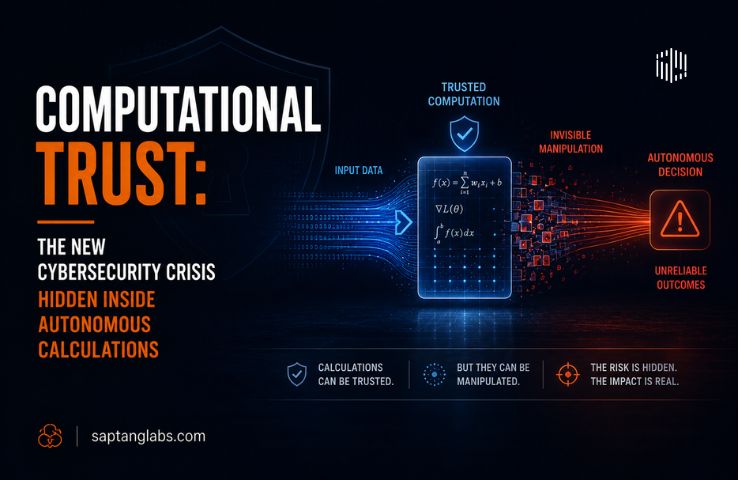
Cybersecurity is entering a new phase where attackers no longer need to destroy systems visibly to create large-scale damage. Increasingly, modern attacks focus on manipulating calculations, altering runtime outputs, and silently influencing trusted systems while environments continue operating normally. The recent Fast16 malware discussions highlighted how dangerous computational manipulation can become in highly automated environments. As enterprises expand their dependence on AI systems, autonomous workflows, industrial automation, and machine-driven operations, Computational Trust is rapidly becoming one of the most important cybersecurity priorities for modern security leaders.
Enterprise cybersecurity is undergoing a major transformation. For years, organizations focused heavily on preventing system disruption, stopping unauthorized access, and protecting sensitive data from theft. Those priorities remain important. However, modern enterprise environments are now becoming deeply dependent on autonomous systems, machine-driven operations, industrial automation, AI-assisted workflows, and computational decision engines that continuously influence critical business functions.
This shift is creating a new category of cyber risk centered around Computational Trust. The challenge is no longer limited to whether systems remain operational after an attack. The larger concern is whether organizations can still trust the calculations, outputs, and runtime decisions generated by highly automated environments. As attackers increasingly target operational integrity instead of visible disruption alone, runtime manipulation is emerging as one of the most important cybersecurity threats of the automation era.
The recent Fast16 malware discussions forced many security researchers and enterprise security teams to rethink how cyber sabotage may evolve in highly automated environments. Unlike traditional malware campaigns focused on ransomware, operational outages, or visible infrastructure disruption, Fast16 highlighted a much quieter and potentially more dangerous possibility.
The malware reportedly focused on manipulating computational outputs while allowing systems to continue functioning normally.
That distinction matters enormously.
Historically, most organizations associated cyber attacks with obvious operational impact. Systems became unavailable, files were encrypted, or networks stopped functioning entirely. Fast16 revealed a very different threat model where the environment itself may continue appearing operationally healthy while the underlying outputs become gradually compromised.
In highly automated environments, this creates serious consequences.
Engineering calculations, operational telemetry, automated analytics, industrial systems, and machine-assisted decision engines all depend heavily on computational integrity. If attackers silently alter outputs during runtime execution, organizations may continue trusting compromised systems long after manipulation begins.
This represents a major shift in cybersecurity thinking.
The question is no longer only whether attackers can access infrastructure. The larger concern is whether organizations can trust the operational truth generated by systems after compromise occurs.
Fast16 therefore exposed something much bigger than a single malware campaign. It highlighted the growing importance of Computational Trust in environments increasingly dependent on automation, runtime intelligence, and autonomous calculations.
Modern enterprises rely heavily on computational systems across nearly every operational layer. Automated calculations now influence financial forecasting, industrial operations, cloud orchestration, supply chain management, infrastructure monitoring, healthcare analytics, AI-assisted workflows, and operational decision-making at scale.
This dependence creates enormous efficiency benefits.
At the same time, it creates a dangerous assumption.
Many organizations still assume that if systems remain operational, outputs remain trustworthy. However, modern runtime manipulation attacks challenge that assumption directly.
Cybersecurity frameworks traditionally focused heavily on confidentiality, availability, and access control. Yet as enterprise automation expands, integrity itself is becoming the most strategically important security layer.
A manipulated output inside a trusted computational environment may create far greater long-term damage than a visible infrastructure outage. Operational decisions, engineering models, autonomous workflows, and machine-assisted analytics all depend on trusted calculations. If those calculations become compromised silently, organizations may continue making decisions based on manipulated operational truth.
That possibility is becoming increasingly realistic in autonomous environments.
The Shift From Destruction to Manipulation
For many years, attackers focused heavily on disruption because visible operational damage created immediate impact. Ransomware campaigns shut down environments. Malware disabled infrastructure. Denial-of-service attacks interrupted operations visibly.
Increasingly, attackers recognize that manipulation can be more strategically valuable than destruction. Instead of shutting systems down entirely, they may quietly influence telemetry, alter runtime calculations, manipulate outputs, or introduce subtle operational drift while allowing systems to continue functioning normally.
This creates a much more difficult detection problem.
When systems fail visibly, organizations respond immediately. However, when systems continue operating while producing manipulated outputs, compromise may remain hidden for extended periods.
That delay creates cascading operational consequences.
A manipulated industrial parameter, altered financial model, corrupted analytics engine, or compromised autonomous workflow may influence thousands of downstream decisions before investigators identify the original manipulation point.
This evolution changes how organizations must think about cyber resilience.
Autonomous systems are accelerating the importance of Computational Trust significantly.
Modern enterprises increasingly deploy AI agents, orchestration engines, industrial automation systems, runtime analytics platforms, and machine-driven decision environments across critical operations. These systems operate continuously while processing large volumes of operational data in real time.
Many autonomous environments now interact directly with:
As organizations expand automation, trust in machine-generated outputs becomes a core operational dependency.
That dependency creates risk.
If attackers manipulate runtime behavior inside trusted systems, the resulting outputs may influence operational decisions rapidly across interconnected environments before human oversight detects inconsistencies.
This is why autonomous systems are becoming highly attractive targets for sophisticated threat actors.
The objective is no longer simply accessing infrastructure.
The objective is influencing trusted operational calculations inside environments already considered legitimate.
One of the most dangerous characteristics of runtime manipulation is invisibility.
Traditional cyber incidents typically generate operational noise. Systems fail visibly, ransomware creates disruption, or infrastructure compromise produces detectable alerts. Computational manipulation behaves differently because systems may continue appearing stable externally while operational integrity slowly degrades internally.
Dashboards may look normal.
Workflows may continue executing successfully.
Infrastructure may remain fully operational.
Meanwhile, the outputs generated by those systems become increasingly unreliable.
This creates a major visibility challenge because many traditional security monitoring systems prioritize availability and access anomalies rather than computational integrity validation.
Organizations may therefore continue trusting manipulated environments long after compromise has already occurred.
That is what makes Computational Trust such an important emerging cybersecurity discussion.
Most enterprise cybersecurity frameworks were designed around protecting infrastructure, networks, endpoints, and applications from unauthorized access or operational disruption.
Computational Trust introduces a different challenge entirely.
The issue is no longer simply whether attackers entered the environment. The larger concern is whether the calculations, telemetry, outputs, and autonomous decisions generated by trusted systems remain accurate during runtime execution.
Traditional monitoring models often focus heavily on:
These controls remain essential. However, they may not identify subtle runtime manipulation occurring inside trusted computational workflows.
For example, an autonomous analytics platform generating slightly altered operational outputs may continue functioning normally without triggering conventional alerts. Similarly, manipulated telemetry inside industrial systems may appear operationally valid from an infrastructure perspective.
This means organizations increasingly require runtime integrity monitoring rather than infrastructure visibility alone.
As enterprises become more dependent on autonomous execution, runtime integrity is becoming central to operational resilience.
Organizations can no longer assume systems remain trustworthy simply because they remain online. Security teams now need stronger visibility into how computational environments behave during execution.
This includes visibility into:
The objective is not only identifying compromise after damage occurs.
The goal is continuously validating whether trusted systems continue generating reliable outputs throughout execution.
This represents a major shift in cybersecurity strategy because organizations must now protect computational truth itself.
Why Computational Trust Is Becoming a Boardroom Issue
Computational Trust is no longer only a technical security concern.
As enterprises increase dependence on autonomous systems, manipulated outputs can directly affect financial operations, customer trust, operational resilience, regulatory compliance, industrial safety, and strategic decision-making.
The question is no longer only whether infrastructure remains protected. The larger concern is whether organizations can trust the machine-generated intelligence driving operational decisions continuously across critical environments.
This changes how cyber resilience itself must be measured.
A system producing manipulated outputs while appearing operationally healthy may create greater long-term damage than one suffering temporary disruption visibly.
That reality is pushing integrity-focused cybersecurity discussions into executive-level risk conversations.
Computational Trust will likely become one of the defining cybersecurity priorities of highly automated environments over the next decade.
Organizations will continue expanding reliance on:
This growth will increase operational efficiency significantly. However, it will also expand the attack surface surrounding runtime integrity and computational manipulation.
Future cybersecurity strategies will increasingly focus on:
Security programs will evolve beyond protecting systems alone.
They will increasingly focus on protecting trust in machine-generated outputs themselves.
Computational Trust is rapidly emerging as one of the most important cybersecurity priorities of the automation era.
The recent Fast16 malware discussions highlighted how dangerous runtime manipulation can become when attackers target trusted computational environments instead of causing visible operational disruption. Systems may continue functioning normally while calculations, telemetry, and operational outputs become gradually compromised underneath the surface.
This changes how organizations must think about cyber resilience.
Traditional security models built primarily around preventing outages and unauthorized access are no longer sufficient for highly autonomous environments. Organizations now require stronger runtime visibility, integrity validation, and operational trust monitoring across systems increasingly responsible for critical business decisions.
The future of cybersecurity will not be defined only by whether organizations can keep infrastructure online.
It will increasingly be defined by whether they can still trust the outputs generated by the systems operating inside that infrastructure.
What is Computational Trust in cybersecurity?
Computational Trust refers to the ability to trust the calculations, runtime outputs, telemetry, and operational integrity generated by autonomous or computational systems.
Why is Computational Trust becoming important?
Organizations increasingly rely on autonomous systems, AI-driven workflows, and machine-generated decisions across critical operations. Manipulated outputs can create major operational risk.
How did Fast16 change cybersecurity discussions?
Fast16 highlighted how attackers may manipulate computational outputs silently while systems continue operating normally, creating a much more difficult detection challenge.
Why are autonomous systems increasing cyber risk?
Autonomous systems process operational decisions continuously with minimal human oversight. If manipulated, they can influence large-scale business operations rapidly.
How can organizations improve Computational Trust?
Organizations can improve Computational Trust through runtime monitoring, integrity validation, execution visibility, anomaly detection, and stronger governance around autonomous systems.
You may also find this helpful: AI Agent Security: How Runtime Exposure and Autonomous Execution Are Reshaping Enterprise Risk