
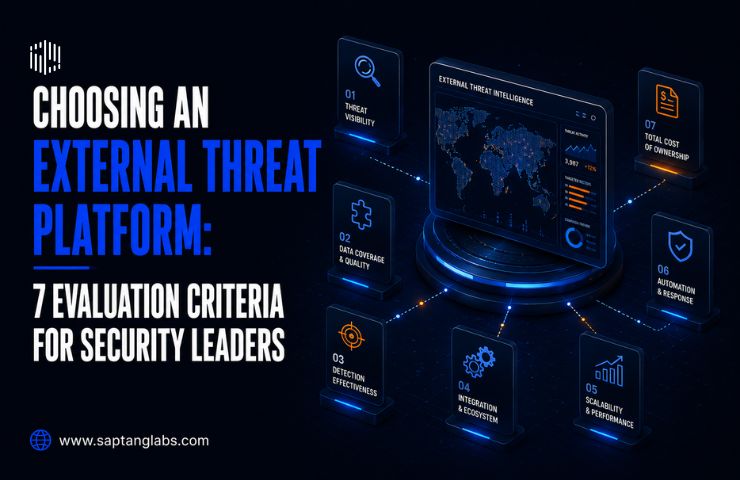
Most organizations invest heavily in internal security controls while external threats continue to grow across phishing infrastructure, fake applications, exposed assets, impersonation campaigns, and unmanaged digital exposure. Choosing the right External Threat Platform is no longer just a tooling decision. It is a strategic security investment. This guide explains the seven most important evaluation criteria security leaders should use when comparing external threat platforms, from visibility depth and takedown capability to automation, intelligence quality, and operational scalability.
The first warning sign did not come from the SOC.
It came from a customer.
A regional banking user called the support center claiming that the mobile application looked “slightly different” during login. At first, the complaint sounded minor. However, within hours, multiple users reported suspicious payment requests and unauthorized credential activity.
The bank’s security team quickly discovered the problem. Attackers had launched a highly convincing fake mobile application using the bank’s branding, interface design, and customer support language. Thousands of users had already downloaded it through third-party distribution channels.
Internally, the organization had invested millions in cybersecurity. Endpoint visibility was strong. SIEM coverage was mature. Incident response capabilities were well established.
Yet none of those controls detected the threat early enough.
The attack existed entirely outside the traditional security perimeter.
This is exactly why External Threat Platforms have become critical for modern enterprises.
Today’s attackers no longer rely only on infrastructure compromise. Increasingly, they operate through phishing ecosystems, impersonation campaigns, fake domains, exposed cloud assets, malicious applications, leaked credentials, and public attack surface exploitation. These threats evolve rapidly and often remain invisible until customers, regulators, or fraud teams report operational damage.
As a result, security leaders are being forced to rethink how they approach external visibility.
However, choosing an External Threat Platform is not simple. The market is crowded with overlapping claims, fragmented capabilities, and inconsistent terminology. Some vendors focus heavily on External Attack Surface Management. Others emphasize takedown operations, digital risk protection, or threat intelligence enrichment. Many platforms promise comprehensive visibility but struggle with operational depth.
For CISOs and security leaders, the challenge is no longer whether external threat monitoring matters.
The real challenge is choosing a platform that can deliver meaningful operational outcomes instead of just generating more alerts.
This is why evaluation criteria matter.
A strong External Threat Platform should not only identify exposure. It should help organizations reduce operational risk, improve visibility, accelerate response, and protect customer trust in measurable ways.
The following framework breaks down the seven most important criteria security leaders should evaluate before selecting an External Threat Platform.
The most important capability in any External Threat Platform is visibility. If a platform cannot continuously discover and monitor external exposure effectively, every downstream capability becomes weaker.
Many organizations underestimate how fragmented their external footprint actually is. Modern enterprises operate across cloud environments, third-party vendors, APIs, exposed development assets, mobile ecosystems, public repositories, marketing infrastructure, and unmanaged domains. Attackers actively search these environments because they often contain weak points overlooked by internal security programs.
A mature External Threat Platform should provide visibility across:
More importantly, visibility should be continuous rather than snapshot-based.
Attack surfaces change daily. New assets appear, configurations shift, cloud workloads scale dynamically, and phishing infrastructure evolves constantly. Platforms relying heavily on periodic scanning often struggle to keep pace with attacker behavior.
Security leaders should also evaluate how effectively the platform prioritizes exposure. Large volumes of raw findings create operational fatigue quickly. Strong platforms focus not only on discovery but also on contextual risk ranking that helps teams identify what matters most operationally.
Not all threat intelligence is equally valuable.
Many platforms aggregate massive amounts of external data but provide very little operational context. This creates a dangerous situation where analysts spend more time validating alerts than responding to genuine threats.
A strong External Threat Platform should provide intelligence that is actionable, contextual, and operationally relevant.
For example, discovering a suspicious domain registration has limited value unless the platform can also determine:
The quality of enrichment matters significantly.
Strong intelligence platforms combine technical telemetry with behavioral analysis, infrastructure relationships, campaign tracking, and attacker pattern correlation. This allows security teams to understand not only what exists externally, but also why it matters operationally.
Security leaders should pay close attention to false positive rates during evaluations. Excessive alert noise reduces trust in the platform and creates long-term operational inefficiency.
Detection alone is not enough.
One of the biggest weaknesses in many External Threat Platforms is the inability to convert intelligence into operational disruption quickly. Identifying phishing infrastructure has limited value if takedown coordination takes several days.
Attackers rely heavily on time.
A phishing campaign active for forty-eight hours creates exponentially more risk than one neutralized within two hours. This is why response capability is one of the most important evaluation criteria for security leaders.
Organizations should evaluate whether the platform supports:
Equally important is response speed transparency.
Vendors often promise “rapid response” without clearly defining operational timelines. Mature platforms should provide measurable performance benchmarks for takedown operations and escalation handling.
Because in external threat management, visibility without disruption capability creates incomplete protection.
External threats rarely operate independently from exposure management.
For example, attackers frequently exploit:
This is why External Attack Surface Management has become tightly connected with external threat operations.
An effective External Threat Platform should integrate attack surface visibility with active threat intelligence. Security teams should be able to identify not only exposed infrastructure, but also understand whether attackers are actively targeting those assets.
This combination significantly improves prioritization.
For example, an exposed asset becomes substantially more important if threat intelligence indicates active reconnaissance or phishing infrastructure linked to the same environment.
Security leaders should evaluate whether platforms combine:
The strongest platforms increasingly operate as unified external exposure intelligence systems rather than isolated monitoring tools.
External threat environments move too quickly for heavily manual workflows.
Large organizations often manage thousands of domains, cloud assets, APIs, and public-facing services simultaneously. Without automation, analysts quickly become overwhelmed by investigation and triage workloads.
This is why automation is critical.
Strong platforms should automate repetitive processes such as:
Automation improves not only speed but also consistency.
Operational scalability becomes especially important during large phishing campaigns or widespread impersonation attacks where investigation volumes increase rapidly.
Security leaders should also evaluate how well the platform integrates with existing security workflows. Mature platforms typically support SIEM integration, SOAR orchestration, API connectivity, ticketing systems, and fraud operations collaboration.
The goal is not simply to generate alerts faster.
The goal is to reduce operational friction while improving response efficiency.
One reason external threat programs struggle internally is because technical findings often fail to translate into business language clearly.
Boards and executive teams rarely want raw threat telemetry. They want to understand operational impact.
A mature External Threat Platform should help security leaders communicate:
Strong reporting capabilities significantly improve executive alignment because they convert technical activity into measurable business outcomes.
For example, saying that a platform identified 10,000 suspicious indicators provides very little executive value. However, explaining that phishing-related customer exposure decreased by sixty percent after implementing proactive monitoring immediately reframes the conversation.
Security platforms should support both operational depth for analysts and strategic clarity for leadership teams.
Choosing an External Threat Platform is not only a technical decision. It is also a long-term strategic partnership decision.
Security leaders should carefully evaluate vendor maturity, operational transparency, research capability, and strategic direction before making a selection.
Questions worth evaluating include:
Security leaders should also assess whether the vendor’s philosophy aligns with the organization’s operational goals.
Some platforms focus heavily on visibility. Others emphasize fraud reduction, takedown operations, or exposure management. The right fit depends heavily on organizational priorities, industry exposure, and threat maturity.
Ultimately, the strongest External Threat Platforms are those that operate as security intelligence partners rather than simple monitoring tools.
The external threat landscape is becoming more complex every quarter.
Attackers are increasingly operating outside traditional enterprise boundaries using phishing ecosystems, fake applications, impersonation campaigns, exposed infrastructure, and social engineering operations designed to exploit trust at scale.
This means organizations can no longer rely exclusively on internal security visibility.
The ability to continuously monitor, prioritize, and disrupt external threats is rapidly becoming a foundational security requirement rather than an optional capability.
Choosing the right External Threat Platform therefore has long-term implications not only for cybersecurity operations, but also for fraud prevention, customer trust, regulatory resilience, and executive risk management.
The organizations that approach this decision strategically will be significantly better positioned to reduce exposure before external threats become operational crises.
Choosing an External Threat Platform is no longer simply a procurement exercise.
It is a strategic decision that directly affects how organizations identify exposure, respond to attacker infrastructure, protect customer trust, and manage operational risk in increasingly complex digital ecosystems.
The strongest platforms do more than generate alerts. They provide continuous visibility, actionable intelligence, rapid disruption capability, scalable automation, and measurable business impact.
For security leaders, the goal should not be selecting the platform with the longest feature list.
The goal should be choosing a platform capable of reducing real-world exposure in meaningful, measurable ways.
Because modern cybersecurity is no longer defined only by what organizations protect internally.
It is increasingly defined by how effectively they manage the threats operating outside the perimeter.
What is an External Threat Platform?
An External Threat Platform helps organizations identify, monitor, and respond to threats operating outside traditional enterprise boundaries, including phishing domains, impersonation campaigns, exposed assets, and malicious infrastructure.
Why are External Threat Platforms important?
They provide visibility into external attack surfaces and help organizations detect threats targeting customers, brands, and public-facing assets before operational damage occurs.
What should CISOs look for in an External Threat Platform?
Security leaders should evaluate visibility depth, intelligence quality, takedown capability, automation, EASM integration, reporting capabilities, and vendor maturity.
How is EASM related to External Threat Platforms?
External Attack Surface Management helps organizations discover exposed assets and understand external exposure risks. Many modern External Threat Platforms combine EASM with threat intelligence and response operations.
Why is automation important in external threat management?
Automation improves scalability, reduces analyst workload, accelerates response time, and helps organizations manage large volumes of external threat activity efficiently.
You may also find this insight helpful: Inside the External Threat Command Center: A Technical Architecture Overview