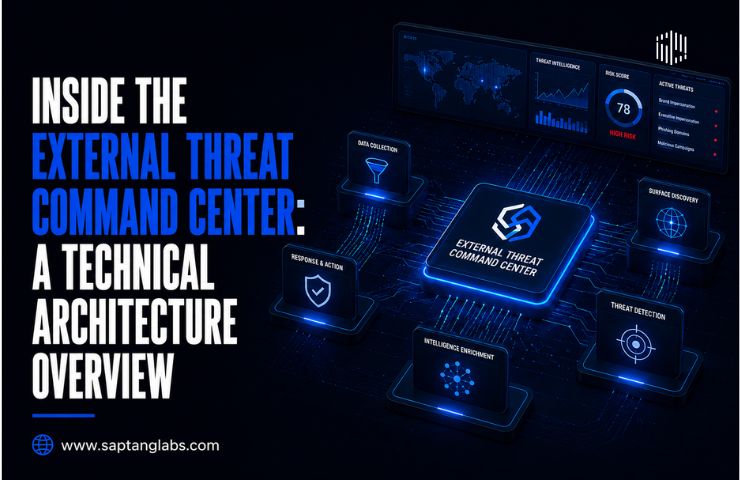
Inside the External Threat Command Center: A Technical Architecture Overview 

Inside the External Threat Command Center: A Technical Architecture Overview 

 TL;TR  

Modern manufacturers sit in the blast radius of attacks that start far outside the factory wall: spoofed supplier portals, weaponized RFQs, exposed remote access and ransomware staging.  

An External Threat Command Center built on a solid External Threat Platform Architecture gives you a single operational brain to see those threats early, understand how they connect to plants and suppliers, and coordinate IT, OT and procurement responses before they become downtime, safety issues or missed orders. 

 The architecture works in layers: collecting external signals, mapping them to your real industrial footprint, correlating campaigns, scoring risk in terms of production and supply chain impact, and then driving concrete playbooks that your teams can trust and repeat. 

The day a fake supplier nearly stalled the line

The email looked boring, which is exactly why nobody questioned it. 

Subject: “Revised payment details – urgent update before next shipment”
From: the domain of your longeststanding raw materials supplier.
Attachment: a neat PDF form, carrying the right logo, the right contact name, even the right purchase order references. 

Procurement glanced at it, forwarded it to finance with a quick “Please update before monthend” note, and went back to arguing over steel prices. 

The first shiver came from your biggest customer, not your SIEM. Their accounts team called late that evening. They had tried to verify a remittance with the supplier, only to be told: “We haven’t changed our bank account in years.” 

Somebody had cloned the supplier’s portal, registered a lookalike domain and launched a tightly targeted phishing run at your procurement teams and a handful of key customers. If finance had processed the change blindly, six figures of payment would have vanished. If the same actor had pivoted into your environment using stolen credentials from that campaign, the next step might have been an “IT issue” that quietly encrypted OTadjacent systems and froze production. 

That whole chain started outside your perimeter. 

This is the reality manufacturers are waking up to: the most dangerous risks to uptime and safety often begin with assets, brands and identities you do not fully own. And that is exactly what an External Threat Command Center, underpinned by a strong External Threat Platform Architecture, is designed to manage. 

Why external threats hit factories where it hurts

Manufacturing is uniquely exposed to the external world. 

You depend on: 

  • Dozens or hundreds of suppliers and integrators, many of them small and lightly defended. 
  • Remote access into plants for OEMs, maintenance partners and thirdparty engineers. 
  • Online portals and cloud spaces where you exchange drawings, firmware and forecasts. 

Attackers have figured this out. Instead of charging through your front gate, they: 

  • Spin up fake supplier domains to push weaponized invoices and RFQs. 
  • Target engineers and planners with phishing that references real part numbers and projects. 
  • Hunt for exposed remote access gateways or OT DMZ web consoles to bridge from IT into plant networks. 
  • Trade stolen credentials to plant VPNs and vendor access accounts. 

When one of those campaigns lands, the damage is measured in hours of production lost, scrap generated, penalties owed and sometimes safety risks to people on the floor. 

Internal monitoring alone cannot see these moves early enough. You need a disciplined, continuous view of what is happening around your brand and your supply chain. That is where external threat architecture comes in. 

 What an External Threat Command Center really is (for a manufacturer)

Strip away the jargon and the External Threat Command Center is simply this: 

A crossfunctional team and platform that keeps watch on all the ways the outside world can hurt your plants, products and partners, and then turns those observations into fast, coordinated decisions. 

On any given day, this Command Center is asking: 

  • Who is currently impersonating our brand, plants or suppliers online? 
  • What new domains, portals or remote access points have appeared that touch our industrial footprint? 
  • Which external campaigns could realistically impact a line, a plant or a critical supplier? 
  • Who needs to act: IT, OT, procurement, supplier management, legal, communications? 

The External Threat Platform Architecture is the technical spine that lets those questions be answered in a repeatable way. It is not yet another “threat intel portal” that analysts stare at in isolation. It is the plumbing that makes external awareness part of everyday operations. 

 External Threat Platform Architecture, explained like a factory system

If you are used to thinking in terms of production systems, here is a useful analogy. 

Imagine external threat management as a production line: 

  • Raw material: external signals about domains, IPs, phishing, exposed assets, supplier issues. 
  • Processing: cleaning, matching to your environment, correlating into campaigns. 
  • Quality: deciding which threats actually matter for uptime, safety and delivery. 
  • Finished goods: actions taken, cases closed, lessons learned. 

The External Threat Platform Architecture is the layout of that line: machines, conveyors, sensors and checkpoints that move from raw data to outcomes without constant improvisation. 

At a high level, it has seven “stations”: 

  1. It collects external signals from the internet, threat feeds, suppliers and customers. 
  2. It cleans and standardizes them into a usable, searchable format. 
  3. It maps them to your real plants, suppliers, remote access points and cloud assets. 
  4. It spots patterns and campaigns across all that data. 
  5. It scores which ones truly matter in manufacturing terms. 
  6. It triggers playbooks that reach IT, OT and procurement. 
  7. It keeps evidence and reporting so you can prove control to customers, auditors and the board. 

Let us walk down that line in a more narrative way. 

 Step 1: Seeing the external world like an attacker 

The first thing a good External Threat Platform Architecture does is teach your organization to see itself the way an attacker does. 

Instead of starting from your internal asset list, it asks: 

  • What domains exist that look like our company name, plant names or product names? 
  • Which supplier and OEM portals are visible and how are they being used or abused? 
  • What remote access gateways, VPN endpoints, cloud dashboards and engineering portals can we see from the internet? 
  • Where are our drawings, firmware, process docs and credentials turning up where they should not? 

The platform pulls from domain registries, certificate transparency, OSINT and commercial feeds, but the goal is not to drown you in indicators. The goal is to build a living picture of your industrial “surface area” from the outside. 

This is where that fake supplier domain would first appear: a newly registered lookalike URL, certificate issued within the last 24 hours, hosted in a region your real supplier never uses. On its own, that is just a dot on a map. The platform’s job is to add enough context to turn that dot into a story. 

 Step 2: Connecting dots to plants and suppliers 

Context is everything in a manufacturingcentric External Threat Platform Architecture. 

The same “suspicious” domain might be irrelevant for a software company and critical for a car plant, depending on what it touches. 

So the platform works hard to maintain a graph of: 

  • Which external domains and portals are part of your corporate web presence. 
  • Which ones belong to key suppliers, integrators and OEMs. 
  • Which IP ranges and hostnames sit in front of plant VPNs, OT gateways or remote access solutions. 
  • Which cloud spaces are used to exchange industrial data and documentation. 
  • It enriches each node with details like: 
  • Plant or business unit association. 
  • Critical lines or products affected. 
  • Singlesource or highdependency suppliers behind that portal. 
  • Regulatory context (food safety, automotive, medical, aerospace, etc.). 
  • Now, when that fake supplier domain surfaces, the platform can tag it as: 
  • “Impersonates Supplier X, used by Plant 4 and Plant 7 for brake component orders.” 
  • “If exploited, could disrupt deliveries to Automotive Customer Y, where penalties kick in after 24 hours of delay.” 

Suddenly, what looked like a generic phishing indicator becomes a threat to a specific line, plant and contract. 

Step 3: Understanding campaigns, not just incidents 

Threats rarely arrive as single, isolated events. Serious actors run campaigns. 

For manufacturers, those campaigns might look like: 

  • A burst of lookalike domains targeting suppliers and logistics partners in a specific region. 
  • Coordinated scanning of remote access infrastructure across multiple companies in your sector. 
  • A stream of phishing emails to plant engineers, referencing real project names and part numbers. 
  • Darkweb posts selling “access to Tier1 automotive supplier VPN” where you recognize your own IP ranges. 

The External Threat Platform Architecture treats these as patterns to be recognized, not random noise. 

It clusters indicators that share: 

  • Similar domain naming conventions. 
  • The same hosting providers or SSL certificates. 
  • Common email templates, landing pages or malware families. 
  • Shared targeting of specific industries, suppliers or geographies. 

Instead of dumping 50 separate alerts on your security team, it tells a single story: 

“A coordinated campaign is impersonating critical suppliers in your automotive program, distributing weaponized RFQs, and scanning remote access systems used by the same plants.” 

That story is what your External Threat Command Center can act on. 

Step 4: Translating technical risk into production risk 

A phishing kit or exposed gateway is a technical problem. A halted paint line is a business crisis. 

A manufacturingaware External Threat Platform Architecture builds a bridge between the two. 

When a campaign is detected, the platform automatically asks: 

  • Which plants, lines and customers could this realistically hit? 
  • How much would downtime cost, in lost output and penalties? 
  • Is there a safety or environmental dimension if process controls are affected? 
  • How quickly could we recover if this entry point turns into a ransomware incident? 

The result might be a simple, brutal ranking: 

  • This fake RFQ campaign against an ancillary supplier is annoying but manageable. 
  • This impersonation of your primary electronics supplier, combined with targeted phishing at your planners, is critical for Plant 2’s output for the next quarter. 
  • This systematic probing of your OT remote access gateways could be the precursor to a multiplant outage. 

When risk is framed that way, it is much easier for CISOs, plant directors and COOs to agree on priorities. You are no longer debating whether a CVSS score is high enough; you are debating how many trucks might not leave the yard. 


Step 5: Making response a practiced, crossfunctional skill 

The worst time to figure out who should do what is in the middle of an external crisis. 

A mature External Threat Platform Architecture bakes in playbooks that cut across silos. For example: 

  • For a supplier impersonation campaign: 
  • Security blocks the domains and URLs across email and web gateways. 
  • Procurement validates all bank detail and RFQ changes via outofband channels. 
  • Supplier management contacts the real supplier to check for compromise and coordinate messaging. 
  • Finance flags relevant payments for additional checks. 
  • For OTadjacent remote access targeting: 
  • Security restricts or hardens exposed gateways and VPNs, possibly with temporary geoblocking. 
  • OT engineers verify that no unauthorized changes have been made to PLCs, HMIs or historians. 
  • Vendor management checks with OEMs and integrators whose access is in scope. 
  • Plant management prepares contingency plans if access must be temporarily limited. 

The architecture’s role is to: 

  • Trigger the right playbook when the right pattern is detected. 
  • Open the right tickets in the tools your teams already use. 
  • Attach all the evidence and context needed so people understand why this matters. 
  • Track status until mitigation is complete. 

Over time, these playbooks become muscle memory. The Command Center is no longer improvising; it is performing. 

Step 6: Building trust with evidence, not promises 

Customers, auditors and boards are increasingly asking manufacturers blunt questions: 

  • “How do you know your critical suppliers aren’t being impersonated or compromised?” 
  • “How would you detect an attack that starts in a vendor’s laptop and ends in your plant?” 
  • “What have you done about external campaigns targeting your sector this year?” 

An External Threat Command Center backed by a rigorous External Threat Platform Architecture gives you answers based on evidence: 

  • Data showing how many external campaigns were detected, and how quickly. 
  • Records of which plants, suppliers and customers were at risk in each case. 
  • Timelines showing when blocks, takedowns and supplier engagements happened. 
  • Changes to playbooks and controls prompted by specific incidents. 

This is not about looking good in a slide deck. It is about being able to stand in front of a customer whose line is depending on yours and say, with a straight face: 

“We monitor external threats to this program, we know what we have seen, this is how we responded, and this is what we are changing to make it harder next time.” 

That level of transparency is rapidly becoming a differentiator when manufacturers compete on reliability and resilience. 

Bringing it all together on the plant floor

External threats will never politely restrict themselves to your office network. They will keep testing suppliers, remote access paths, cloud portals and human workflows around your plants. 

You cannot bubblewrap your factories from the outside world. But you can design an External Threat Platform Architecture that: 

  • Sees impersonation and exposure across your extended industrial ecosystem. 
  • Maps it to specific plants, lines, suppliers and customers. 
  • Recognizes campaigns before they reach your OT. 
  • Scores risk in terms operations understand. 
  • Drives practiced, crossfunctional responses. 
  • Leaves a clean trail of evidence and learning behind each incident. 

In other words, you can build an External Threat Command Center that earns its place next to your SOC and your plant control room. 

And the next time a fake RFQ lands in someone’s inbox, you are not relying on luck or the sharp eyes of one overworked buyer. You have a system that has seen this pattern before, knows who needs to move and gives them the tools and data to move fast. 

FAQ 

  1. How is an External Threat Platform different from what our SOC already runs?
    Your SOC mostly watches internal telemetry: logs, endpoints, network flows inside your perimeter. An External Threat Platform focuses on what happens outside: domains, portals, remote access, supplierexposures and campaigns in the wild. The two should be connected, but they solve different parts of the problem. 
  2. We are midsized. Do we really need an External Threat Command Center?
    You may not need abig dedicated room with screens, but you do need at least a small virtual team and a platform that can see external threats to your key plants and suppliers. Even one cleverly crafted supplier fraud attempt or remote access incident can cost more than the investment in architecture. 
  3. What are the quickest wins when starting out?
    Common early moves include monitoring for brand and supplier impersonation, watching for exposed remote access and VPN endpoints, and setting up simple playbooks for fake invoices and RFQs. These are highimpact in manufacturing andrelatively straightforward to automate. 
  4. How do we balance security with vendor access and production needs?
    The architecture should support finegrained decisions, not blanket bans. That means knowing which vendors need which access for whichplants, and being able to tighten controls surgically during a campaign without paralyzing operations. Clear playbooks and communication with suppliers are critical. 
  5. What skills are essentialonthe team running this?
    You need a mix: threat analysts who understand campaigns, engineers who can integrate data and automate actions, and people who speak both IT and OT. Equally important are representatives from procurement, supplier management and plant operations, because many external threats cut across all three. 

You may also find this insight helpful:  From Alert Fatigue to Action: How AI Reduces False Positives by 80% 

Focus Keyword: External Threat Platform Architecture 

SEO Title (≤ 55 characters):
External Threat Platform Architecture For Manufacturing 

Meta Description (≤ 150 characters):
Explore external threat platform architecture for manufacturing to protect plants, suppliers, uptime and safety from evolving cyber risks. 

Tags (Title Case, comma separated):
External Threat Platform Architecture, Manufacturing Cybersecurity, External Threat Command Center, Industrial Security, OT Security, Supply Chain Security, Cyber Risk Management 

Linkedin 


Leave a Reply

Your email address will not be published. Required fields are marked *