
TL;DR
The meteoric rise of Unified Payments Interface (UPI) has been matched by a 90% surge in sophisticated fraud. From social engineering to malicious screen-sharing apps, external threats are evolving faster than traditional reactive defenses. This article explores why the “human firewall” is failing, the specific mechanics of modern phishing, and why banks must pivot toward proactive, AI-driven external threat detection to safeguard the digital payment ecosystem.
Rajesh, a veteran fraud investigator at a major retail bank, remembers the exact moment he realized the old rulebook was obsolete. It wasn’t a massive server breach or a sophisticated database injection. It was a Tuesday afternoon when his dashboard lit up with three hundred identical “unauthorized transaction” complaints, all originating from a single digital neighborhood.
The victims weren’t victims of a technical bug. They were victims of a “vibe.” They had been systematically nudged, via perfectly crafted WhatsApp messages and urgent voice calls, into “authorizing” their own financial ruin. This is the new face of UPI fraud. It is personal, it is external, and it is growing at a rate of 90% year-over-year.
For Fraud-Fighter Fatima and her team, this isn’t just a statistic. It represents a fundamental shift in the battlefield. The threat is no longer inside the bank’s perimeter; it is living in the pockets of every customer, exploiting the very convenience that made UPI a revolution.
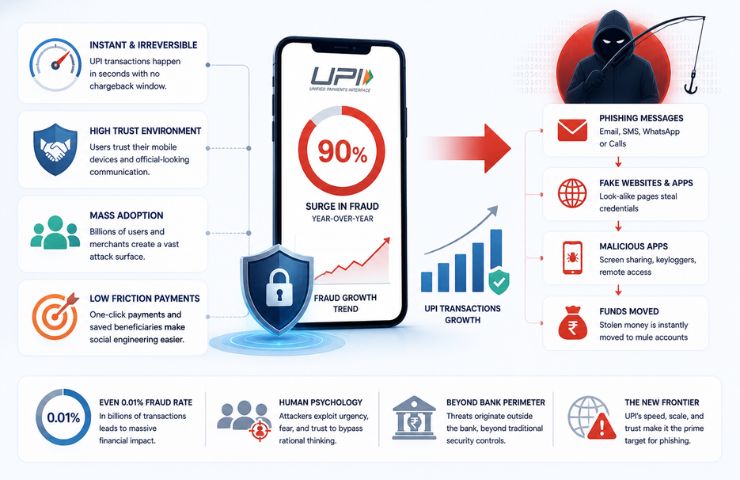
The convenience of “one-click” payments is a double-edged sword. When money moves at the speed of light, fraud moves at the speed of thought. The 90% jump in UPI fraud isn’t an accident of technology, but a mastery of human psychology by external threat actors.
Banks have spent billions securing their internal cores, yet the external landscape remains a “Wild West.” Phishing has evolved from broken-English emails to high-fidelity clones of banking apps and official-looking government portals.
To fight the enemy, we must understand their choreography. Modern banking phishing isn’t a single event; it is a multi-stage funnel designed to bypass the most vigilant Fraud-Fighters.
1. The Lure (Social Engineering)
It starts with a sense of urgency. A message arrives: “Your KYC has expired. Your account will be frozen in 2 hours.” The tone is authoritative, mimicking the bank’s own communication style. This is the “External Vibe” that tricks the user’s brain into bypassing critical thinking.
2. The Tooling (Malicious Apps and URLs)
The user is directed to download a “verification app.” In reality, this is a screen-sharing tool or a keylogger. Once the user enters their UPI PIN, the attacker, watching from a remote dashboard, has everything they need.
3. The Exfiltration
The money doesn’t just disappear into one account. It is “mule-mapped.” The stolen funds are instantly split across dozens of low-tier accounts, making traditional recovery virtually impossible for the bank’s manual SOC teams.
Why Reactive Detection is a Losing Game
Most banks are still playing defense with a blindfold on. They wait for a customer to call and report a loss before they investigate. In the world of 90% fraud growth, if you are reacting, you have already lost.
The “Reactive Trap” relies on historical patterns. But attackers change their infrastructure daily. A “known bad” IP address from yesterday is a “trusted” residential node today. For professionals like Fatima, the goal must shift from “finding the thief” to “predicting the path.”
To protect the Top of the Funnel (TOFU), banks must look outward. Proactive detection means monitoring the internet for the setup phase of an attack, not just the execution.
Monitoring the Digital Shadows
Banks need systems that scan for newly registered domains that mimic their brand. If “YourBank-KYC-Update.com” was registered ten minutes ago, it should be flagged and blocked at the DNS level before the first phishing SMS is even sent.
App Intelligence and Malware Scanning
When a customer opens their banking app, the system should be able to detect if a suspicious screen-recording app is running in the background. If it is, the transaction must be blocked immediately, with a clear explanation provided to the user.
Community-Led Defense
Fraud-Fighters must unite. By using shared “threat pools,” a phishing template identified by one bank can be automatically blocked by every other bank in the network within seconds. This turns the attackers’ scale against them.
We cannot blame the customer for being tricked by a “perfect” fraud. Instead, we must design interfaces that make fraud physically difficult to execute.
High-visibility warnings, transaction “cool-down” periods for new payees, and biometric-backed authorization for high-value transfers are not “friction”—they are features. The goal is to create a digital environment where the “vibe” of a legitimate transaction feels distinctly different from a fraudulent one.
If you are leading a fraud prevention team today, your priority list should look like this:
We are entering an era where AI agents will write the phishing scripts and AI defenders will block them. The 90% jump in fraud is a warning shot. It tells us that the digital payment revolution is only as strong as its weakest external link.
For Fatima and the thousands of Fraud-Fighters across the globe, the mission is clear. We aren’t just protecting balances; we are protecting the trust that allows a modern economy to function. By shifting from reactive “clean-up” to proactive “prevention,” banks can finally turn the tide against external threats.
Why did UPI fraud specifically jump by 90%?
The surge is driven by the massive increase in first-time digital users who are unfamiliar with security protocols, combined with the extreme speed of UPI which makes it difficult to stop a transaction once it is initiated.
Is it always the user’s fault?
No. While social engineering targets the user, the “fault” often lies with a lack of proactive monitoring that allows fraudulent infrastructure (fake apps and sites) to exist in the first place.
What is the “Top of Funnel” (TOFU) in fraud?
In marketing, TOFU is about awareness. In fraud, it refers to the initial contact phase (the phishing SMS or call). If banks can break the chain at the TOFU stage, the transaction never happens.
Can banks actually stop external phishing?
While you cannot stop an attacker from trying, you can significantly reduce their success rate by using automated tools to find and take down phishing sites and by educating users through “just-in-time” alerts.
What should I do if I think I’ve been scammed?
Immediately report the transaction on the National Cyber Crime Reporting Portal (1930 in India) and contact your bank to freeze your UPI ID. Every second counts in the recovery of funds.
Final Thought:
The 90% statistic isn’t just a number on a chart. It is a call to action. In the battle for digital payment security, the best defense is a proactive, intelligent, and relentless offense.
You may also find this insight helpful: VibeCrime Attacks: How Autonomous AI Systems Conduct Complex Cyber Operations Without Human Direction
SEO Detail:
Focus Keyword: UPI Fraud Prevention
SEO Title (≤55 characters):
UPI Fraud Prevention: How Banks Can Stop Threats
Meta Description (≤150 characters):
UPI fraud surged 90%. Discover how banks can prevent phishing, detect threats early, and secure digital payments with AI-driven strategies.
Tags (Title Case, Comma Separated):
UPI Fraud Prevention, UPI Fraud 2026, Banking Security, Digital Payment Fraud, Phishing Attacks, Cybersecurity In Banking, Fraud Detection, AI In Banking Security, External Threat Detection, Fintech Security