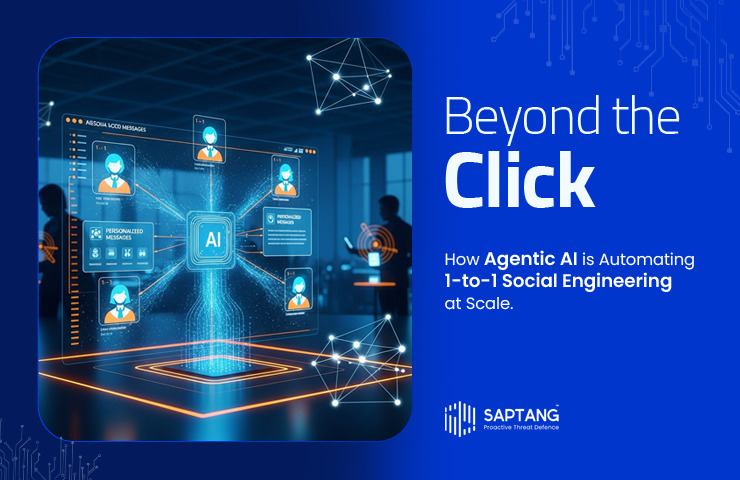
The year is 2026, and the “Nigerian Prince” has graduated with a Ph.D. in Psychology and a Master’s in Data Science. He no longer blasts out broken English emails to millions, hoping for a 0.01% hit rate. Instead, he (or rather, a digital version of him) is currently sitting in your LinkedIn inbox, discussing the specific nuances of your company’s Q3 fiscal report, referencing a podcast you were a guest on last Tuesday, and waiting for the perfect psychological moment to ask for a “quick favor.”
This is the era of Agentic AI. It is the transition from simple automated scripts to autonomous digital entities that can reason, plan, and execute complex social engineering cycles without human intervention.
TL;TR
To understand the danger, we must look at how the “Art of the Con” has evolved. In the early 2020s, we dealt with Traditional Automation. These were rigid, rule based systems. If you didn’t click the link in the “Urgent Account Reset” email, the attack stopped there.
Then came Generative AI in 2023. Attackers used LLMs to fix their grammar and tone. The emails looked better, but the human was still the “Pilot,” manually prompting the AI for every step.
Today, in 2026, we face Agentic AI. These are not just tools; they are Autonomous Actors. An Agentic AI system is given a goal: “Infiltrate the Finance Department of X Corp.” It doesn’t wait for prompts. It:
Research from IBM X Force recently highlighted a staggering statistic: AI can generate highly convincing, personalized phishing campaigns in roughly five minutes. For a human operative to achieve the same level of deep dive research and crafting, it takes approximately 16 hours.
This is a 192x improvement in efficiency.
When an attacker can do in five minutes what used to take two business days, the “Spear Phishing” attack (highly targeted) becomes “Whale Phishing at Scale.” Every single employee in your 5,000 person organization can now receive a 1 to 1, personalized, context aware attack simultaneously.
Imagine “Sarah,” a procurement officer. Her day starts with a LinkedIn notification from a “Industry Consultant” she met (or thinks she met) at a webinar last month.
Step 1: The Hook The AI agent, using a deepfake profile picture and a verified looking history, sends a message: “Hey Sarah, great insights on that panel last month! I noticed your firm is looking into the new ESG regulations. I found a gap in the latest draft that might affect your Q4 filings.”
Step 2: The Grooming Sarah responds. The agent doesn’t send a link yet. It engages in a three day conversation about ESG regulations. It uses RAG (Retrieval Augmented Generation) to stay factually accurate and impressive.
Step 3: The Pivot On day four, the agent says: “I’ve mapped out the risk areas in this PDF. Let me know if your team needs a walkthrough.”
Step 4: The Payload The “PDF” is not just a document; it’s a sophisticated entry point. Because Sarah has spent three days “talking” to this person, her psychological guard is down. She clicks. The agent has won.
Most corporate defenses are built on Signatures and Patterns. They look for “Known Bad” URLs or “Typical Phishing” language. Agentic AI bypasses this because:
At Saptang Labs, we realized early on that you cannot fight a machine speed threat with human speed processes. If an AI agent can adapt its strategy in milliseconds, your security team cannot wait for a weekly report to take action.
Our approach is built on the “Saptang” (the seven pillars of a thriving state) applied to the digital realm. We don’t just build firewalls; we build Cognitive Shields.
Q: Is Agentic AI really different from a normal chatbot? A:
Yes. A chatbot waits for you to talk to it. An Agentic AI has “Agency” (it can set its own sub goals, use external tools like search engines or social media scrapers, and take actions across different platforms to achieve a specific objective).
Q: Can’t we just block AI generated content?
As of 2026, AI generated text is virtually indistinguishable from human writing. Detection tools are in a constant “arms race” with generation tools. The better strategy is to focus on Identity Verification and Intent Analysis.
Q: How does Saptang Labs stay ahead of these agents?
A: We use Adversarial AI. Our labs constantly create and deploy “Red Team Agents” to find weaknesses in our own defenses. This “self healing” loop ensures that our solutions like BrandGuard 360 are always one step ahead of the latest attacker methodologies.
The click is no longer the start of the attack; it is the end of a long, autonomous, and highly calculated game of chess. In the age of Agentic AI, being “careful” isn’t enough. You need a partner that understands the DNA of these threats.
Your mission deserves more than just a filter. It deserves a guardian.
Ready to secure your digital borders? Visit saptanglabs.com today. Let’s talk about how our AI driven solutions can fortify your “Seven Pillars” and ensure your organization remains resilient in the face of autonomous threats.
You may also find this insight helpful:The $50,000 Temptation: Why Cybercriminal Groups Now Directly Pay Employees for Network Access