- 07 November, 2025
- No Comments
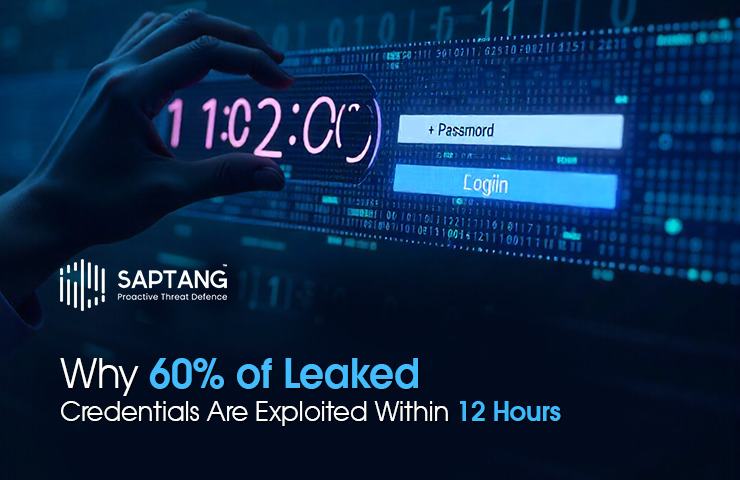
Credential Exposure: Why 60% of Leaked Credentials Are Exploited Within 12 Hours (and What You Can Do)
TL;DR
When credentials are leaked, attackers start exploiting them at machine speed. Evidence from industry breach reports shows the majority of exposed credentials are used within hours. The defence is not panic; it is visibility and speed: continuous credential exposure monitoring, adaptive multi factor authentication, rapid containment workflows, and behavioural analytics. SaptangLabs helps organisations detect exposed credentials in real time, prioritize risk, and automate containment, so you stop exploitation long before it becomes a breach.
The reality no one wants to admit
Credentials are still the single largest door into an organisation. Password reuse, unmanaged tokens, and slow detection create a predictable path for attackers. When credentials appear on public leak sites or on forums, automated tools begin validating them across services. In modern operations that validation process is often completed within hours.
When I led incident response teams, the hard truth we learnt was simple: prevention is limited, detection is everything. If you only act after an alert lands in a queue, the attacker has likely already escalated privileges and moved laterally. That is why the 12 hour window matters. It is the time in which visibility and automation change the outcome from compromise to containment.
The 12-hour exploitation lifecycle (simplified)
The following table describes the common sequence after a credential leak. Times are approximate but reflect observed attacker behaviour in high frequency credential attacks.
| Time After Leak |
Activity Observed |
Threat Actor Behavior |
| 0–2 hours |
Credentials sold or shared |
Automated scanners begin validating logins |
| 2–6 hours |
Credential stuffing |
Attackers test reused passwords across services |
| 6–12 hours |
Exploitation |
Privilege escalations, lateral movements, and persistence attempts |
Industry breach analyses and incident response playbooks consistently show credential misuse as a dominant factor in successful intrusions. Containment time measured in days or weeks is far too slow when adversaries operate in minutes.
Why this keeps happening
Three structural problems produce this fast exploitation cycle:
- Password reuse and weak secrets, so one leak opens many doors.
- Lack of continuous visibility into external credential exposure. Many teams only learn about leaked credentials when a user reports suspicious activity.
- Automation on the attacker side. Attack toolkits perform reconnaissance, validation and exploitation at cloud scale with minimal human intervention.
These are not theoretical weaknesses. They are operational gaps every security leader must treat as priority infrastructure failures.
The modern defence playbook
Stopping rapid credential exploitation requires shifting to a posture of continuous detection, contextual risk scoring, and automated containment. The cornerstone controls are:
- Continuous credential exposure monitoring. Integrate dark web and paste site feeds into your security data pipeline to detect exposures tied to corporate domains or assets.
- Risk-based access and adaptive multi factor authentication. Enforce stronger controls when context indicates higher risk, such as unusual device, location, or time.
- Passwordless and hardware-backed authentication for high privilege accounts. Removing shared secrets dramatically reduces attack surface.
- Privileged access management and just-in-time elevation. Limit the window for abuse when credentials are misused.
- Behavioural analytics and anomaly detection. Detect patterns that indicate account misuse even if valid credentials are used.
- Playbooks and automation. When exposure is detected, trigger immediate token revocation, credential resets, session termination, and increased monitoring.
These controls work together: detection buys you time, adaptive controls limit impact, and automation closes the window attackers exploit.
How SaptangLabs helps, practically
SaptangLabs built capabilities specifically to address the 12-hour risk window. We combine continuous external exposure intelligence with internal context and automated response.
Key capabilities we deploy with enterprise teams:
- Real-time credential exposure alerts: continuous scanning of paste sites, forums and indexed leak sources that maps leaked credentials to corporate identities.
- Risk prioritization engine: exposure is scored by asset criticality, user privilege and likely reuse patterns, so teams focus on highest impact events first.
- Automated containment workflows: integration with access management and identity providers to revoke tokens, force password resets or apply conditional access without manual tickets.
- Adaptive MFA orchestration: policies that upweight authentication strength when exposure or anomalous behaviour is detected.
- Behavioural detection and correlation: combining external exposure signals with login and session telemetry to detect early signs of account takeover.
Practical result: customers who integrated these capabilities reported dramatic reductions in successful account takeovers and faster remediation times, turning a multi-day response into one measured in hours or minutes.
Actionable steps you can implement this week
- Connect a credential exposure feed to your SIEM or XDR pipeline so exposures route to your triage queue automatically.
- Implement conditional access that forces step-up authentication or blocks access for high-risk geographies and devices.
- Identify all service accounts and tokens, enforce rotation and apply least privilege.
- Enroll high privilege users in hardware-backed authentication and reduce password reliance.
- Build an automated playbook that immediately revokes sessions and rotates credentials for exposed identities.
These are not theoretical. They are operational changes that materially reduce exploitation risk when leaks happen.
FAQs
- How fast should I expect to know when credentials tied to my domain are leaked?
Answer: Within minutes to an hour if you have continuous monitoring connected. Manual discovery is too slow.
- Is MFA enough to stop credential exploitation?
Answer: MFA reduces risk but is not a silver bullet. Attackers can still phish, bypass weak MFA methods, or exploit sessions. Adaptive MFA plusbehavioural signals is more effective.
- Are password managers safe?
Answer: Password managers are a recommended mitigation for password reuse, but they must be combined with strong endpoint hygiene and MFA, and encrypted backups must be protected.
- What immediate steps should a security team take on receiving a credential exposure alert?
Answer: Prioritize by privilege, trigger automated credentialrotation and token revocation for high-risk accounts, enable step-up authentication, and monitor for anomalous activity.
- How can I measure success?
Answer: Track reduction in successful credential-based access attempts, mean time to containment for exposures, and the number of accounts remediated within the first hour.
Final Thoughts
Credential exposure is predictable, but exploitation does not have to be inevitable. The 12-hour window is a hard reality. Organisations that combine continuous external visibility with adaptive controls and automation convert that window into time to act, not time to lose.
At SaptangLabs we work with enterprises to operationalize this approach: continuous exposure detection, risk prioritization, and automated containment that reduce successful account takeovers and shorten remediation to minutes. If you want to see how a modern identity defence posture works in your environment, request a targeted demo and a risk discovery briefing tailored to your architecture.
You may also find this helpful: AI vs The Adversary: What 2025’s ML-Driven Attacks Reveal About Your Defence Stack