TL;DR:
The massive strategic shift to multi-cloud was meant to boost resilience, but it created an unintended, high-stakes exposure: Identity Drift. This is the slow, silent accumulation of unnecessary privileges across both human and machine accounts, driven by the pace of digital transformation and simple human oversight. Drift has become the highest-value weakness attackers exploit, bypassing firewalls and patches to move straight to your most critical data. Traditional, reactive IAM tools cannot detect or stop this organizational entropy. To secure your modern enterprise, you must invest in unified, proactive identity visibility and automated governance that treats identity as your new, only true perimeter.
Every C-suite executive understands that innovation requires speed. We launched into the multi-cloud era for agility, resilience, and scale. Yet, for many enterprises, that acceleration came with a hidden cost: an explosion in the number of digital identities, permissions, and roles that no one can truly account for or control.
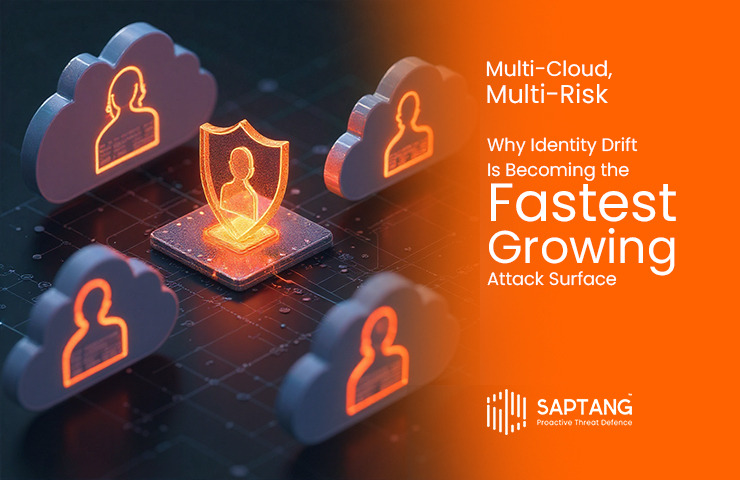
This silent expansion is known as Identity Drift. It’s not a sudden cyber-attack; it’s the gradual, often unnoticed, strategic decay of your security posture. Think of it as digital entropy, the natural tendency for permissions to accumulate and hygiene to erode over time, driven by human needs and the velocity of technology.
Executives who still view Identity and Access Management (IAM) as a back-office chore are already behind. Identity is the currency of modern enterprises. If you lose control of that currency, you lose control of your strategic assets. Identity drift is the hidden weak point attackers are exploiting at scale, making it the most critical governance challenge today.
Identity drift is a human problem first, amplified by machine speed. It is fueled by Project Pressure and the simple human desire for convenience.
Identity drift typically emerges from four recurring patterns that combine to form a massive attack surface:
The failure to contain identity drift carries measurable, material risk that hits the balance sheet.
We believe you can have both speed and security. As a Proactive Threat Intelligence company, we shift the focus from reacting to compromised accounts to predicting and preventing drift. Our framework acts as your unified Identity Governance Control Centre.
Identity drift is not an engineering problem; it is an executive governance challenge. Reversing it requires resource commitment and a top-down mandate.
The multi-cloud identity ecosystem is now the largest and fastest-moving attack surface in the enterprise. Perimeters can be secured, but identity drift evolves silently shaped by human actions, daily changes, and the sheer pace of digital transformation.
Enterprises that recognize Identity Drift as a strategic governance challenge, and not just a technical issue; will build resilience, drastically reduce breach exposure, and ensure their security posture actively supports, rather than stifles, business velocity.
Identity is the new perimeter. Controlling drift is the new mandate.
Q: Is identity drift the same as privilege creep?
A: No. Privilege creep is one symptom (permissions increase over time). Identity drift is the broader issue, encompassing lifecycle failures, unused roles, machine identities, and inconsistent privileges across your entire multi-cloud environment.
Q: Why is multi-cloud accelerating identity drift?
A: Each cloud has its own unique Identity and Access Management (IAM) system, creating fragmentation, duplication, and disconnected governance models. This allows drift to occur naturally and unnoticed in the gaps between providers.
Q: Which identities pose the biggest risk; human or machine?
A: While humans are the entry point, machine identities pose the highest persistent risk. They outnumber humans significantly and often lack proper lifecycle management, monitoring, or expiration controls, creating persistent backdoors.
Q: Can Zero Trust alone stop identity drift?
A: Zero Trust principles provide the philosophical guidance (never trust, always verify). However, without identity lifecycle governance and continuous, automated privilege monitoring, drift will still accumulate and erode your Zero Trust posture.
Q: How can leadership measure identity drift?
A: Track and monitor key metrics: identity volume, privilege growth rate, the volume of unused permissions, stale accounts, and role deviations across different cloud environments.
Don’t Manage Your Perimeter with Human Oversight.
You need a unified, proactive solution that moves at the speed of the cloud.
Request a Zero-Drift Assessment with Saptanglabs today. We will show you precisely where your hidden multi-cloud identity attack surface lies, quantify its financial risk, and provide the automated blueprint to stop drift permanently.
You may also find this helpful: The Trust Gap: Why 60% of CEOs Still Don’t Get Real-Time Risk Visibility