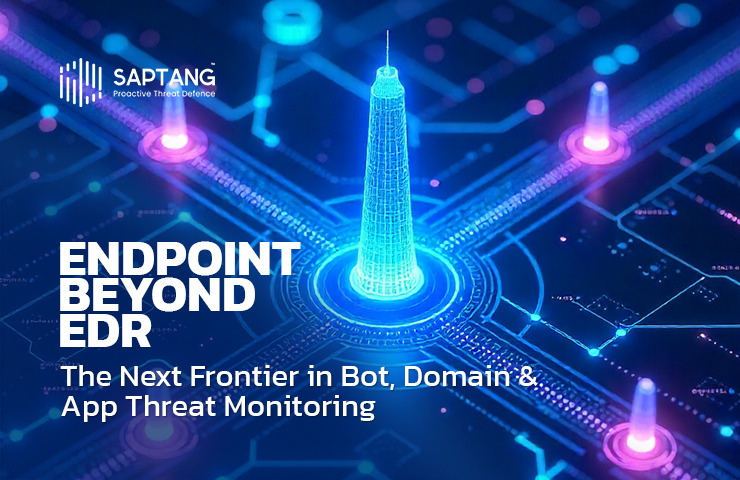
EDR was designed to protect endpoints, but today’s attackers no longer play within those boundaries. Modern threats now live in botnets, domain infrastructures, and app-layer abuse where traditional endpoint tools have limited visibility. The next frontier in cybersecurity lies in connecting endpoint telemetry with bot, domain, and app intelligence, building defense systems that predict, not just react.
For years, Endpoint Detection and Response (EDR) has been the backbone of enterprise defense. It detects anomalies, monitors behavior, and helps security teams isolate compromised systems. But EDR has one critical limitation, it only sees what happens inside the endpoint.
Attackers, however, have evolved. They exploit what EDR doesn’t see: traffic from bots, domain manipulation, and malicious app behavior. Modern threats flow between the endpoint, the network, and the cloud, creating blind spots where incidents begin long before an alert appears.
According to a 2024 Gartner report, over 68 percent of successful breaches now involve non-endpoint vectors such as API abuse, domain spoofing, or bot-driven infiltration.
The takeaway is simple: the endpoint is no longer the perimeter.
EDR tools were built for a world where threats originated from within the device itself. But today’s attack surface extends far beyond.
Here’s what EDR often misses:
When visibility stops at the device level, analysts chase symptoms instead of the source. Alerts keep coming, but context remains fragmented.
This gap has created a new challenge for Security Operations Centers: too much data, not enough insight.
Cyberattacks today are no longer isolated to one system or channel. They evolve across multiple layers in real time.
A single intrusion campaign can start with a malicious domain registration, shift to a bot network for traffic redirection, and end with credential abuse inside an enterprise app.
Some common examples include:
These multi-layer threats exploit the lack of coordination between EDR, DNS monitoring, and app visibility tools. Each system detects fragments, but none see the full pattern.
“Endpoint Beyond EDR” is not a new tool, it is a new mindset.
It means expanding visibility beyond what the agent sees and connecting three additional layers of intelligence:
Together, these create a unified picture of threat behavior, correlating endpoint signals with external risk vectors.
Traditional EDR systems face structural limitations that make this expansion difficult:
This fragmented approach slows down response time, increases analyst fatigue, and leaves blind spots in threat correlation.
The next phase of security evolution lies in unified telemetry, the ability to correlate endpoint, network, domain, and app-level data in real time.
An ideal model looks like this:
When every signal is connected, analysts can trace an intrusion from the first domain ping to the last data exfiltration attempt.
It transforms threat hunting from reaction to prediction.
Consider a high-traffic retail platform facing repeated credential-stuffing attacks. EDR logs showed no anomalies, endpoints appeared clean.
However, cross-layer analysis through unified telemetry revealed the truth.
By correlating domain and bot intelligence with endpoint telemetry, the organization traced the full attack chain and neutralized the threat in under two hours.
This is the essence of Endpoint Beyond EDR; connecting what EDR cannot see.
For CISOs and SOC teams, the implications are clear:
Unified threat intelligence enables organizations to see patterns before they become breaches. It reduces alert fatigue, shortens response time, and turns fragmented signals into actionable insight.
At Saptang Labs, our mission is to build visibility that looks beyond the endpoint.
Through integrated modules like BotFence, DomainFence, and AppFence, organizations gain continuous insight across bots, domains, and app ecosystems.
Our approach enables:
This is not just about adding another security layer, it is about connecting every layer that matters.
The endpoint is still important, but it is no longer the full picture. The future of security lies in visibility that moves beyond the endpoint to the network, the domain, and the application.
True defense today means anticipating threats that EDR was never built to see.
At Saptang Labs, we are helping enterprises build this next generation of visibility, one that connects data, detects patterns, and defends with intelligence.
Discover how your organization can move beyond EDR. Visit www.saptanglabs.com.
You may also find this helpful: Why 60% of Leaked Credentials Are Exploited Within 12 Hours