
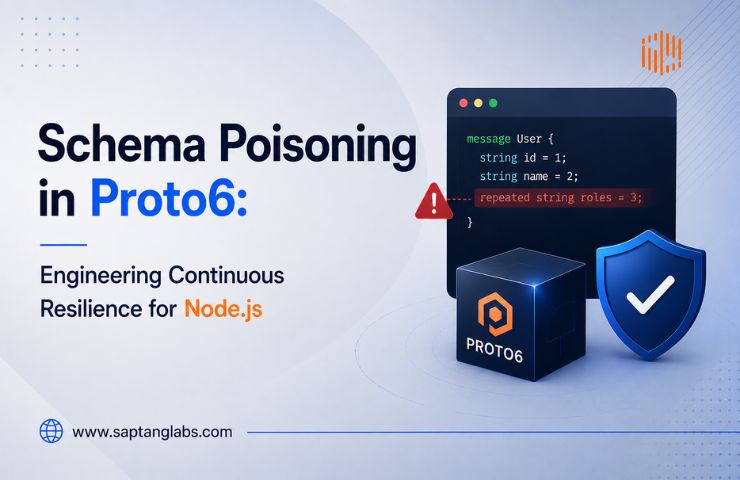
The recently disclosed Proto6 vulnerabilities in the protobuf.js library expose a catastrophic flaw in how Node.js applications handle data serialization. By exploiting implicit trust in Protocol Buffers definitions, attackers can execute arbitrary code and trigger massive denial of service events through a technique known as Schema Poisoning. This is not a simple configuration error. It is a fundamental supply chain and architectural weakness impacting millions of applications, including Google Cloud functions and CI/CD pipelines. Standard reactive patching is insufficient because the attack surface spans dynamic schema registries, untrusted payloads, and third party integrations. Engineering true resilience requires a continuous security validation posture, active attack surface management, and the implementation of robust input sanitization to preempt these injection attacks before they compromise the Node.js runtime.
Alex, a backend architect for a high volume fintech platform, watched the primary Node.js microservices flatline on the monitoring dashboard. The logs did not show a database failure or a network outage. Instead, they revealed a rapid spike in memory allocation followed by an immediate process crash. The incident response team initially suspected a massive volumetric attack. However, the root cause was much more subtle and far more dangerous. An authenticated tenant had uploaded a seemingly benign configuration file to the dynamic schema registry. This file contained a deeply nested Protocol Buffers definition designed to trigger unlimited recursion. The application parsed the file, exhausted the JavaScript call stack, and died instantly.
This scenario perfectly illustrates the devastating reality of the Proto6 vulnerabilities. Discovered by security researchers, these six distinct flaws in the widely used protobuf.js library highlight a critical blind spot in modern software engineering. We have built massive ecosystems on the assumption that data schemas are inherently safe. As the Proto6 disclosure proves, this assumption is false. We must now address the urgent engineering challenge of preventing Schema Poisoning across our entire infrastructure.
To defend against these threats, engineering teams must dissect the anatomy of the attack. Schema Poisoning occurs when an attacker manipulates the structural definition of data, rather than the data payload itself, to compromise the parsing engine. Protocol Buffers, originally developed by Google, serve as a language agnostic binary serialization format. Developers rely on .proto files to define how data is structured, which the protobuf.js library then compiles into JavaScript code for the Node.js runtime.
The vulnerability exists because the library historically failed to sanitize the inputs provided within these schema definitions. If an application dynamically loads schemas from untrusted sources, such as user uploads, plugin directories, or shared repositories, it blindly trusts the structural instructions.
This blind trust allows attackers to inject malicious payloads directly into the parsing logic. They can alter namespace names, modify field parameters, and inject raw control characters. When the protobuf.js engine attempts to generate the static code or decode the binary messages, it inadvertently executes the attacker’s embedded instructions. This transforms a simple serialization task into a remote code execution vector.
Key Characteristics of the Threat
The six vulnerabilities collectively categorized under the Proto6 moniker expose several distinct attack paths within the Node.js environment. Understanding these specific vectors is crucial for building targeted continuous validation tests.
The most critical path involves remote code execution through prototype pollution and code injection. JavaScript utilizes prototype based inheritance, meaning objects inherit properties from their prototype chain. The CVEs categorized as high severity demonstrate that an attacker can manipulate object keys within a crafted schema to bypass prototype safety checks. By polluting the base prototype, the attacker alters the behavior of all subsequent objects created by the application. This allows them to inject arbitrary JavaScript code that the server executes with full privileges.
Another devastating vector focuses on process wide denial of service. Attackers can craft a binary payload featuring recursive message types. When the application attempts to decode this payload, the library enters an infinite loop of property resolution. This rapidly consumes the available stack memory, triggering a fatal error that terminates the Node.js process. In highly available environments, orchestrators like Kubernetes will attempt to restart the crashed pod. If the poisoned schema remains in the message queue or registry, the pod will instantly crash again upon restart, creating a persistent denial of service loop.
Furthermore, CI/CD pipelines are uniquely vulnerable. Many development teams use automated pipelines to compile .proto files into static JavaScript artifacts during the build phase. If an attacker submits a pull request containing a poisoned schema, the CI runner will execute the malicious code while attempting to build the project. This can lead to the theft of deployment credentials, source code exfiltration, and the silent compromise of the final production artifact.
The core philosophical failure exposed by Proto6 is the implicit trust developers place in serialization libraries. We meticulously sanitize SQL queries and HTTP inputs, yet we often treat data structure definitions as sterile components. This discrepancy creates a massive attack surface.
When you allow dynamic schema loading without strict validation, you are essentially providing an open terminal to your backend systems. The library assumes the schema is a legitimate blueprint. It does not possess the contextual awareness to recognize when a field name contains a malicious JavaScript execution gadget.
This requires a fundamental shift in how we architect data processing pipelines. We must transition from an assumption of safety to a posture of zero trust regarding all incoming definitions. Every schema, descriptor, and binary payload must be treated as potentially hostile until cryptographically verified and syntactically sanitized.
Relying solely on vendor patches to mitigate Schema Poisoning is an insufficient strategy. Patching is a reactive measure that addresses known vulnerabilities after they are disclosed. It does not protect against zero day variants or misconfigurations that reintroduce the risk. To achieve genuine resilience, organizations must adopt Continuous Security Validation.
This engineering approach involves actively and continuously testing the application’s ability to withstand schema manipulation attacks. Instead of passively scanning for outdated library versions, engineering teams must deploy automated platforms that simulate the specific exploit techniques utilized in the Proto6 vulnerabilities.
Saptang Labs advocates for a testing methodology where safe, controlled payloads containing recursive nesting and prototype pollution gadgets are routinely sent against the application’s ingestion endpoints. This dynamic validation proves whether the underlying input sanitization routines and the patched libraries are actually functioning as intended. If a developer accidentally rolls back to a vulnerable version of protobuf.js during a frantic debugging session, the continuous validation platform will immediately flag the regression by successfully executing the safe exploit payload.
This continuous feedback loop empowers development teams to catch serialization flaws in staging environments before they reach production. It transforms security from a periodic compliance checklist into an integrated component of the software development lifecycle.
Attack Surface Management for Node.js Dependencies
You cannot secure what you cannot see. The modern Node.js ecosystem is infamous for its deep and complex dependency trees. An application might not directly import protobuf.js, but it could rely on a database driver, a cloud logging utility, or a messaging framework that uses the library under the hood.
This transitively inherited risk is a major challenge for security teams. Preempting Schema Poisoning requires comprehensive Attack Surface Management tailored for software supply chains. Organizations need real time visibility into every third party module executing within their environments.
Effective Attack Surface Management platforms continuously map the software bill of materials for every deployed service. When a vulnerability like Proto6 is announced, these systems can instantly identify exactly which microservices, CI/CD runners, and serverless functions are exposed. This targeted visibility allows security operations teams to prioritize remediation efforts based on actual runtime exposure, rather than chasing false positives generated by superficial code scanners.
By combining deep dependency mapping with continuous runtime analysis, engineering teams can ensure that no vulnerable instance of the serialization library remains hidden in the shadows of the infrastructure.
Mitigating the risks associated with Proto6 requires a multi layered engineering response. Organizations must implement the following strategic controls to harden their Node.js applications.
What exactly is Schema Poisoning?
Schema Poisoning is an attack technique where a malicious actor manipulates the structural blueprint of data, such as a Protocol Buffers .proto file. By injecting malicious instructions into the schema, the attacker tricks the parsing library into executing unauthorized code or consuming excessive system resources during the serialization or deserialization process.
Why are Node.js applications specifically vulnerable to the Proto6 flaws?
Node.js applications often rely on the protobuf.js library to handle high speed binary data transfer in microservices and gRPC architectures. The vulnerabilities exploit the dynamic nature of JavaScript, specifically prototype inheritance. Attackers use crafted schemas to pollute the prototype chain, allowing them to inject code that the Node.js runtime executes during object instantiation.
Can a Web Application Firewall protect my application from these attacks?
In most cases, standard Web Application Firewalls are ineffective against these specific attacks. WAFs are designed to inspect standard web traffic like HTTP headers and URL parameters. They struggle to parse and validate custom binary streams or deeply nested schema definitions. Relying solely on a WAF provides a false sense of security against complex serialization exploits.
How does an attacker trigger a denial of service using Proto6?
An attacker can trigger a denial of service by exploiting the unbounded recursion vulnerability. They send a specially crafted binary payload containing deeply nested recursive message types. When the protobuf.js library attempts to decode this payload, it enters an infinite loop, exhausting the JavaScript call stack and causing the Node.js process to crash immediately.
Why is Attack Surface Management necessary if we just patch our code?
Patching is crucial, but modern applications have complex, hidden dependencies. Your team might patch the direct imports, but a third party logging tool or cloud SDK might still run a vulnerable version of protobuf.js internally. Attack Surface Management provides the continuous visibility required to uncover these hidden transitive dependencies, ensuring your entire infrastructure is actually resilient.
What is the role of Continuous Security Validation in this scenario?
Continuous Security Validation proactively tests your technical controls. Instead of assuming the patch worked, this engineering approach automatically and repeatedly sends safe, simulated Schema Poisoning payloads against your application. This real world testing proves whether your environment can actually withstand an attack, preventing regressions and identifying misconfigurations before a real threat actor exploits them.
You may also find this post helpful insight: Preempting SolarWinds Serv-U Crashes: An Engineering Approach to Path Traversal Risks