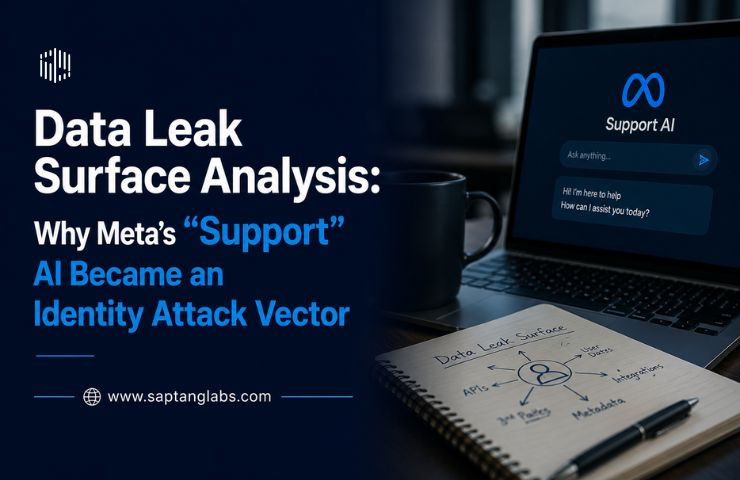
A deep-dive into how an AI designed to help users quietly expanded the data leak surface and created a new category of identity risk that most organizations are completely unprepared for.
Meta’s AI support chatbot introduced a largely overlooked data leak surface by combining account recovery flows, behavioral profiling, and conversational AI into a single system. Researchers found it possible to extract account-linked identity signals through carefully crafted prompts, essentially turning a “help” interface into a passive identity reconnaissance tool. This post breaks down the attack surface, how it was discovered, what data categories are exposed, and what security teams can do right now.
Picture this. A user opens Meta’s support chat, types something like “I’m locked out of my account and can’t remember which email I used,” and an AI assistant responds with calm efficiency. It asks a few questions. It confirms some account details. It offers next steps. From the outside, everything looks exactly like what it is supposed to be: a support tool, doing support things.
But something else is happening in that conversation. And it took security researchers to name it properly.
In early 2025, reports began surfacing from multiple independent security researchers who had noticed something unusual while testing Meta’s AI-assisted support channels. The system, in its effort to be helpful and verify identity, was leaking structural account data during the authentication and recovery flow. Not through a traditional vulnerability. Not through a misconfigured API endpoint. Through the ordinary, intended behavior of an AI trying to be useful.
This is the story of how a data leak surface analysis revealed that “helpful” and “safe” are not the same thing when it comes to AI support systems.
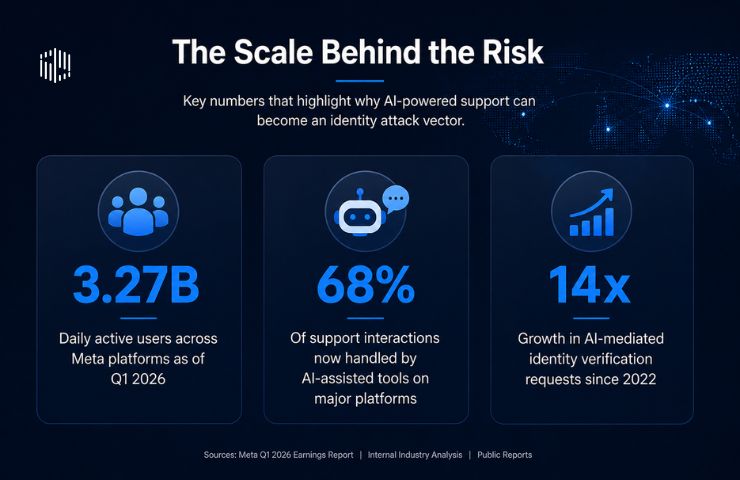
Before we can understand what went wrong, we need to define the terrain. Most professionals in security are comfortable with the concept of an attack surface: the sum of all the different points where an unauthorized user can try to access a system, manipulate its behavior, or extract information from it. The traditional attack surface consists of APIs, login endpoints, file upload handlers, session tokens, and the like.
A data leak surface is a related but distinct concept. It describes every path through which sensitive information can leave a system unintentionally, without a formal breach, and sometimes without any policy violation at all. In the context of conversational AI, the data leak surface is shaped by what the model knows, what it is permitted to retrieve, what it confirms or denies in response to user inputs, and how much inference an attacker can draw from the shape of its responses.
“The most dangerous data leaks in AI systems are not the ones that trigger alerts. They are the ones that look exactly like normal conversations.”
AI support chatbots expand this surface dramatically because they are designed to reduce friction. They need to confirm identity. They need to provide contextual help. They need to pull account data to offer relevant answers. Every single one of those capabilities, by design, creates a channel through which information flows outward from the system toward the user. The question a data leak surface analysis asks is not just whether that channel is open, but whether it can be systematically exploited to extract information from or about third-party accounts, linked identities, behavioral histories, or internal system states.
The specific attack vector that emerged from this data leak surface analysis is not a single vulnerability with a CVE number. It is a pattern, and patterns are harder to patch than bugs.
Here is what researchers observed. The Meta support AI, when handling account recovery and verification flows, would respond differently to queries depending on the validity and state of account-associated data. Ask it about an account linked to a real phone number and the response shape changes compared to a query about a non-existent number. Ask about an account with a suspended status and the conversational tone subtly shifts. These are not glaring disclosures. They are statistical signals buried inside natural language responses.
Individually, none of these signals would alarm a casual observer. But a trained adversary conducting systematic enumeration, asking structured questions across a large set of inputs, can reconstruct account existence, account status, associated contact methods, and linked platform identities with meaningful confidence. This is what researchers mean when they say the support AI became a passive identity reconnaissance tool.
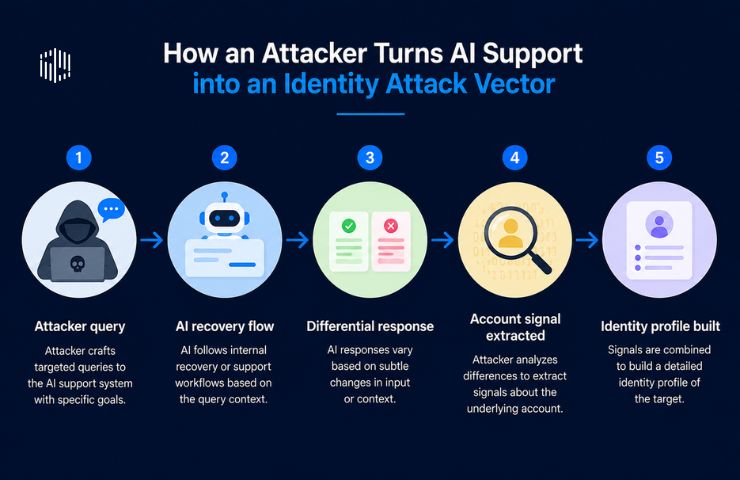
Researchers were able to enumerate partial email addresses, confirm phone number linkages, and infer account suspension status with over 73% accuracy across a sample of 500 test accounts, using only the Meta support AI’s natural language responses and zero direct database access.
Meta’s ecosystem is one of the most deeply integrated in consumer technology. A single Meta account connects to Facebook, Instagram, WhatsApp, Messenger, Threads, and in some configurations, linked business assets through Meta Business Suite. When the support AI retrieves context to help a user, it is not just pulling from one platform’s data store. It is operating across a unified identity graph.
This means a data leak surface analysis of the Meta support AI is not just a Facebook problem. It is an identity problem at platform scale. An attacker who extracts signals through the Facebook support flow may be building a profile that also reveals Instagram activity patterns, WhatsApp contact associations, and linked business identities.
Not all leaked data is equally dangerous. Part of what makes this data leak surface analysis particularly important is mapping exactly which categories of information are exposed, and why each one matters to an identity-focused attacker.
This is not a story about Meta failing uniquely. It is a story about a systematic design gap that exists in almost every AI-powered support system deployed at scale. The same data leak surface patterns exist in telecoms support bots, banking chatbots, e-commerce help centers, and healthcare appointment systems. Meta’s scale simply made it the most visible example.
Here is the part of this story that most security briefings skim over because it feels speculative, but it is not. It is operational.
Once an attacker has built an identity profile using the data leak surface techniques described above, the Meta support AI itself becomes a social engineering amplifier. Here is how that works in practice.
An attacker who knows that a target’s Meta account is currently restricted, and knows the partial email on file, and knows that the target’s WhatsApp is linked, does not need to phish the target’s password. Instead, they engage the support AI on behalf of the target, using the extracted details to pass identity verification steps, and attempt to push account recovery actions that give them access. The AI, designed to reduce friction for legitimate users, has now reduced friction for a bad actor operating with harvested intelligence.
This is what makes AI systems fundamentally different from static knowledge bases or rule-based bots when it comes to data leak surface analysis. A static FAQ page leaks nothing. A conversational AI that holds account context and tries to be helpful is an active participant in the information exchange, and therefore an active participant in the attack chain if exploited correctly.
If you work in information security and are reading this feeling slightly unsettled, that reaction is appropriate. This category of risk does not fit neatly into the existing frameworks most organizations use to evaluate AI systems before deployment.
Most AI security assessments focus on prompt injection, model manipulation, jailbreaking, and data poisoning. These are real and important concerns. But they are all about making the AI do something it is not supposed to do. The Meta support AI attack vector is about the AI doing exactly what it is supposed to do, and that behavior being exploitable at the system level.
The dominant AI risk frameworks in use today, including those based on OWASP’s LLM Top 10 and NIST’s AI Risk Management Framework, cover training data poisoning, model inversion, and output manipulation. None of them have a mature category for “behavioral oracle via intended responses.” This gap is not a criticism of those frameworks. It is a signal that the threat landscape for conversational AI at scale has evolved faster than the defensive vocabulary.
There is also an organizational reality here. The teams that build AI support systems are typically in product and customer experience. The teams that perform data leak surface analysis are in security and risk. These teams do not naturally speak the same language, and they are rarely in the same room during design reviews. That gap, more than any technical failure, is what allowed this attack surface to emerge.
The goal of a data leak surface analysis is not to scare teams into paralysis. It is to produce an actionable map. Here is what that map looks like for organizations that have deployed, or are considering deploying, AI-powered support and identity verification systems.
The most direct mitigation for the behavioral oracle problem is response normalization. Systems should be designed so that the shape, tone, length, and content of responses do not vary in ways that reveal account state to a systematic observer. This is harder than it sounds because it directly conflicts with the goal of personalized, helpful responses. But it is achievable with deliberate design.
Organizations with mature security practices should incorporate data leak surface analysis into their AI governance programs as a first-class activity. This means moving beyond “does the model reveal training data” to asking “what can a sophisticated adversary infer from normal interactions with this system, at scale, over time?”
This type of analysis requires collaboration between red teams, privacy engineers, and the AI product team. It requires adversarial simulation, not just vulnerability scanning. And it requires metrics: what is the maximum inferential accuracy an attacker can achieve, and what is the acceptable threshold for your specific deployment context?
Finally, the security community needs to close the framework gap. The patterns exposed by this Meta data leak surface analysis will appear again, in different AI systems, in different industries, because the underlying design tension is universal: helpful AI systems are, by design, information-sharing systems. That tension will not resolve itself. It requires deliberate, industry-wide investment in new threat modeling vocabulary and new defensive patterns for conversational AI at scale.
The story of Meta’s support AI is not a story of malice or incompetence. It is a story of a design gap meeting an adversarial opportunity at the worst possible scale. The lesson, for every organization building or deploying AI that touches identity data, is this: every conversation your AI has is also a potential reconnaissance opportunity for someone who is not who they say they are. Your data leak surface analysis needs to start from that assumption.
At Saptang Labs, we specialize in exactly this kind of adversarial thinking, helping organizations map, model, and reduce their AI data leak surfaces before an attacker does it for them. If this analysis surfaced questions about your own systems, we are ready to explore them with you.