
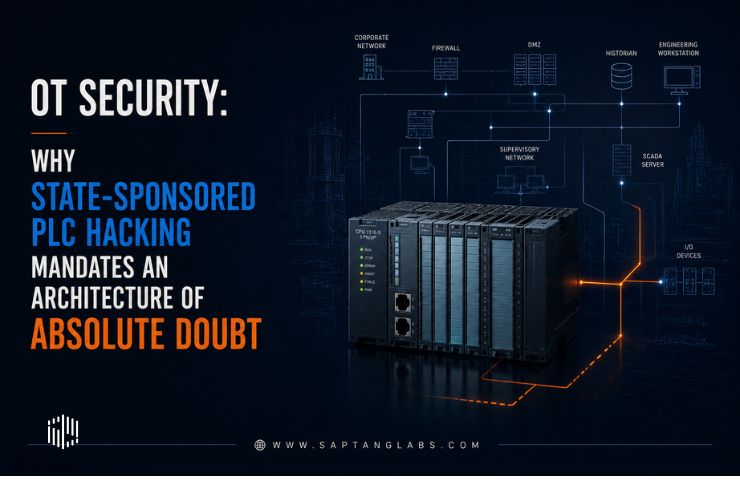
The future of OT Security will not be determined by how well organizations protect their network perimeter. It will be determined by how effectively they validate trust inside their operational environments. State-sponsored actors are increasingly targeting programmable logic controllers, industrial control systems, and operational workflows that influence physical processes. These attacks exploit trusted communications, legitimate pathways, and operational assumptions rather than obvious security weaknesses. As industrial environments become more connected, organizations must move beyond traditional trust models and adopt an Architecture of Absolute Doubt, where every command, every connection, and every operational interaction is continuously verified before trust is granted.
Industrial organizations have always operated under a unique set of priorities. Reliability comes first. Safety is non-negotiable. Availability is essential. Production interruptions carry significant consequences, and operational continuity often determines business success.
For decades, these priorities shaped the design of operational technology environments. Industrial networks were built to ensure that machinery, controllers, sensors, and production systems could communicate efficiently without unnecessary barriers. Trust was embedded into the architecture because the systems operating within those environments were assumed to be known, controlled, and isolated.
That assumption no longer reflects reality.
Modern industrial operations are connected to cloud platforms, remote maintenance systems, enterprise applications, third-party vendors, and increasingly sophisticated digital ecosystems. Every connection creates opportunity. Every integration expands capability. At the same time, every new trust relationship introduces risk.
State-sponsored adversaries have recognized this transformation. They understand that influencing operational technology can generate consequences that extend far beyond the digital environment. The compromise of a PLC is not simply an information security incident. It has the potential to affect production quality, operational reliability, public services, supply chains, and critical infrastructure.
This shift is fundamentally changing the conversation around OT Security.
The challenge is no longer protecting industrial environments from unauthorized access alone. The challenge is ensuring that trusted activity remains trustworthy.
Many industrial environments still operate on a principle that originated long before today’s threat landscape emerged. If a device exists inside the operational network, it is often assumed to be trustworthy. If communication originates from a known system, it is generally treated as legitimate. If a command comes from an authorized source, it is expected to be safe.
These assumptions were reasonable when industrial systems operated within isolated environments.
Unfortunately, modern adversaries do not attack industrial organizations the way they did twenty years ago.
State-sponsored groups rarely rely on noisy intrusion techniques or obvious disruptions. They invest time in understanding operational processes, communication patterns, engineering workflows, and trust relationships. Their objective is often persistence rather than immediate impact.
This patience changes the nature of the threat.
Rather than attacking the perimeter directly, sophisticated operators frequently focus on becoming part of the trusted environment. They seek to understand how commands move through the network, how operators interact with systems, and how industrial processes are controlled.
Once they achieve visibility, they gain something far more valuable than access.
They gain credibility.
When malicious activity can masquerade as trusted operational behavior, detection becomes significantly more difficult. This is why trust itself is becoming one of the most attractive attack surfaces in modern industrial environments.
Programmable Logic Controllers occupy a unique position within industrial operations. They are responsible for translating digital instructions into physical actions. They regulate machinery, control industrial processes, manage operational workflows, and influence critical systems that organizations depend upon every day.
This position makes them extraordinarily valuable targets.
A compromised workstation may expose sensitive information. A compromised PLC can alter physical outcomes.
The difference is profound.
Recent years have demonstrated that state-sponsored adversaries are increasingly interested in operational technology because it provides strategic leverage. The objective is not always disruption. In many cases, attackers seek intelligence, persistence, environmental understanding, or future operational positioning.
The industrial sector represents a particularly attractive target because operational environments often prioritize continuity over verification. Systems are expected to work. Communications are expected to be legitimate. Commands are expected to be trustworthy.
Adversaries understand these expectations.
Instead of breaking industrial processes, they often seek to blend into them.
This approach creates an environment where operational trust becomes a liability. Security teams may focus on identifying malicious behavior while sophisticated attackers concentrate on making malicious behavior appear legitimate.
The result is a cybersecurity challenge that traditional defensive models were never designed to address.
The modern industrial environment is dramatically different from the one that existed when many operational systems were originally deployed.
Today’s facilities depend on remote engineering access, industrial analytics platforms, cloud integrations, third-party service providers, and connected operational ecosystems. These capabilities create efficiency and visibility, but they also introduce new dependencies.
Every dependency becomes a trust relationship.
Every trust relationship creates a potential pathway.
Traditional security architectures often focus on controlling access to environments. Once access is granted, far less attention is paid to validating ongoing activity. This model works reasonably well against opportunistic threats. It struggles against adversaries who intentionally operate through trusted pathways.
Consider the reality facing many industrial organizations today.
An authorized engineering workstation may issue commands to a controller.
A maintenance platform may communicate with operational devices.
A trusted vendor may access industrial systems remotely.
All of these activities are legitimate under normal circumstances.
The problem is that sophisticated attackers increasingly seek to operate through those same trusted mechanisms.
If organizations cannot distinguish between trusted activity and trustworthy activity, they create conditions where adversaries can remain hidden for extended periods.
This distinction is becoming one of the defining challenges of modern OT Security.
Industrial organizations have spent years building architectures based on trust. The next phase of OT Security requires a different mindset.
Trust can no longer be assumed simply because a user, device, or process appears familiar.
Trust must become a continuously validated condition.
This concept can be described as an Architecture of Absolute Doubt.
The phrase may sound extreme, but the principle is straightforward.
Every command should be verifiable.
Every communication path should be observable.
Every operational interaction should be evaluated in context.
This does not mean organizations must distrust their employees, engineers, or operational systems. Instead, it means accepting a fundamental reality of modern cybersecurity.
Visibility without validation is no longer enough.
In industrial environments, the consequences of misplaced trust can be significant. A single unauthorized command, a manipulated engineering workstation, or a compromised operational process can influence outcomes far beyond the digital environment.
An Architecture of Absolute Doubt acknowledges this reality by treating trust as something that must be earned continuously rather than granted permanently.
Many organizations have invested heavily in monitoring technologies. They collect logs, inspect traffic, analyze events, and generate alerts across industrial environments.
These capabilities are valuable.
However, visibility alone does not guarantee security.
A security team may observe communications between trusted systems without understanding whether those communications remain legitimate. They may see commands being executed without knowing whether the operational context makes sense. They may monitor activity continuously while missing the subtle indicators that reveal manipulation.
This is why visibility must evolve beyond observation.
Organizations need contextual understanding.
They need to know not only what happened, but why it happened, whether it should have happened, and whether it aligns with expected operational behavior.
State-sponsored adversaries thrive in environments where visibility exists without verification.
They understand that many monitoring systems focus on detecting obvious anomalies. Sophisticated attackers often avoid obvious anomalies entirely.
Instead, they operate within expected boundaries while quietly influencing outcomes.
The organizations most prepared for future OT threats will be those capable of validating operational intent rather than merely observing operational activity.
The future of industrial cybersecurity requires a broader perspective than traditional network protection alone.
Organizations must begin by understanding their trust relationships comprehensively. They need visibility into how systems communicate, how commands flow through operational environments, and how industrial processes depend upon one another.
Equally important is the ability to identify when trusted relationships begin behaving differently than expected.
This requires stronger operational intelligence, deeper behavioral visibility, and greater understanding of industrial workflows.
Security leaders should also prioritize resilience rather than assuming prevention will always succeed. State-sponsored adversaries possess significant resources, patience, and technical expertise. The goal should not simply be preventing every intrusion. The goal should be ensuring that trust cannot be exploited without detection.
Finally, organizations must embrace the idea that OT Security is no longer solely an operational concern.
It is a business resilience issue.
The reliability of production systems, the continuity of critical services, and the integrity of industrial processes increasingly depend on cybersecurity decisions made today.
State-sponsored PLC hacking represents more than a new attack technique. It represents a challenge to the assumptions that have shaped industrial cybersecurity for decades.
The traditional belief that trusted systems will continue behaving as expected is becoming increasingly difficult to defend. Sophisticated adversaries understand how industrial environments operate. They understand the value of persistence. Most importantly, they understand the power of trust.
The future of OT Security will belong to organizations that recognize this reality early.
An Architecture of Absolute Doubt is not about fear. It is about discipline.
It is about acknowledging that trust must be validated continuously, particularly in environments where digital actions can create physical consequences.
As industrial systems become more connected and threat actors become more capable, the most important question may no longer be whether an organization can detect malicious activity.
The most important question may be whether it can prove that trusted activity deserves trust at all.
What is OT Security?
OT Security focuses on protecting operational technology systems, industrial control systems, PLCs, SCADA environments, and critical infrastructure from cyber threats that could affect physical operations.
Why are PLCs targeted by state-sponsored attackers?
PLCs directly control industrial processes. Compromising them can influence production systems, utilities, manufacturing operations, and critical infrastructure.
What is an Architecture of Absolute Doubt?
It is a security approach where trust is continuously validated rather than assumed. Every user, device, communication path, and operational interaction is verified before being trusted.
Why are traditional industrial trust models becoming risky?
Modern industrial environments are highly connected. Remote access, cloud integrations, third-party services, and digital transformation initiatives have expanded trust relationships significantly.
How can organizations improve OT Security?
Organizations can improve visibility, strengthen verification processes, monitor operational behavior continuously, validate trust relationships, and build resilience into industrial operations rather than relying solely on perimeter defenses.
You may also find this helpful insight: Persistent Botnet Infrastructure: Validating Containment Against Extreme Scale