
Botnets are no longer limited to simple distributed denial-of-service campaigns. Modern botnet ecosystems operate as resilient, adaptive, and globally distributed infrastructures capable of supporting cybercrime, espionage, fraud, credential theft, ransomware delivery, and large-scale disruption. The challenge for modern enterprises is no longer simply detecting botnet activity. The real challenge is validating whether containment strategies can withstand extreme scale. Persistent Botnet Infrastructure represents one of the most significant threats to enterprise resilience because attackers continuously evolve command structures, communication channels, and persistence mechanisms faster than many traditional defense models can adapt.
Cybersecurity leaders often measure success through prevention. They focus on blocking malware, reducing vulnerabilities, strengthening authentication, and limiting exposure across critical systems. These priorities remain essential. However, modern threat actors increasingly operate within an entirely different framework. Rather than launching isolated attacks, they build infrastructure.
This infrastructure is persistent, resilient, and designed for longevity.
Botnets have evolved from collections of infected devices into sophisticated operational ecosystems capable of maintaining influence across cloud environments, enterprise networks, consumer devices, industrial systems, and globally distributed infrastructure. They no longer represent temporary threats that disappear after a single campaign. Instead, they function as durable operational assets that can be reused, expanded, and repurposed continuously.
This shift creates a difficult question for security leaders.
Can an organization truly claim containment if the underlying botnet infrastructure remains operational elsewhere and can rapidly regenerate?
The answer increasingly determines whether enterprises can withstand modern cyber operations at scale.
Most organizations think about botnets only when they generate visible disruption.
A denial-of-service attack occurs. Network traffic spikes unexpectedly. Systems become unavailable. Security teams investigate and mitigate the immediate impact.
However, the visible attack often represents only a small portion of the overall threat.
Behind every large-scale operation sits an infrastructure designed to survive defensive actions. Attackers invest heavily in persistence because infrastructure continuity enables future campaigns. The longer a botnet survives, the greater its value.
Modern botnet ecosystems support:
This versatility makes Persistent Botnet Infrastructure a strategic threat rather than a tactical one.
Organizations must therefore shift their focus from event response toward infrastructure resilience analysis.
The earliest botnets relied on relatively simple command-and-control architectures.
A central server issued instructions. Infected devices received commands. Operations depended heavily on maintaining communication with a limited number of control points.
This model created weaknesses.
Security teams could identify command servers, disrupt communications, and significantly reduce operational capability.
Modern botnets evolved in response.
Today’s botnet operators employ:
These techniques increase resilience dramatically.
Rather than depending on a single point of failure, modern botnets distribute operational control across multiple environments. This makes containment substantially more difficult.
The challenge is no longer finding a single command server.
The challenge is understanding an ecosystem designed to survive disruption.
Scale is the defining characteristic of Persistent Botnet Infrastructure.
A small botnet may involve hundreds or thousands of compromised systems. Modern botnet ecosystems can leverage millions of devices distributed across multiple countries, networks, and technology platforms.
This creates several operational advantages for attackers.
First, scale increases redundancy.
Even if a portion of the infrastructure is disrupted, the remaining systems continue functioning.
Second, scale complicates attribution.
The larger the network, the more difficult it becomes to identify controlling entities and operational relationships.
Third, scale creates operational endurance.
Attackers can absorb takedowns, replace infrastructure, and continue campaigns with minimal interruption.
This is why extreme scale fundamentally changes containment requirements.
Organizations must evaluate not only whether they stopped an attack but whether they reduced the adversary’s ability to regenerate operations.
One of the most dangerous misconceptions in cybersecurity is the belief that immediate disruption equals long-term containment.
Consider a common scenario.
A security team identifies malicious traffic originating from a known botnet. The relevant indicators are blocked. Network defenses are updated. Operations return to normal.
From an operational perspective, the incident appears resolved.
However, the broader infrastructure may remain fully operational.
The botnet can continue:
This creates what can be described as the containment illusion.
Organizations may successfully block symptoms while the underlying infrastructure remains largely untouched.
True containment requires understanding persistence mechanisms rather than focusing exclusively on visible activity.
Persistent Botnet Infrastructure survives because it is intentionally engineered for resilience.
Several architectural characteristics contribute to this durability.
Distributed Command Models
Instead of relying on centralized control, modern botnets distribute decision-making across multiple nodes.
Dynamic Infrastructure Rotation
Domains, IP addresses, and communication channels change continuously.
Multi-Layer Redundancy
Backup systems ensure operational continuity even after partial disruption.
Cloud Resource Abuse
Legitimate cloud environments may be leveraged temporarily for operational purposes.
Decentralized Recovery Paths
Compromised devices can reconnect through multiple communication routes if primary channels are disrupted.
These capabilities create infrastructures capable of surviving significant defensive pressure.
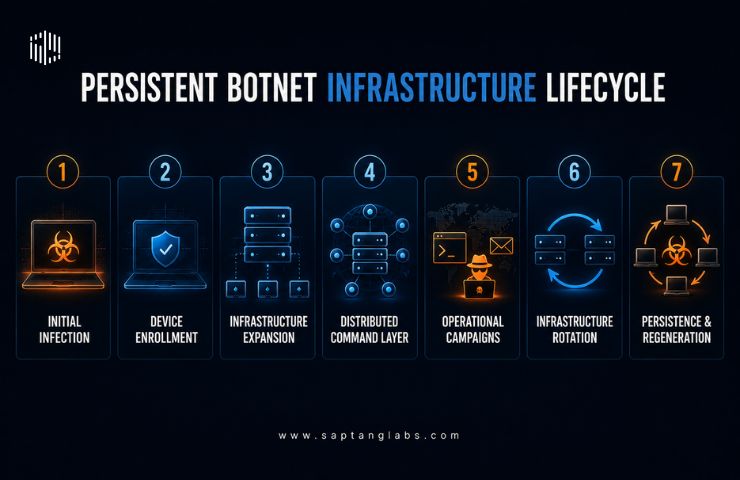
This cycle demonstrates why botnet operations often remain active long after individual campaigns conclude.
Why Traditional Detection Models Struggle
Traditional security monitoring was largely designed for discrete events.
Alerts are generated when unusual behavior occurs. Analysts investigate. Remediation follows.
Persistent Botnet Infrastructure behaves differently.
The threat often unfolds gradually.
Indicators may appear insignificant individually. Communication patterns may resemble legitimate traffic. Infrastructure components may change continuously.
This creates visibility challenges.
Security teams often focus on:
While valuable, these controls may not provide sufficient visibility into infrastructure-level persistence.
Botnet operators understand this limitation.
Their goal is often not immediate impact but long-term operational survival.
That objective requires patience, adaptability, and infrastructure discipline.
Effective containment depends on context.
Organizations cannot disrupt what they do not understand.
Threat intelligence provides visibility into:
This broader perspective enables defenders to identify patterns that individual alerts may never reveal.
Threat intelligence transforms containment from reactive response into strategic disruption.
Rather than chasing indicators, organizations begin understanding ecosystems.
That distinction is critical.
Many organizations struggle to evaluate whether containment efforts are truly successful.
Traditional metrics often focus on:
These measurements provide value, but they rarely answer the most important question.
Has the adversary lost operational capability?
More meaningful containment metrics include:
Infrastructure Disruption Duration
How long did the disruption affect adversary operations?
Regeneration Speed
How quickly did the infrastructure recover?
Visibility Coverage
How much of the ecosystem is observable?
Communication Suppression
Were command channels disrupted effectively?
Operational Degradation
Did the attacker’s ability to execute campaigns decline measurably?
These metrics focus on strategic outcomes rather than tactical actions.
Detection remains important.
However, Persistent Botnet Infrastructure requires a broader mindset.
Security leaders must increasingly focus on:
The objective is not simply identifying threats.
The objective is reducing the attacker’s ability to sustain operations over time.
This requires continuous intelligence, infrastructure awareness, and proactive monitoring.
Containment becomes an ongoing process rather than a one-time event.
Botnet ecosystems continue evolving rapidly.
Future infrastructures will likely incorporate:
These capabilities will further increase resilience.
As botnets become more autonomous, defenders must improve visibility across distributed environments and focus increasingly on operational intelligence rather than isolated indicators.
The future challenge will not be identifying malicious activity.
It will be understanding how infrastructure survives after disruption.
Persistent Botnet Infrastructure represents one of the most significant operational challenges in modern cybersecurity. The threat extends far beyond individual attacks because the underlying infrastructure is designed for survival, adaptation, and long-term use.
Organizations that focus only on immediate indicators may achieve temporary relief while leaving the broader ecosystem untouched. True containment requires visibility into infrastructure relationships, communication pathways, persistence mechanisms, and regeneration capabilities.
As botnets continue evolving toward greater scale and resilience, security leaders must rethink what containment actually means. The goal is no longer simply stopping an attack. The goal is reducing the adversary’s ability to sustain operations across time.
In an era of extreme scale, containment is not measured by what was blocked today.
It is measured by whether the infrastructure can return tomorrow.
What is Persistent Botnet Infrastructure?
Persistent Botnet Infrastructure refers to long-lived, resilient networks of compromised systems designed to support cyber operations across extended periods.
Why are modern botnets difficult to contain?
Modern botnets use distributed architectures, dynamic communication channels, redundancy, and infrastructure rotation to survive defensive actions.
How does botnet scale affect cybersecurity risk?
Large-scale botnets provide attackers with redundancy, resilience, and operational endurance, making disruption significantly more difficult.
What is the difference between disruption and containment?
Disruption temporarily interrupts operations. Containment reduces the adversary’s ability to regenerate and sustain future activity.
How can organizations improve botnet containment?
Organizations should combine threat intelligence, infrastructure visibility, continuous monitoring, and ecosystem-level analysis to identify persistence mechanisms and reduce operational resilience.
You may also find this helpful insight: Understanding Persistent Token Compromise: The Invisible Threat to Session Security