
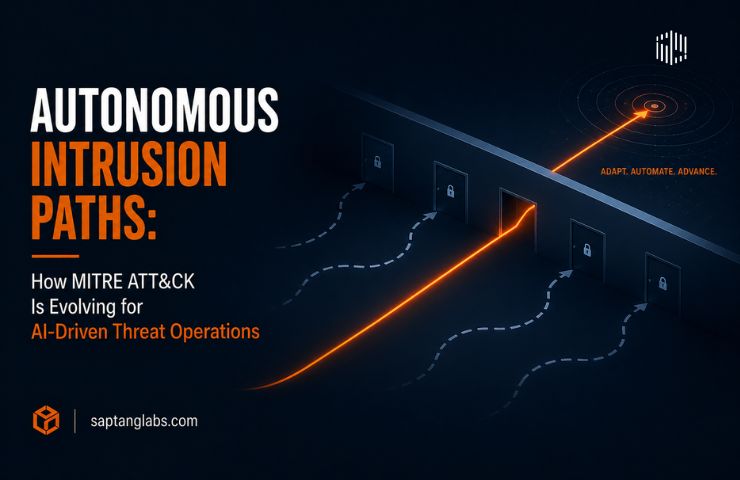
Modern cyber attacks are becoming faster, more adaptive, and increasingly autonomous. Attackers are no longer relying only on isolated malware deployment or traditional perimeter exploitation. Instead, they are chaining identities, cloud sessions, APIs, runtime workflows, and trusted operational behaviors into dynamic intrusion paths that evolve continuously during active attacks. This shift is forcing enterprises to rethink how they use frameworks like MITRE ATT&CK because modern AI-driven threat operations now operate with machine-speed adaptability across enterprise environments. Autonomous Intrusion Paths are rapidly becoming one of the most important cybersecurity challenges facing modern organizations.
Introduction
Enterprise cybersecurity is entering a new operational era. For years, most security models focused heavily on preventing unauthorized access, detecting malware, and responding to visible indicators of compromise after attacks had already begun. While those capabilities remain important, modern threat operations are evolving far beyond traditional intrusion models.
Today’s attackers increasingly rely on autonomous workflows, identity abuse, runtime adaptation, cloud session exploitation, and AI-assisted operational decision-making to move dynamically across enterprise environments. These attacks rarely follow predictable sequences anymore. Instead, they evolve continuously during execution while adapting to available access paths, operational visibility gaps, and trusted workflows already operating inside enterprise systems. This growing shift is creating a new cybersecurity challenge called Autonomous Intrusion Paths, where AI-driven threat operations reshape how organizations must think about attack progression, runtime exposure, and operational trust.
The MITRE ATT&CK framework remains one of the most important resources for understanding adversary behavior across modern cyber operations. It provides structured visibility into tactics, techniques, and operational behaviors used by threat actors throughout the attack lifecycle.
For many years, organizations relied on MITRE ATT&CK primarily as:
These use cases remain extremely valuable. However, the operational environment surrounding ATT&CK is evolving rapidly because attackers themselves are evolving.
Modern intrusions no longer behave like static attack chains.
Instead, attackers increasingly adapt dynamically while moving across cloud infrastructure, communication systems, APIs, runtime workflows, and identity environments in real time. AI-assisted operations now allow threat actors to analyze environments faster, identify attack opportunities dynamically, and adjust intrusion paths continuously during execution.
This changes how organizations must interpret MITRE ATT&CK itself.
The framework is no longer only about understanding isolated techniques.
It is increasingly about understanding how techniques combine into autonomous operational ecosystems.
Autonomous Intrusion Paths refer to dynamic attack sequences capable of adapting continuously across enterprise environments through automated decision-making, runtime intelligence, and AI-assisted operational workflows.
Traditional attack chains often followed relatively structured progression models:
Modern intrusion paths behave differently.
AI-assisted threat operations now allow attackers to:
This creates highly fluid attack environments.
Instead of following fixed sequences, autonomous intrusion paths evolve based on:
This operational flexibility creates a major challenge for traditional detection models.
One of the most important trends visible across MITRE ATT&CK mappings today is the growing dominance of identity-centric attacks.
Modern attackers increasingly prefer:
over noisy infrastructure compromise.
This shift matters because identities already operate inside trusted enterprise boundaries.
An attacker using legitimate sessions often appears operationally normal from a traditional security perspective. That allows intrusion paths to remain quieter, more persistent, and harder to detect.
AI-driven operations amplify this problem significantly.
Autonomous systems can now analyze:
at machine speed.
This allows attackers to build intrusion strategies dynamically while adapting continuously to operational conditions inside enterprise environments.
That is why modern cyber intrusions increasingly revolve around identity orchestration rather than direct perimeter breach alone.
Enterprise environments have become deeply interconnected.
Modern organizations now operate across:
This operational complexity expands runtime exposure dramatically.
Attackers no longer need to compromise isolated infrastructure directly if they can abuse trusted runtime relationships already operating inside the environment.
For example, a single compromised identity may provide:
AI-assisted threat operations can then chain these opportunities together automatically while searching for lower-resistance intrusion paths dynamically.
This creates intrusion ecosystems far more adaptive than traditional attack chains.
Many enterprise detection systems were designed around identifying:
These controls remain essential. However, Autonomous Intrusion Paths increasingly operate inside trusted operational behavior rather than outside it.
This creates major visibility challenges.
For example:
AI-driven threat operations also evolve much faster than traditional defensive response cycles.
An attacker no longer needs to follow predictable operational patterns if autonomous tooling continuously adjusts attack progression dynamically based on environmental feedback.
This is one reason many organizations now struggle to identify intrusions until attackers have already achieved persistence across multiple systems.
One of the most significant shifts in modern cybersecurity is operational speed.
Historically, cyber attacks required:
AI-assisted operations now reduce much of that friction.
Modern threat ecosystems increasingly rely on:
This accelerates intrusion progression dramatically.
A threat actor no longer needs extended timelines to evaluate environments manually. Autonomous systems can identify relationships, trust dependencies, exposed workflows, and lateral movement opportunities continuously at machine speed.
This creates serious pressure on defenders.
Human-only detection workflows may struggle significantly against intrusion paths capable of adapting faster than analysts can investigate operational anomalies.
MITRE ATT&CK itself remains highly relevant. However, how organizations use the framework must evolve.
Historically, ATT&CK mapping focused heavily on:
Modern AI-driven operations require much deeper contextual analysis.
Organizations increasingly need visibility into:
This means ATT&CK is becoming less about individual techniques alone and more about operational interaction between techniques inside autonomous environments.
The future challenge is not simply detecting isolated ATT&CK behaviors.
It is understanding how autonomous systems combine those behaviors dynamically across enterprise infrastructure.
Organizations cannot defend effectively against Autonomous Intrusion Paths without continuous runtime visibility.
Traditional security telemetry often focuses heavily on infrastructure events while missing operational context surrounding:
This creates dangerous blind spots.
Runtime intelligence allows organizations to observe:
The objective is no longer simply identifying known threats.
The larger goal is understanding how intrusion paths evolve dynamically during active runtime execution.
This is becoming one of the most important priorities in modern enterprise cybersecurity.
Autonomous Intrusion Paths create much larger business implications than traditional cyber attacks.
As attack progression becomes:
organizations face:
This directly affects:
Boards are beginning to recognize that cyber threats are no longer evolving at purely human speed.
That changes how enterprise risk itself must be evaluated.
Modern CISOs can no longer rely exclusively on:
Autonomous Intrusion Paths require:
This represents a major strategic shift.
The focus is no longer only preventing intrusion.
The larger challenge is identifying how intrusion paths evolve dynamically across interconnected enterprise systems before attackers establish operational persistence successfully.
That distinction is becoming critically important in AI-driven threat environments.
The future of enterprise cybersecurity will increasingly revolve around:
As AI-driven threat operations mature, organizations capable of understanding dynamic intrusion behavior operationally will be significantly better prepared than those relying solely on static security models.
The cybersecurity industry is therefore moving toward environments where:
This evolution is reshaping enterprise cyber strategy fundamentally.
Autonomous Intrusion Paths are rapidly becoming one of the defining cybersecurity challenges of the AI era.
Modern attackers increasingly combine identities, runtime workflows, cloud exposure, API trust relationships, and adaptive operational behavior into dynamic intrusion ecosystems capable of evolving continuously during active attacks. This shift is forcing enterprises to rethink how frameworks like MITRE ATT&CK are interpreted and operationalized across modern environments.
Traditional detection models built around static attack assumptions are struggling against machine-speed threat operations capable of adapting faster than human-led workflows can respond consistently.
This changes the future of cybersecurity significantly.
Organizations now require deeper runtime visibility, identity intelligence, attack path analysis, and operational trust monitoring capable of identifying adaptive intrusion behavior before persistence expands across enterprise systems.
Because the future challenge is no longer only stopping attackers from entering environments.
It is understanding how autonomous intrusion paths evolve after they are already inside.
What are Autonomous Intrusion Paths?
Autonomous Intrusion Paths are adaptive attack sequences that evolve dynamically through AI-assisted operational behavior, runtime intelligence, and automated decision-making.
How is MITRE ATT&CK evolving for AI-driven threats?
Organizations increasingly use MITRE ATT&CK to understand how multiple techniques interact dynamically across runtime environments instead of viewing techniques in isolation.
Why are identity attacks becoming more important?
Modern attackers increasingly abuse trusted identities, sessions, and authentication workflows because these methods create quieter and more persistent intrusion paths.
Why are traditional detection systems struggling?
Traditional models often focus on static attack indicators, while autonomous threat operations adapt continuously during runtime execution.
How can organizations defend against Autonomous Intrusion Paths?
Organizations can improve runtime visibility, strengthen identity intelligence, monitor operational trust relationships, reduce exposure, and adopt adaptive threat detection strategies.