TL;DR
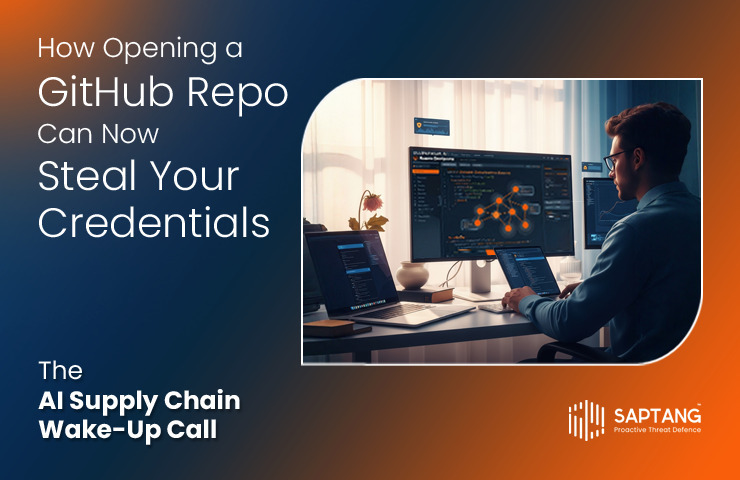
Security researchers discovered critical vulnerabilities in AI coding assistants that allow attackers to steal API keys and execute malicious code simply by getting developers to clone GitHub repositories. The attack works before any warning prompt appears, turning routine development activities into credential theft operations.
The bottom line: Configuration files developers trusted as passive data now control active execution. With 80% of Fortune 500 companies using AI coding tools and 47% having no security controls on these platforms, stolen API keys are already circulating in dark web marketplaces. Your development team’s credentials may be compromised right now.
A senior developer at a financial services company received a Slack message from a colleague. They had found an interesting open-source project on GitHub that could solve a problem the team was wrestling with. The message included a link. Clone it and take a look, the colleague suggested.
The developer clicked the link, copied the repository URL, and ran git clone in their terminal. Standard practice. Something developers do dozens of times daily. The repository downloaded. The developer opened it in their AI coding assistant to explore the code.
Within milliseconds, before any code review, before any warning prompt, a configuration file executed. The developer’s API key for the AI service was extracted and transmitted to a server controlled by attackers. The entire development team’s shared workspace, accessible through that API key, was now compromised.
This scenario, disclosed this week by security researchers, represents a fundamental shift in supply chain security. The tools developers use to write secure code have become attack vectors themselves. And the threat is already active.
AI coding assistants changed how developers work. They analyze codebases, suggest improvements, and generate solutions to complex problems. To function effectively, these tools need configuration files that specify preferences, project settings, and integration details.
Developers naturally assumed these configuration files were passive data, like text files or JSON settings. The recent vulnerability disclosure proves this assumption catastrophically wrong. Configuration files now control what code executes, when it runs, and what access it has.
Attackers discovered they could embed malicious hooks and server configurations in files that AI coding tools automatically process. When a developer clones a repository containing these weaponized configurations and opens it in their AI assistant, the malicious code executes immediately.
What gets compromised:
The vulnerability bypasses trust prompts entirely. By the time any warning appears, the credential theft has already occurred.
Organizations invested billions in securing their software supply chains. They scan dependencies, verify signatures, and audit open-source components. Security teams established rigorous processes for vetting third-party libraries. Code review workflows catch suspicious commits. Automated tools flag known vulnerabilities before they reach production.
Yet most have no visibility into the AI tools developers use daily. These platforms access the same codebases, credentials, and intellectual property that traditional security controls protect. But because AI assistants are productivity tools rather than dependencies, they bypass established security processes entirely.
Recent research shows 80% of Fortune 500 companies use AI coding assistants. Among these organizations, 47% have no security controls on their AI platforms. Another 29% of employees use unsanctioned AI agents that security teams do not even know exist. Each represents an unmonitored pathway to sensitive data.
The Indian IT sector faces particular exposure. With massive developer populations, widespread GitHub usage, and extensive contractor networks, a single compromised repository can cascade across hundreds of organizations. Indian software companies building products for global clients must now consider AI tools as supply chain attack vectors requiring the same scrutiny as any third-party dependency.
The gap creates multiple exposure points:
Traditional security tools provide no defense. Firewalls cannot inspect AI service traffic. Endpoint protection sees legitimate developer tools, not malicious configuration files. The compromise happens entirely within trusted processes.
When attackers steal API keys through these vulnerabilities, the credentials enter an underground economy with well-established distribution channels. This is not random chaos but an organized marketplace with buyers, sellers, validators, and specialized services.
Within hours, stolen keys appear on dark web marketplaces and encrypted Telegram channels. Automated systems test them to verify which remain active and what access they provide. Keys that offer access to enterprise codebases or sensitive data command premium prices. A single API key providing access to a Fortune 500 company’s development environment can sell for thousands of dollars.
The credentials then get weaponized for multiple purposes. Attackers use AI service access to analyze proprietary code for vulnerabilities. They extract intellectual property and trade secrets buried in comments and documentation. They identify additional credentials and secrets embedded in source code. Each stolen API key becomes a gateway to broader compromise.
The timeline between theft and exploitation is compressing. Where credential-based attacks once took weeks to materialize, attackers now move within days or even hours. Automated tools scan stolen credentials continuously, testing them against multiple services and platforms. The window for defensive action shrinks with each passing month.
Organizations typically discover the breach weeks or months later, only after attackers have fully exploited the access. By then, source code has been copied, vulnerabilities have been catalogued, and additional credentials have been harvested. The initial API key theft was just the beginning of a comprehensive intelligence-gathering operation.
Protecting against AI supply chain attacks requires rethinking security assumptions about development tools. Traditional controls remain necessary but insufficient. Organizations need layered defenses specifically designed for this threat model.
These measures do not eliminate risk but significantly reduce the window attackers have to exploit stolen credentials. Combined with external threat monitoring, they transform reactive incident response into proactive threat prevention.
Q1: Has this vulnerability been fixed?
The specific vulnerabilities disclosed this week were patched in December 2025. However, the fundamental security model remains problematic. Configuration files in AI tools have execution capabilities that create ongoing risk. Organizations should assume similar vulnerabilities exist in other AI development platforms.
Q2: How do I know if my organization’s API keys were stolen?
Without external threat monitoring, you likely will not know until attackers use the keys for visible attacks. Dark web monitoring services can alert you when your API keys appear in underground marketplaces or credential dumps, allowing you to rotate them before exploitation.
Q3: Should we stop using AI coding assistants?
No. AI coding tools provide significant productivity benefits. The solution is implementing proper security controls including API key rotation policies, external monitoring for credential exposure, repository vetting processes, and limiting what sensitive data AI tools can access.
Q4: Are other AI development tools vulnerable?
This disclosure focused on specific tools, but the attack pattern applies broadly. Any AI assistant that processes configuration files from repositories creates similar risk. Organizations should audit all AI development tools for comparable vulnerabilities.
Q5: How quickly do stolen API keys get weaponized?
Attackers test stolen keys within hours of obtaining them. Active keys that provide valuable access are sold or exploited immediately. Organizations have very narrow windows to detect and rotate compromised credentials before damage occurs.
How Saptang Labs Protects Against AI Supply Chain Attacks
The vulnerabilities disclosed this week highlight why external threat monitoring is essential. Internal security tools cannot detect when your API keys appear on dark web marketplaces or when attackers discuss targeting your organization.
Saptang Labs provides the external visibility enterprises need:
Discover if your development team’s credentials are already compromised. Contact Saptang Labs for an assessment of your external threat exposure.
Visit saptanglabs.com or email sales@saptanglabs.com to protect your AI supply chain today.
You may also find this helpful insight: 25 Million Victims, 84 Days Invisible: The Conduent Breach Nobody Saw Coming