TL;DR:
In a world where digital threats evolve at orbital velocity, enterprise leadership often operates with critical blind spots, relying on reactive measures that mirror flying a spacecraft through a debris field without a real-time map.
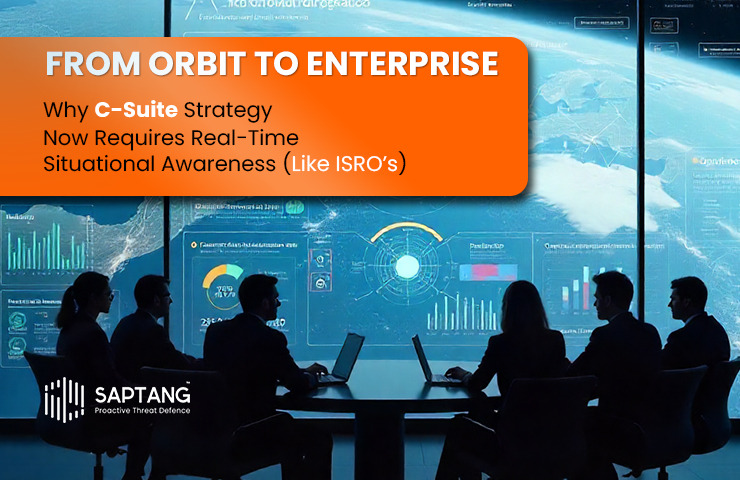
Just as ISRO’s Space Situational Awareness (SSA) system, Project NETRA, proactively tracks and evades space debris to protect multi-billion-dollar assets, today’s C-suite requires an equivalent Corporate Real-Time Situational Awareness (C-RTSA) framework. This framework, powered by proactive threat intelligence, is essential not merely for defense, but for translating complex risks into financially contextualized insights that drive strategic growth and ensure business continuity in an increasingly volatile digital landscape.
Imagine, for a moment, the silence of space. Billions of dollars of national assets; cutting-edge communication satellites, Earth observation platforms, and propulsion modules critical for lunar missions like Chandrayaan-3; hurtling through the vacuum.
Now, picture a fragment of defunct satellite, perhaps no larger than your fist, silently moving at 27,000 km/h. This seemingly innocuous piece of “space debris,” if it collides with an active satellite, can instantly create thousands more fragments, triggering a catastrophic cascade known as the Kessler Syndrome. The financial loss would be monumental, the strategic setback severe. In this environment, tolerance for the unknown is zero.
This isn’t science fiction; it’s the daily reality that institutions like the Indian Space Research Organisation (ISRO) meticulously manage. Their answer? Project NETRA (Network for space object TRacking and Analysis), spearheaded by the IS4OM (ISRO System for Safe & Sustainable Space Operations Management) Centre.
This isn’t a reactive clean-up crew; it’s a Proactive Defense System. NETRA is designed to continuously track, catalogue, predict trajectories, and, critically, issue Collision Avoidance Maneuvers (CAMs) for ISRO’s high-value assets.
The core insight from ISRO’s multi-billion-dollar investment is profound: A known threat, no matter how small or fast, can be mitigated. The true failure isn’t the debris itself, but the lack of accurate, real-time Space Situational Awareness (SSA).
Now, draw a direct parallel. Your corporate digital environment is no less cluttered, no less dangerous, and arguably, far more dynamic than Low Earth Orbit.
This is where the Trust Gap re-emerges. While ISRO invests in an always-on, predictive SSA system like NETRA, many C-suites, according to our earlier discussed statistics, are still operating with a significant blind spot. They rely on periodic compliance reports, annual penetration tests, or fragmented security tools; the equivalent of ISRO waiting for NASA’s NORAD to retroactively inform them about a near-miss, rather than having their own real-time, predictive capability. This reactive posture is not just slow; it’s exponentially expensive and strategically paralyzing.
The central question for every CEO, CISO, and executive today must shift: If ISRO demands Real-Time Situational Awareness to protect its multi-billion dollar satellites from literal debris, what equivalent, proactive Corporate Real-Time Situational Awareness (C-RTSA) are you deploying to safeguard your digital enterprise from highly sophisticated, financially devastating cyber threats?
III. Research & Data: The Failure of Fragmented Corporate Defenses
The “why” of this critical gap is rooted in the inherent limitations of traditional security models, which parallel the absence of a unified SSA system.
Consider these stark contrasts:
This discrepancy isn’t due to a lack of security tools; it’s due to the fragmentation trap. An organization might deploy a dozen best-of-breed security solutions (EDR, Firewalls, SIEM, DLP, Cloud Security Posture Management, GRC platforms), each generating its own alerts and reports. These siloed tools are like individual, powerful telescopes pointed in different directions, without a central command center to correlate the data, interpret the patterns, and issue coordinated “collision avoidance maneuvers.” This leads to:
This fragmented security stack is the antithesis of Project NETRA’s unified, predictive system. It fails to provide the true Corporate Real-Time Situational Awareness the C-suite desperately needs.
At Saptanglabs, we understand that effective risk management in the digital age requires a paradigm shift. Our Proactive Threat Intelligence (PTI) framework is engineered to function as your enterprise’s Corporate SSA Control Centre, providing the visibility, prediction, and maneuver capability that defines true strategic advantage.
Just as NETRA tracks tiny fragments of orbital debris, we relentlessly monitor the global digital environment for signs of impending threats:
This continuous, real-time intelligence gathering allows us to identify “digital debris” long before it enters your network’s direct trajectory.
Unlike reactive systems that merely log events, our platform utilizes advanced AI/ML to fuse global threat intelligence with your internal security posture data. We don’t just tell you what threats exist; we predict which threats are most likely to target your specific assets and how they might impact your business operations. This is akin to NETRA predicting the exact point of potential collision and the likely orbital debris trajectory.
The ultimate goal of Corporate SSA is to translate complex technical risks into clear, actionable financial terms. We equip the C-suite with the “financial radar” necessary to make informed, strategic decisions.
Instead of reporting “High Severity Vulnerability X,” our C-RTSA dashboard would present: “Vulnerability X poses a High Probable Impact resulting in an estimated $5 million revenue loss due to system downtime, a $1.5 million regulatory fine risk, and 30 days of brand reputational damage if exploited. Recommended Collision Avoidance Maneuver: Deploy Patch Y within 24 hours and isolate Asset Z.“
This transforms security from a technical expenditure into a strategic investment with a quantifiable ROI. It allows you to confidently answer the “why” for every security spend by demonstrating its direct impact on EBITDA and shareholder value.
The lesson from ISRO is unequivocal: operating in any high-stakes, high-velocity environment without real-time, proactive situational awareness is an invitation to disaster. Your enterprise, with its multi-billion-dollar digital assets, innovative IP, and critical customer data, is your most valuable satellite. Allowing it to drift through a digital debris field without a comprehensive Corporate Real-Time Situational Awareness system is a risk no prudent C-suite can afford.
The choice is clear: continue to be part of the 60% of organizations reacting to unseen threats or embrace the proactive intelligence that propels the successful 40%. Saptanglabs offers not just a defense mechanism, but a strategic advantage—an always-on, predictive radar that ensures your business maneuvers confidently through any digital storm, protecting your revenue and accelerating your growth.
Q: What is “Real-Time Situational Awareness” in a corporate context?
A: Corporate Real-Time Situational Awareness (C-RTSA) is the continuous process of perceiving current threats, comprehending their potential impact on your business (financially and operationally), and projecting future risks to enable proactive decision-making. It integrates global threat intelligence with your internal security posture to provide a unified, actionable view.
Q: How does this differ from my existing Security Information and Event Management (SIEM) system?
A: While SIEMs collect logs and alerts, C-RTSA goes further. It layers predictive intelligence and risk quantification over that data, translating raw technical events into business-contextualized insights. It answers, “what does this mean for my revenue?” rather than just “what happened?”
Q: Can proactive threat intelligence truly prevent zero-day attacks?
A: While no system can guarantee 100% prevention of every zero-day, proactive threat intelligence significantly reduces your exposure and impact. By tracking threat actor methodologies, TTPs, and potential vulnerabilities before they are publicly known or exploited, you can implement stronger compensating controls, harden likely targets, and minimize the window of opportunity for an attack.
Q: How quickly can an organization implement a C-RTSA framework?
A: The implementation timeline varies based on an organization’s existing infrastructure and maturity. However, with a focused approach on integrating key data sources and leveraging Saptanglabs’ platform, significant improvements in risk visibility and proactive posture can be achieved within weeks to a few months, not years.
Elevate Your Strategic Defense.
Don’t let your enterprise drift through the digital debris field unchecked. It’s time to equip your C-suite with the same level of Real-Time Situational Awareness that safeguards multi-billion-dollar missions in space.
Schedule a Proactive Risk Intelligence Briefing with Saptanglabs today. Discover how we can provide your Corporate SSA Control Centre, quantify your cyber risk in monetary terms, and secure your strategic advantage. Threat Intelligence, Enterprise Risk Management, ISRO, Risk Quantification, Corporate SSA, CISO.
You may also find this helpful: GenAI in the Hands of Criminals: How Autonomous Attacks Will Challenge Every Enterprise by 2026