Introduction: The Illusion of Safety
Brand monitoring has quietly become one of the most misunderstood investments in digital risk management. On paper, it sounds responsible. Dashboards show alerts, charts show activity, and weekly reports show that threats are being “tracked.” To leadership teams, this visibility often feels like control.
In reality, many brands are only watching damage happen.
Every day, impersonation accounts mislead customers, scam ads run under trusted brand names, fake apps collect credentials, and cloned websites harvest payments. Monitoring tools detect these threats, log them, and notify teams. But in many cases, nothing is removed quickly, if at all. The harm continues while organizations reassure themselves that the issue is “being monitored.”
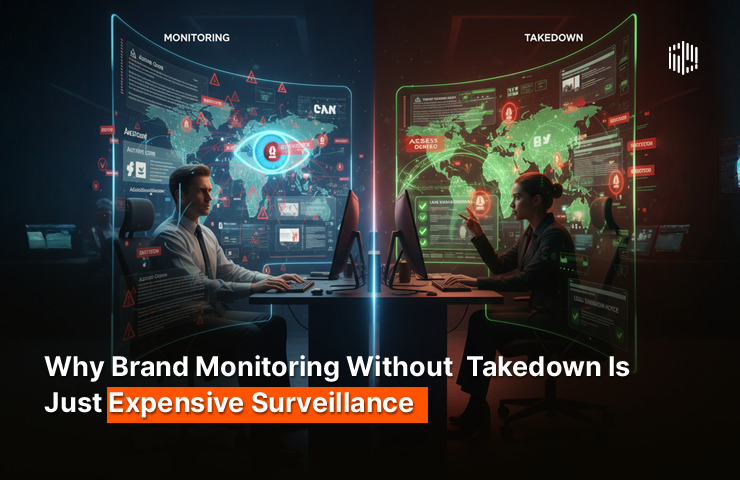
This gap between seeing and stopping is where brand monitoring quietly turns into expensive surveillance. Visibility without intervention does not reduce risk. It only documents it.
Modern brand monitoring solutions are designed primarily for detection. They scan vast parts of the internet to identify where a brand name, logo, or likeness appears without authorization. This includes social platforms, search ads, marketplaces, app stores, websites, and sometimes closed forums.
From a technical standpoint, these tools are impressive. They use pattern recognition, image matching, keyword analysis, and automation to surface misuse that would otherwise go unnoticed. For large brands with global presence, this capability is necessary. The scale of the internet makes manual discovery impossible.
However, detection is only one phase of protection. Monitoring answers the question, “Where is our brand being misused?” It does not answer the more important question, “How fast can we stop the damage?”
In most deployments, brand monitoring stops at reporting. Alerts are sent, incidents are categorized, and dashboards are updated. The tool’s job ends where real risk begins.
The most dangerous weakness in brand monitoring programs is the delay between identifying a threat and taking action against it. This delay is not accidental. It is structural.
Once an alert is generated, it typically passes through multiple layers. A brand or marketing team reviews it. Legal teams are consulted to assess legitimacy. Platform-specific reporting rules are examined. Someone manually submits a takedown request. Each step introduces friction, uncertainty, and time.
Threat actors operate very differently. They rely on speed, volume, and disposability. Fake accounts are spun up in minutes. Scam ads are launched, tested, and shut down rapidly. Domains are registered and abandoned without consequence. The longer a threat stays live, the more value it extracts.
Research across digital fraud and brand abuse consistently shows that the majority of financial and reputational damage occurs in the first 24 to 48 hours of a malicious campaign. A monitoring alert that leads to action days later has already failed its purpose.
Detection without response is not partial protection. It is delayed failure.
There is a deeply ingrained belief in many organizations that awareness is inherently valuable. If teams know a problem exists, they assume they are better protected. In security and brand protection, this belief is misleading.
Awareness does not stop customers from clicking on scam ads. Awareness does not prevent fake customer support accounts from messaging victims. Awareness does not shut down cloned checkout pages. Only action does.
In fact, over-reliance on awareness can be harmful. Teams become conditioned to seeing alerts without resolution. Over time, this creates alert fatigue. Incidents begin to feel routine rather than urgent. Risk becomes normalized because it is constantly visible but rarely eliminated.
Security has never been about knowing threats exist. It has always been about how quickly and consistently threats are neutralized.
The cost of brand monitoring is often justified as a line item for visibility. But the real cost lies beneath the surface, accumulating quietly across teams and systems.
From a financial perspective, organizations pay not only for monitoring tools but also for the internal labor required to interpret alerts. Marketing teams spend hours reviewing incidents. Legal teams are consulted repeatedly. Customer support teams handle the fallout when users are misled or defrauded.
Operationally, passive monitoring creates inefficiency. Alerts pile up faster than they can be addressed. Teams debate severity instead of resolving issues. Decision-making slows as incidents blur together.
Reputationally, the damage is harder to quantify but more severe. Customers rarely differentiate between a brand and an impersonator using its name. When trust is broken, it is broken with the brand, not with the attacker.
Studies on consumer trust indicate that customers who encounter brand impersonation are significantly less likely to trust future communications from that brand, even after the issue is explained. Monitoring does not prevent this erosion. Takedown does.
Surveillance is observation without intervention. This is exactly what brand monitoring becomes when alerts are generated but threats remain live.
Dashboards may show activity, but activity is not progress. Reports may show trends, but trends do not protect customers. Leadership may feel informed, but information without control creates false confidence.
Over time, organizations begin to accept a certain level of abuse as inevitable. Fake accounts are expected. Scam ads are seen as unavoidable. This acceptance is dangerous because it shifts focus from prevention to documentation.
At that point, monitoring no longer serves the brand. It merely records its ongoing exposure.
Without effective takedown, brand abuse escalates across multiple vectors.
Impersonation accounts grow in credibility the longer they exist. Followers increase, engagement builds, and fake legitimacy forms. Scam advertising campaigns extract value quickly and disappear before slow responses can catch up. Clone websites and apps harvest sensitive data, creating compliance and legal risks that extend far beyond marketing concerns.
More recently, AI-generated content has introduced a new dimension of risk. Deepfake videos and audio impersonating executives or brand representatives spread rapidly and are difficult to counter once viral momentum builds.
The common thread across all these risks is time. The longer malicious content remains online, the more damage it causes and the harder it becomes to undo.
Takedown transforms brand protection from passive observation into active defense. It shortens the lifecycle of abuse and reduces the incentive for attackers to target the brand again.
Effective takedown is not simply filing complaints. It involves pre-established platform relationships, verified brand authority, legal alignment, and automated workflows that remove friction from the response process.
When takedown is integrated with monitoring, response times drop dramatically. Threats that once stayed live for days can be removed within hours. This speed matters. It limits exposure, protects customers, and sends a clear signal that abuse will not be tolerated.
Industry benchmarks show that brands with automated or managed takedown capabilities reduce average threat exposure time by more than 70 to 80 percent compared to monitoring-only approaches.
Monitoring is still essential. Without detection, there is nothing to act on. But monitoring must be treated as the first step, not the solution.
A mature brand protection program follows a clear lifecycle. Threats are detected, verified, acted upon, removed, and analyzed to prevent recurrence. Success is measured not by the number of alerts generated but by the reduction of live threats over time.
When brands focus on outcomes rather than dashboards, protection becomes tangible. Fewer impersonation accounts survive. Scam campaigns are disrupted early. Attackers move on to easier targets.
This is the difference between knowing you are under attack and actually defending yourself.
When organizations compare monitoring-only programs with those that include takedown, a clear pattern emerges. Detection volume often remains similar, but live threat volume diverges sharply.
In monitoring-only setups, alerts increase while active abuse remains steady or grows. In monitoring-plus-takedown environments, active abuse peaks initially and then declines as enforcement discourages repeat attacks.
This data reinforces a simple truth. Threat actors are rational. They prefer brands that do not respond quickly. Consistent takedown changes attacker behavior.
Before investing further in brand monitoring, organizations must ask harder questions. Detection alone is not enough.
Brands should understand exactly what happens after a threat is found, who owns the takedown process, how long removal typically takes, and whether enforcement is automated or manual. They should also ask how success is measured. Alert volume is not success. Reduced exposure is.
If a vendor cannot clearly explain how threats are removed, the solution is incomplete.
The future of brand protection is not about seeing more. It is about stopping faster.
Leadership teams must shift their mindset from visibility to control. The goal is not to monitor damage but to prevent it from spreading. This requires investment in enforcement, not just intelligence.
Brands that make this shift protect more than their reputation. They protect their customers, their revenue, and their long-term credibility.
Brand monitoring without takedown is not brand protection. It is expensive surveillance dressed up as security.
In a digital environment where threats move at machine speed, observation alone is inadequate. Protection demands action. Detection must lead to removal. Reports must lead to resolution.
If your brand can see the damage but cannot stop it, you are not protected. You are only watching.
Brand monitoring creates visibility, but visibility without takedown does not reduce risk. When threats are detected but left live, brands incur financial, operational, and reputational costs while attackers continue to benefit. Real brand protection requires pairing monitoring with fast, consistent takedown so threats are not just observed but eliminated before they cause lasting harm.
Is brand monitoring still necessary?
Yes. Monitoring is essential for discovery, but it must feed directly into enforcement to be effective.
Why can’t internal teams manage takedowns efficiently?
Platform policies, legal requirements, and scale make manual takedowns slow and inconsistent without dedicated systems and expertise.
How fast should a takedown ideally occur?
Within hours, not days. The first 24 hours account for most of the damage.
Which channels are most vulnerable to brand abuse today?
Social media, paid ads, app stores, marketplaces, and lookalike websites remain the most targeted.
How should brands measure real protection success?
By reduced exposure time, fewer repeat incidents, and declining volume of live threats, not by the number of alerts generated.
You may also find this helpful insight: ML vs Rules: Why Traditional Telecom Security Can’t Scale