TL;DR
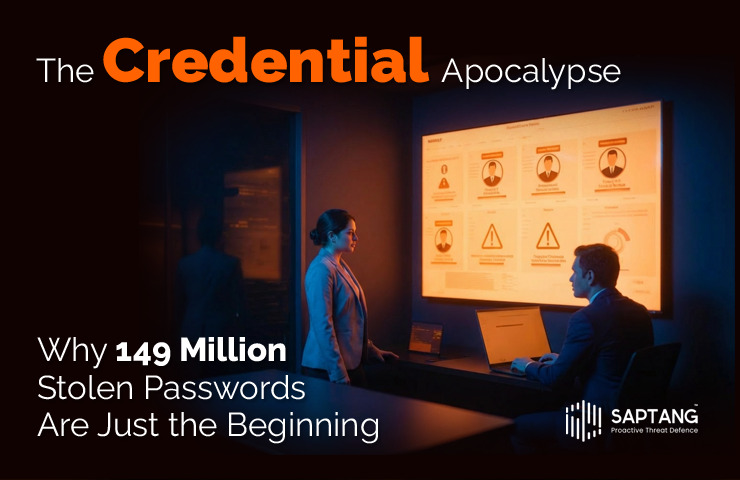
A publicly exposed database containing 149 million stolen credentials, including 48 million Gmail accounts, was discovered this week. Within hours, the dataset multiplied across underground channels. No breach notification went out. No public disclosure was made. Yet the credentials are already being traded and weaponized.
The critical problem: Organizations discover they have been compromised only after attackers have already sold their employees’ credentials multiple times on dark web marketplaces. The window between credential exposure and account takeover is shrinking to just 48 hours.
What you need to know: Your corporate credentials are likely already circulating in underground forums. The question is not whether your organization will face credential-based attacks, but whether you will detect the exposure before attackers exploit it.
Security researcher Jeremiah Fowler was conducting routine internet scans when he discovered something that perfectly illustrates the credential security crisis facing enterprises today. An unsecured database sitting openly on the internet, requiring no authentication to access, containing 149 million stolen passwords.
This was not a sophisticated hack. No zero-day exploit was used. No advanced persistent threat group orchestrated the exposure. Someone simply configured a database incorrectly, leaving it publicly accessible. But the contents tell a far more troubling story about how credential theft has become an industrial-scale operation.
The database contained credentials for Gmail, Facebook, Instagram, Yahoo Mail, and dozens of other services. 48 million Gmail accounts alone. These were not randomly generated passwords. They were real credentials harvested from actual users, organized, indexed, and ready for immediate use by anyone who found them.
Here is what makes this incident particularly significant. Within hours of its discovery, the dataset began multiplying. It was reposted across multiple underground channels, shared in private forums, and distributed through encrypted messaging groups. What started as a single exposed database evolved into one of the largest credential dumps of early 2026.
And throughout this entire process, no breach notification reached the affected users. No security alert warned organizations that their employees’ credentials were being actively traded. The victims remained completely unaware while attackers gained everything they needed for account takeover attacks.
Inside the Dark Web Credential Market
To understand why credential dumps like this are so dangerous, you need to understand the ecosystem that has developed around stolen authentication data. This is not amateur hour. Credential trading has become a sophisticated, professional marketplace with buyers, sellers, brokers, and specialized services.
When a credential database enters the underground economy, it follows a predictable lifecycle. First, it gets validated. Automated systems test each username and password combination to determine which accounts are still active. This validation process happens at massive scale, often completing within hours.
Next comes sorting and categorization. Credentials are organized by value. Corporate email accounts command premium prices. Banking credentials are separated from social media accounts. Credentials that provide access to privileged systems or contain financial information get flagged for special treatment.
Then the sales begin. Fresh databases sell at higher prices because fewer people have attempted to use them yet. As credentials get older and more widely distributed, prices drop. But even aged credentials retain value because many users never change their passwords, even years after breaches.
The pricing structure reveals what attackers value most:
A database containing 149 million credentials represents hundreds of millions of dollars in potential value to criminals. This is why credential theft continues to accelerate despite increasing security awareness.
Here is the timeline that should concern every security professional. When fresh credentials hit the market, sophisticated attackers move immediately. Within 48 hours of a database being shared in underground channels, the first wave of attacks begins.
Hour 1 to 12: Initial distribution. The database gets shared in private forums and messaging groups. Early buyers begin validation testing. Automated systems start checking which accounts remain active.
Hour 12 to 24: Credential stuffing attacks accelerate. Attackers test the credentials against hundreds of online services, looking for password reuse. Corporate VPN portals, cloud services, and email systems face login attempts from unusual locations.
Hour 24 to 48: Successful account compromises get exploited. Attackers who gained access begin reconnaissance, looking for valuable data, financial information, or lateral movement opportunities within corporate networks.
Most organizations discover the breach days or weeks later, long after attackers have accomplished their objectives. By the time security teams realize credentials were compromised, the damage is done.
The immediate reaction to hearing about a credential dump is often to assume it affects only individuals with poor password hygiene. This is a dangerous misunderstanding. Large-scale credential exposures create cascading risks that directly threaten enterprise security.
The Corporate Email Problem
48 million Gmail accounts in a single database. Think about what that means for enterprise security. Gmail dominates corporate email in many organizations, particularly in India where Google Workspace has massive adoption. Every employee Gmail account represents a potential entry point into corporate systems.
When an attacker gains access to a corporate email account, they inherit that employee’s identity. They can send emails that appear completely legitimate because they originate from actual corporate accounts. They can access documents shared via Google Drive. They can join video meetings. They can reset passwords for other services using email verification.
This is not theoretical. Business email compromise attacks cost organizations billions annually, and most begin with compromised email credentials purchased from dark web marketplaces.
Despite decades of security awareness training, password reuse remains endemic. Studies consistently show that 60 to 70 percent of users reuse passwords across multiple services. When credentials from one service are compromised, attackers test them everywhere else.
An employee whose personal Gmail password appears in a credential dump likely uses the same or similar password for corporate systems. VPN access, cloud platforms, internal applications, and administrative interfaces all become vulnerable through a single compromised credential.
Organizations cannot control what passwords employees choose for personal accounts. But those personal account compromises directly impact corporate security through credential stuffing attacks.
Stolen credentials enable far more than just account takeover. They provide attackers with intelligence that makes social engineering attacks exponentially more effective.
When attackers gain access to an email account, they learn communication patterns, organizational structure, ongoing projects, and relationship dynamics. They see which vendors the company works with, which executives communicate with whom, and what terminology is used internally.
This intelligence transforms generic phishing attempts into highly targeted spear phishing campaigns. An attacker who has spent days reading someone’s email can craft messages that are nearly impossible to distinguish from legitimate communications.
For Indian organizations, credential security has moved from important to critical. The convergence of several factors makes credential-based attacks particularly threatening right now.
Regulatory Pressure Is Increasing
The RBI’s April 2026 cybersecurity framework explicitly requires financial institutions to implement external threat monitoring capabilities. This includes monitoring for credential exposure on dark web marketplaces and underground forums.
Organizations must demonstrate not just that they have security controls, but that those controls provide visibility into external threats before they result in breaches. Discovering that your employees’ credentials have been traded on the dark web weeks after the fact is no longer acceptable from a compliance perspective.
The Digital Personal Data Protection Act adds another layer of obligation. When employee or customer credentials are compromised, organizations face notification requirements and potential penalties. Proactive monitoring becomes both a security necessity and a regulatory requirement.
Google Workspace has achieved massive penetration in Indian enterprises, from startups to large corporations. When a credential dump contains 48 million Gmail accounts, a significant portion affects Indian users and organizations.
This concentration creates efficiency for attackers. Rather than targeting diverse email platforms, they can focus credential stuffing efforts on Google services, knowing that successful compromises will likely provide access to corporate environments.
Indian banks, fintech companies, and payment processors face relentless credential-based attacks. Attackers know that compromising a single employee account at a financial institution can provide access to customer data, transaction systems, and financial information.
The rapid growth of digital banking in India has expanded the attack surface dramatically. Every employee with access to customer accounts, every developer with production system credentials, and every executive with privileged access represents a target. When those credentials appear in dark web dumps, attacks follow quickly.
Traditional approaches to credential security have focused on password complexity requirements, periodic resets, and multi-factor authentication. These remain important, but they are no longer sufficient. Organizations need visibility into credential exposure before attackers exploit it.
Continuous Dark Web Monitoring
The most effective defense against credential-based attacks is detecting exposure early. This requires continuous monitoring of dark web marketplaces, underground forums, encrypted messaging channels, and paste sites where stolen credentials are shared.
What to monitor for:
When credentials are detected in the wild, organizations can force password resets before attackers exploit them. This transforms credential monitoring from reactive to proactive defense.
Multi-factor authentication remains essential, but implementation matters. SMS-based codes can be intercepted. Authentication apps provide better security. Hardware tokens offer the strongest protection for high-value accounts.
Beyond MFA, implement risk-based authentication that considers context. Login attempts from unusual locations, at unusual times, or from devices the user has never used before should trigger additional verification even when credentials are correct.
This approach limits the damage from compromised credentials. Even if an attacker has valid username and password combinations, contextual anomalies can prevent unauthorized access.
Not all credentials should provide equal access. Implement least privilege principles rigorously. Regular user accounts should not have administrative capabilities. Access to sensitive systems should require separate authentication with higher security requirements.
When credentials are compromised, segmentation limits the blast radius. An attacker who gains access to a standard employee account cannot automatically pivot to administrative systems or access sensitive data repositories.
Q1: How do I know if my organization’s credentials are in this specific database?
Organizations need access to the database itself or threat intelligence services that have analyzed it. Manual checking is impractical with 149 million credentials. Dark web monitoring platforms like Saptang Labs continuously track these databases and alert organizations when their corporate email domains or employee credentials appear in dumps.
Q2: Should we force password resets for all employees?
Blanket password resets create significant operational disruption and user frustration. A better approach is targeted resets based on threat intelligence. If monitoring identifies specific employee credentials in a dump, reset those accounts immediately. For the broader organization, implement risk-based authentication that detects unusual login patterns even with valid credentials.
Q3: Is multi-factor authentication enough to protect against stolen credentials?
MFA significantly reduces risk but is not foolproof. Attackers have developed techniques to bypass MFA through phishing, session hijacking, and social engineering. MFA should be one layer in a defense-in-depth strategy that includes credential monitoring, anomaly detection, and continuous authentication.
Q4: How quickly do attackers exploit fresh credential dumps?
The window between credential exposure and exploitation is shrinking. Sophisticated attackers begin testing credentials within hours of a database appearing in underground channels. Within 48 hours, successful compromises are being actively exploited. This is why real-time monitoring and rapid response are critical.
Q5: Can we prevent our credentials from ending up in these databases?
Complete prevention is impossible because you cannot control security at every third-party service your employees use. However, you can minimize exposure through password managers that generate unique passwords for each service, strong password policies, user education about phishing, and most importantly, early detection when credentials are exposed so you can respond before attackers exploit them.
The 149 million credential dump discovered this week illustrates why external threat monitoring is essential. You cannot prevent every credential exposure, but you can detect it early and respond before attackers exploit it.
For Indian enterprises facing RBI April 2026 compliance requirements: Our platform provides the external threat visibility mandated by regulatory frameworks while protecting against the credential attacks that increasingly target financial services, technology, and government sectors.
Contact Saptang Labs today to see what credentials from your organization are already circulating in underground channels. Visit saptanglabs.com or email sales@saptanglabs.com for a confidential consultation.
You may also find this helpful insight: When Enterprise AI Tools Become Invisible Command-and-Control Infrastructure