
TL;TR
The dynamic of the “Insider Threat” has fundamentally shifted. In 2026, cybercriminal syndicates are no longer relying solely on phishing to trick employees; they are treating them as business partners. Groups like Lapsus$ and various ransomware affiliates are offering life-changing sums of money, often starting at $50,000, in exchange for VPN credentials or the installation of a single executable. This turns a company’s own staff into a deliberate backdoor. To counter this, organizations must move beyond internal monitoring and utilize the external reconnaissance capabilities of Saptang Labs to identify where their employees are being recruited in the digital shadows.
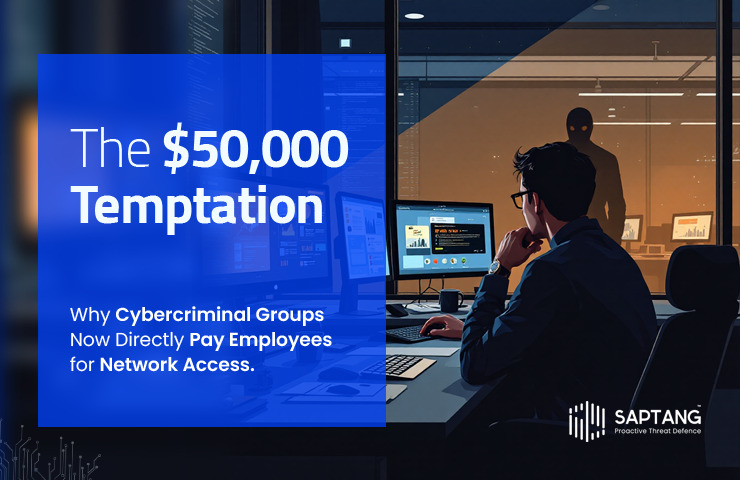
On a rainy Tuesday evening, an IT administrator for a major regional healthcare provider sat in his home office, scrolling through a private Discord server dedicated to high-end PC gaming. A direct message popped up from a user he didn’t recognize. It didn’t contain a link to a virus or a suspicious attachment.
Instead, it contained a simple, professional proposition: “We know you have administrative access to the hospital’s patient records system. We will transfer $50,000 in Bitcoin to your wallet tonight if you just give us your VPN credentials for four hours. No one will ever know it was you.”
For the administrator, who was currently struggling with a rising mortgage and the costs of a new child, the proposal wasn’t a “cyberattack.” It was a financial exit ramp. He wasn’t being “hacked” in the traditional sense; he was being recruited. This is the new reality of the 2026 threat landscape. The most sophisticated “malware” in your network might actually be a trusted employee who decided that their company’s data was worth more than their salary.
This shift from accidental negligence to deliberate collaboration is what we call the Industrialized Insider. Cybercriminal groups have realized that paying a human is often faster, cheaper, and more reliable than trying to bypass a multi-million dollar security stack. When an employee willingly hands over the keys, every firewall, EDR, and zero-trust policy becomes effectively moot.
To a Board of Directors, $50,000 sounds like a massive sum. To a ransomware affiliate looking at a potential $5 million payout from a successful encryption event, that same $50,000 is merely a 1% acquisition cost. In the world of high-stakes cybercrime, this is considered a highly efficient investment.
By paying an employee, the criminal group eliminates the “Exploitation Phase” of the kill chain. They don’t need to spend weeks looking for a zero-day vulnerability. They don’t need to send ten thousand phishing emails and hope for a click. They simply buy their way into the network with the highest level of privilege available. This is a cold, calculated business decision that exploits the widening gap between executive compensation and the financial pressures faced by mid-level staff.
The Recruitment Channels of 2026:
Historically, the “Insider Threat” was characterized as a disgruntled worker who wanted to get revenge on their boss. While that profile still exists, the 2026 insider is often someone who feels they are making a “victimless” economic choice. They convince themselves that the company is insured, that no one will get hurt, and that the money will solve their personal problems.
Attackers have become experts at identifying these vulnerabilities. They use AI to scrape social media for signs of financial distress, recent divorces, or even gambling habits. They don’t just offer money; they offer a “solution” to a specific life crisis. This psychological manipulation makes the bribe feel less like a crime and more like a secret partnership.
At Saptang Labs, we track the “Quiet Build” phase of an attack. In the context of employee bribery, this build doesn’t happen on your servers; it happens on the external web. Attackers spend weeks “warming up” a relationship with a potential insider. They might start with small, harmless requests for information before escalating to the full bribe.
This infrastructure is often visible if you know where to look. We see the patterns of “Access Wanted” advertisements on the dark web and the uptick in social engineering reconnaissance targeting specific departments. If a company is only looking at its internal logs, it is essentially wearing a blindfold. Resilience requires knowing who is talking to your employees when they are off the clock.
Highlighter Points for Executive Leadership:
If your strategy for stopping a bribed employee is to wait for them to do something suspicious, you have already lost. The data will be gone by the time the alert fires. The defense must shift toward identifying the recruitment phase before the bribe is ever accepted.
This requires a holistic approach that combines technical security with human-centric policy. It means implementing “Two-Person Integrity” for sensitive system changes, much like the protocols used in nuclear missile silos. But more importantly, it means having the external visibility to see the “Bounty” being placed on your network access in the digital underground.
Strategic Defensive Pillars:
The most dangerous threats to your organization are the ones you cannot see in your own logs. Saptang Labs specializes in the External Perimeter. We don’t just watch your network; we watch the adversary.
Our AI-driven engines crawl the encrypted channels and dark web forums where these “Access for Cash” deals are brokered. We identify the specific infrastructure being used to recruit insiders, allowing you to proactively warn your staff and harden your systems before the money changes hands. When an attacker puts a price tag on your network, we make sure you are the first to know.
1 Is it really common for employees to take these bribes?
While it is not “common” in the sense of happening daily, theincidence has risen by over 300% since 2023. As the payouts for ransomware increase, the budget for bribing insiders grows proportionally. Even one success in a year can be catastrophic for a firm.
2. Can’t we justmonitorour employees’ personal social media?
Not only is this a massive privacy violation that destroys company culture, but it is also ineffective. Attackers use private, encrypted apps like Telegram and Signal. The key is to monitor the attackers’ recruitment posts, not the employees’ personal lives.
3. Does Multi-Factor Authentication (MFA) stop this?
No. If the employee is a willing conspirator, they will simply approve the MFA prompt on their phone or provide the session token to the attacker.MFA is designed to stop unauthorized users, not authorized users who have turned rogue.
4. What departments are most at risk?
IT Administrators and DevOps engineers are the primary targets due to their high-level access. However, HR and Finance are increasingly targeted for “business logic” fraud where the bribe is to simply ignore a suspicious invoice or change a direct deposit bank account.
5. How doesSaptangLabs help without spying on our staff?
We focus on the “Recruiter” side of the equation. We track the criminal infrastructure, the C2 servers, and the recruitment posts on the dark web. We provide intelligence on who is being targeted and how, allowing you to build a culture of resilience rather than a culture of surveillance.
The “The $50,000 Temptation” is a stark reminder that in 2026, cybersecurity is as much about human psychology and economics as it is about bits and bytes. When a threat actor can’t break your code, they will try to break your people. Cyber resilience now requires an understanding that every employee is a potential target of an industrialized recruitment machine.
By partnering with Saptang Labs, you move the defensive line to the External Perimeter. We provide the foresight to see the “Quiet Build” of insider recruitment campaigns, giving you the chance to act before a single credential is sold. In a world where your staff is being offered life-changing money to betray you, the only true defense is to see the bribe coming from the shadows.
You may also find this insight helpful: The Invisible Inventory: Why Shadow APIs Are the Single Point of Failure for 2026 Enterprises