
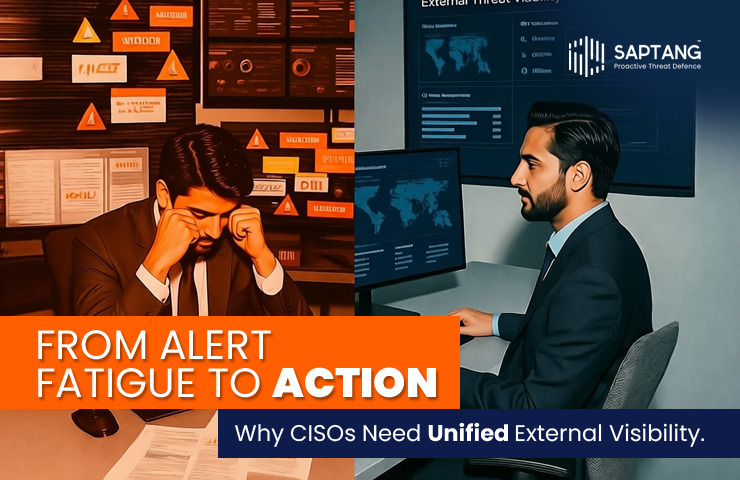
Introduction: When Every Alert Feels Urgent, Nothing Truly Is
A decade ago, a CISO’s biggest challenge was visibility.
Today, it is overload. Modern security leaders wake up to dashboards already blinking red. Overnight alerts pile up before the first coffee. Teams race to triage signals that all claim urgency, yet few explain intent. Despite investments in SIEMs, EDRs, XDRs, SOAR platforms, and threat feeds, many CISOs share a quiet frustration. With so much information, why does decisive action still feel so difficult?
This is the paradox of modern security leadership. Alert volume has exploded, but clarity has not kept pace. Incidents still surprise organizations. Breaches still feel sudden, even when logs later reveal long dwell times. Boards still ask why threats were not seen earlier.
The uncomfortable answer is this. Most security visibility is inward-looking. Most alerts are generated after attackers have already crossed a boundary. And most tools react to activity rather than intent.
This is where alert fatigue begins, and this is where unified external visibility becomes not a luxury, but a necessity for today’s CISO.
Alert fatigue is often discussed as an analyst issue. Too many tickets. Too much noise. Burnout on the front lines. While all of this is true, it misses the deeper impact.
At the CISO level, alert fatigue manifests differently.
It looks like decision paralysis.
It sounds like conflicting risk assessments.
It feels like reacting instead of leading.
When every tool generates its own version of risk, prioritization becomes subjective. When alerts lack context, urgency becomes arbitrary. When leadership cannot clearly explain which risks matter most and why, security conversations drift from strategy to firefighting.
This has real consequences.
Alert fatigue, at its core, is not about too many alerts. It is about too little meaning.
To understand why alert fatigue persists, we need to look at how most security programs are designed.
Enterprise security stacks are built around internal telemetry. Logs from endpoints, servers, applications, and networks form the backbone of detection. These tools are excellent at answering one question.
What is happening inside the environment?
But modern attacks do not begin there.
Threat actors spend significant time outside the perimeter. They observe. They prepare. They test. They gather intelligence long before triggering a single internal alert. By the time activity is visible in logs, the attacker already understands the environment better than most defenders.
This creates a dangerous gap.
Everything before intrusion remains invisible. Everything after intrusion becomes noisy.
Alert fatigue is not accidental. It is the natural outcome of visibility that starts too late.
Every major incident has a prelude that rarely makes it into incident reports.
Credentials leak quietly on underground forums. Brand impersonation domains are registered and left dormant. Phishing templates are tested against small targets. Cloud assets are scanned repeatedly but not exploited. Third-party access points are mapped patiently.
These activities generate no alerts inside traditional security tools. They happen in spaces organizations do not own and therefore do not monitor.
Yet these early signals carry the highest strategic value. They reveal intent. They reveal targeting. They reveal preparation.
By the time an internal alert fires, the most valuable window for prevention has already closed.
This is the blind zone where most CISOs operate today.
When incidents occur, the default response is often to buy another tool. Each breach exposes a gap, and each gap gets its own solution. Over time, security stacks grow wider but not smarter.
The result is fragmentation.
Instead of reducing uncertainty, tools multiply it. Instead of enabling faster action, they demand more interpretation.
The problem is not lack of investment. It is lack of unification.
Unified external visibility is often misunderstood as just another threat feed or monitoring service. In reality, it represents a fundamental shift in how security leaders understand risk.
At its core, unified external visibility answers one critical question.
What risks are forming around us before they touch us?
It brings together multiple external signals into a single, coherent view that a CISO can act on. Not raw data. Not endless alerts. But context.
Unified external visibility includes:
More importantly, it connects these signals to business relevance. Which exposure matters most. Which activity indicates real intent. Which risks demand immediate action.
This is not about adding noise. It is about reducing it.
When CISOs gain unified external visibility, the security conversation changes.
Instead of reacting to incidents, teams begin anticipating them. Instead of explaining what went wrong, leaders explain what was prevented. Instead of measuring success by response speed, success is measured by incidents that never occurred.
This shift has profound effects.
Most importantly, CISOs regain control of the narrative.
Consider a scenario where employee credentials appear on a dark web marketplace. Without external visibility, this remains unknown until credentials are misused and alerts fire. With external visibility, passwords are reset, access is reviewed, and an incident never materializes.
Or a case where phishing infrastructure is registered using lookalike domains. Without visibility, the first sign is a successful compromise. With visibility, domains are taken down and campaigns disrupted before launch.
Or cloud assets that slowly expand beyond intended exposure. Without awareness, attackers eventually exploit them. With visibility, misconfigurations are corrected early.
In each case, the difference is timing. And timing is everything in security.
Unified external visibility cannot be treated as a technical add-on. It is a strategic capability that requires leadership ownership.
CISOs are uniquely positioned to bridge technical signals and business risk. They understand the cost of incidents, the pressure of compliance, and the expectations of boards. Delegating external visibility entirely to operational teams risks repeating the same fragmentation that caused alert fatigue in the first place.
When CISOs own external visibility, security becomes proactive, communicative, and credible.
This is where Saptang Labs plays a critical role.
Saptang Labs focuses on giving CISOs clarity where traditional tools fall silent. By providing unified external visibility, Saptang Labs helps organizations see risks forming beyond their perimeter and act while those risks are still manageable.
The approach is not about flooding teams with intelligence. It is about distilling external signals into actionable insight. What matters now. What can wait. What requires immediate intervention.
By complementing existing security investments and compliance frameworks, Saptang Labs enables CISOs to shift from reactive defense to anticipatory security leadership.
To explore how unified external visibility can transform your security strategy, visit https://www.saptanglabs.com and learn how external risk intelligence can turn alert fatigue into confident action.
Alert fatigue is a symptom, not the disease. The real issue is visibility that starts too late and ends in noise.
As threats continue to evolve, CISOs who rely solely on internal alerts will always be one step behind. Those who invest in unified external visibility gain something far more valuable than another dashboard.
They gain foresight.
In a world where attackers prepare quietly and strike selectively, the future of security leadership belongs to those who can see before others even begin to react.
Modern CISOs face alert fatigue not because of too many tools, but because visibility starts too late. Most attacks begin externally, long before internal alerts fire. Unified external visibility gives CISOs early insight into threats forming outside the perimeter, enabling proactive action, clearer prioritization, and stronger leadership decisions. Saptang Labs helps organizations close this gap by turning external signals into actionable intelligence.
What is unified external visibility in cybersecurity?
It is a consolidated view of external risks such as leaked credentials, brand abuse, attacker reconnaissance, and attack surface exposure before they lead to incidents.
Why does alert fatigue persist despite advanced security tools?
Because most tools focus on internal activity and generate alerts after attackers have already progressed, creating noise instead of foresight.
How is external visibility different from traditional threat feeds?
External visibility provides contextual, prioritized insight tied to your organization, not generic intelligence streams.
Can unified external visibility work with existing SOC tools?
Yes. It complements SIEM, EDR, and SOC workflows by providing early signals that improve prioritization and response.
When should CISOs invest in external visibility?
When incidents feel surprising, alerts feel overwhelming, and leadership seeks clearer, earlier risk insight.
You may also find this insight helpful: From Blind Spots to Boardroom Security Metrics