
Introduction: The Moment Trust Stops Being Reliable
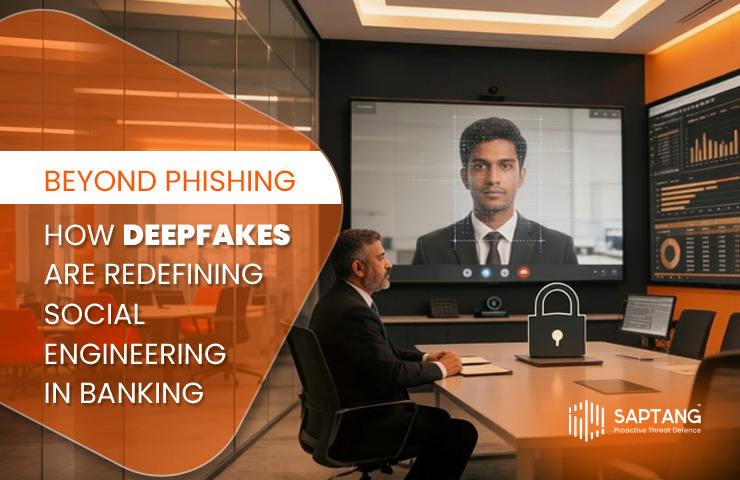
Late one evening, a mid-sized financial institution processed a high-value transfer after what appeared to be a routine executive approval call. The voice was familiar. The instructions aligned with an ongoing transaction. The urgency matched the context. No suspicious links. No malicious attachments. No obvious anomalies.
Days later, investigators concluded that the voice had been synthetically generated.
The incident did not involve malware, credential theft, or system intrusion. It was pure social engineering, powered by artificial intelligence. What made it different from traditional phishing was not just sophistication. It was authenticity.
For decades, banks have fought social engineering through awareness training, email filtering, and authentication controls. Phishing emails were the dominant vector. The battle lines were clear. Today, those lines are dissolving. Deepfake technology has expanded social engineering beyond written deception into voice, video, and real-time identity simulation.
In a sector built on trust, this shift is not incremental. It is structural. And many institutions are still responding with yesterday’s defenses.
Social engineering has always targeted human psychology rather than technical systems. Early attacks relied on impersonation emails, spoofed domains, and fabricated urgency. The success rate depended largely on carelessness or lack of awareness.
Banks responded methodically. They deployed advanced email security gateways. They implemented multi-factor authentication. They ran continuous phishing simulations. Over time, the success rate of basic phishing attempts declined.
But attackers adapted.
Deepfakes represent the next stage of that evolution. Instead of convincing someone through text alone, attackers now replicate the sensory cues that humans instinctively trust. A familiar tone of voice. A face on a video call. A real-time interaction that mirrors natural conversation patterns.
This dramatically lowers psychological resistance. When employees believe they are interacting with someone they know and recognize, the skepticism that typically accompanies suspicious emails weakens. Decision-making becomes faster and less guarded.
Unlike phishing, which often relies on volume, deepfake-driven social engineering tends to be targeted and researched. Attackers study public speeches, interviews, earnings calls, and social media videos. They gather speech samples and facial data. They craft scenarios that align with ongoing corporate activities. The attack feels contextual because it is.
The shift from generic deception to contextual impersonation marks a significant escalation in risk for financial institutions.
Banking is uniquely vulnerable because of its operational structure. Financial institutions operate in environments where speed, trust, and authority drive action. Senior executives frequently authorize urgent decisions. Relationship managers engage clients through digital channels. Remote onboarding has become mainstream.
Each of these developments creates exposure.
In banking, a single instruction can move millions. A single approval can unlock credit lines or authorize transactions. Unlike many industries, the consequences of manipulated communication are immediate and financially significant.
Three areas stand out as particularly exposed:
These are not peripheral processes. They sit at the core of daily banking operations.
Deepfakes exploit authority hierarchies. If a call appears to come from a senior leader during a time-sensitive transaction, employees are conditioned to act. Traditional safeguards such as callback verification may fail if the attacker controls multiple communication channels or spoofs internal numbers.
Furthermore, customer-facing channels introduce another layer of vulnerability. As voice authentication gains popularity, cloned voices can potentially bypass systems that rely solely on vocal characteristics. Without layered verification, such systems become soft targets.
The financial sector’s drive toward seamless digital experience has, unintentionally, increased the value of synthetic identity attacks.
Traditional phishing required victims to interpret written cues. Was the sender legitimate? Did the link look suspicious? Was the grammar inconsistent?
Deepfake-driven social engineering removes many of those evaluation points. Instead of analyzing text, employees are responding to what appears to be a legitimate human interaction.
This transition can be understood through three defining characteristics of modern deepfake attacks:
The psychological impact of this shift is profound. Humans are wired to trust visual and auditory signals. When those signals are convincingly replicated, traditional fraud awareness training becomes less effective.
What makes this especially concerning for banks is that high-level financial decisions often occur over calls and video meetings. If those channels can be convincingly manipulated, the entire trust model requires rethinking.
Digital transformation has reshaped customer onboarding. Video verification, document uploads, and remote identity checks have become standard practice across financial institutions. These systems were designed to improve convenience while maintaining compliance.
Deepfakes challenge that assumption.
When attackers can generate hyper-realistic video personas that simulate natural blinking, facial movement, and speech synchronization, the reliability of visual verification alone diminishes. Synthetic identities can be paired with stolen or fabricated documentation to create highly convincing onboarding attempts.
The risk is not limited to account opening. Once an account is established, fraudsters can leverage it for transaction laundering, mule networks, or cross-border fund movement before detection mechanisms flag anomalies.
The deeper concern is regulatory exposure. Financial regulators expect robust identity verification processes. If deepfake exploitation results in systemic onboarding vulnerabilities, institutions may face both financial and reputational consequences.
This demands a shift from static verification to continuous identity validation across the customer lifecycle.
Executive Impersonation and High-Value Fraud
One of the most alarming applications of deepfake technology in banking is executive impersonation.
Fraud investigations across global markets have revealed scenarios where attackers used cloned voices to instruct finance teams to execute urgent transfers. In some cases, attackers staged multi-party calls using multiple synthetic personas to create the illusion of consensus.
The financial impact can be significant, but the reputational impact may be even greater. When stakeholders learn that senior leadership was convincingly impersonated, confidence in internal controls weakens.
Executive impersonation is particularly dangerous because it bypasses the informal trust mechanisms that organizations rely upon. Employees are trained to escalate concerns, but they are also trained to respond swiftly to leadership directives. Deepfakes manipulate that dual conditioning.
The attack is not on infrastructure. It is on authority.
Many banks still rely on a combination of employee awareness, transaction monitoring, and post-event investigation to manage fraud risk. While these controls remain important, they were not designed to detect AI-generated identity manipulation.
Deepfake detection is technically complex. Synthetic media continues to improve in realism, making manual detection unreliable. Even experienced professionals can struggle to distinguish between genuine and manipulated audio or video.
Moreover, attackers continuously refine their techniques. As detection tools evolve, so do generation models. This creates an arms race dynamic where reactive defense strategies are insufficient.
Institutions must expand their defense posture to include:
Importantly, these controls must be embedded into governance frameworks rather than treated as experimental add-ons.
Deepfakes are not merely an operational concern. They are a governance challenge.
Boards and risk committees must understand that AI-driven impersonation can directly impact financial stability, regulatory compliance, and public trust. Cybersecurity reporting should now include exposure assessments related to synthetic media threats.
Institutions that treat deepfakes as niche cyber risks may find themselves unprepared for targeted attacks. The threat intersects with fraud risk, operational resilience, data protection, and even insider risk frameworks.
Forward-looking organizations are beginning to integrate deepfake risk into enterprise risk management strategies. This includes scenario testing, red team simulations, and executive-level awareness programs.
The question is no longer whether deepfakes can affect banking. It is how prepared institutions are when they do.
TL;DR
Deepfakes are transforming social engineering in banking from text-based deception to real-time synthetic impersonation. Financial institutions face elevated risk across executive communication, digital onboarding, and voice authentication channels. Traditional phishing defenses are no longer sufficient. Banks must adopt advanced detection technologies, strengthen cross-channel verification, and elevate deepfake risk to board-level governance discussions. Ignoring the shift could expose institutions to significant financial, regulatory, and reputational damage.
Addressing deepfake risk requires more than awareness training. It demands forensic capability, advanced detection expertise, and proactive risk assessment.
Saptang Labs works closely with financial institutions to identify vulnerabilities in digital communication channels, evaluate exposure to synthetic identity attacks, and strengthen fraud investigation frameworks. Through digital forensics, adversarial simulations, and security posture assessments, the team helps banks move from reactive response to anticipatory defense.
What differentiates Saptang Labs is its investigative depth. Rather than focusing solely on surface-level controls, the approach examines how AI-driven manipulation intersects with operational workflows, governance structures, and compliance requirements.
In an era where trust itself can be fabricated, institutions need partners who understand both the technical and behavioral dimensions of emerging threats.
To explore how your organization can assess and mitigate deepfake-driven social engineering risk, visit https://saptanglabs.com and connect with the team.
Are deepfake attacks already affecting banks?
Yes. Several financial institutions globally have reported incidents involving AI-generated voice impersonation and synthetic identity fraud. While not all cases are publicly disclosed, the trend is increasing and documented by regulatory and cybersecurity bodies.
Can traditional fraud detection systems identify deepfakes?
Most legacy systems were designed to detect anomalous transactions rather than synthetic media manipulation. While they may flag suspicious fund movements, they often do not detect the impersonation method itself.
Is multi-factor authentication enough to prevent deepfake fraud?
Multi-factor authentication reduces risk but does not eliminate it. If attackers successfully manipulate human decision-makers or exploit voice-based systems, additional layered controls are necessary.
What should banks prioritize first?
Institutions should begin with risk assessment. Mapping where voice, video, and identity verification intersect with high-value decisions helps identify exposure points. From there, implementing advanced detection technologies and updating governance frameworks becomes critical.
Deepfakes are not a distant possibility. They are an evolving reality. For financial institutions that operate on trust, recognizing this shift early may determine whether they lead the response or become case studies in the next wave of social engineering fraud.
You may also find this helpful insight: Why Banks Are Always One Step Behind Emerging Fraud