TL;DR
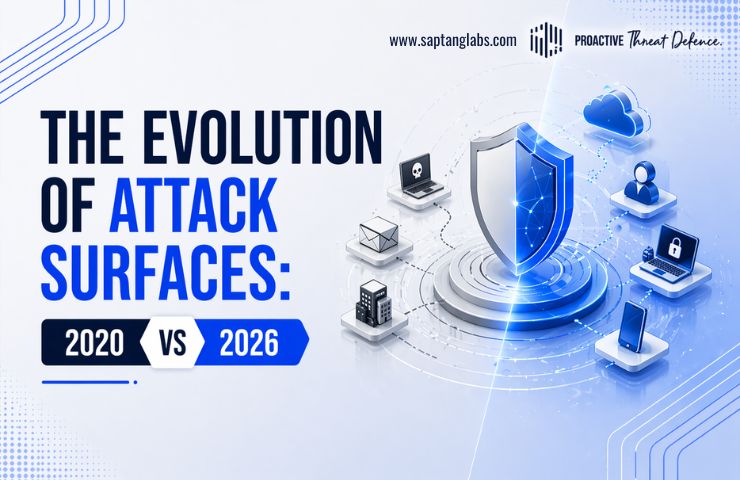
The enterprise attack surface has not just expanded; it has fundamentally transformed. In 2020, security was built around a defined perimeter with controlled infrastructure. In 2026, that perimeter no longer exists. Cloud sprawl, SaaS adoption, APIs, remote work, and AI agents have created a distributed and constantly changing external attack surface. Most of this exposure exists outside traditional visibility, making detection reactive and delayed. For security leaders, the shift is clear. Defense must move from perimeter-based control to continuous external visibility and intelligence-driven risk management.
There was a time when explaining security to a board was straightforward.
A simple diagram showed a box representing the organization. A firewall stood at the edge. Inside were systems, applications, and users. Outside was the internet and the threats that needed to be kept away.
It made sense. It was intuitive.
That model worked because the environment was predictable.
Looking back from 2026, that same model feels outdated. Not because it was wrong, but because the assumptions behind it no longer hold. The idea of a fixed perimeter has quietly disappeared.
In early 2020, most enterprise environments were still centralized.
Critical workloads lived in data centers. Cloud adoption was growing, but it was limited and controlled. Remote work existed, but it was not the default. SaaS applications were few and largely approved by IT.
The attack surface was defined and manageable.
Security teams knew what they were protecting. Asset inventories were accurate. Vulnerability scans completed on time. Annual testing covered most exposures.
The environment changed slowly, and that made it easier to defend.
The shift did not happen gradually. It accelerated almost overnight.
Remote work became the norm. Applications had to be accessible from anywhere. Cloud adoption moved from optional to essential. Teams started deploying faster, often without centralized oversight.
What began as a response to necessity became the new operating model.
By the time organizations stabilized, the attack surface had already expanded far beyond what traditional security models were designed to handle.
Today, the enterprise environment is no longer centralized. It is distributed across multiple layers, many of which are not fully visible.
Cloud has become the default platform for most workloads. Infrastructure is created and removed in minutes. This speed creates efficiency, but it also introduces gaps in tracking and control.
At the same time, the workforce has become decentralized. Employees operate from home networks, personal devices, and public environments. Access is no longer tied to a location.
SaaS adoption has grown rapidly. Business teams select tools independently, leading to a mix of approved and unapproved applications. Each one introduces new access points and integrations.
APIs have become the backbone of modern applications. A single transaction can involve dozens of services communicating externally.
And now, a new layer has emerged.
AI agents.
These systems operate continuously, interact with multiple services, and often hold privileged access. They are not bound by human limitations, which makes them powerful but also difficult to govern.
The challenge is not just growth. It is the pace of change.
In a single week, an organization can introduce dozens of new cloud resources, multiple SaaS integrations, and hundreds of API endpoints. Most of these changes happen outside traditional security workflows.
This creates a structural problem.
As a result, security teams are often reacting to threats instead of anticipating them.
One of the most critical shifts in 2026 is the rise of the external attack surface.
This is everything that is visible from the outside. It includes cloud resources, domains, APIs, and third-party integrations that are exposed to the internet.
The challenge is simple but serious.
Attackers see more than organizations do.
They scan infrastructure continuously. They identify misconfigurations, forgotten assets, and weak points. They operate with a perspective that most internal tools do not provide.
Common exposures include:
These are not rare issues. They are common across enterprises.
A company acquires a smaller organization as part of its growth strategy.
The integration focuses on systems, teams, and processes. Security reviews are conducted, but they prioritize active infrastructure.
Months later, a vulnerability is discovered in a legacy subdomain belonging to the acquired company. It was not part of the official asset inventory. It was not monitored.
Attackers found it first.
They used it as an entry point to host malicious content and launch phishing campaigns under the company’s brand.
The issue was not a failure of security tools. It was a failure of visibility.
The evolution of the attack surface requires a shift in thinking.
Security can no longer rely on defined boundaries. The environment is too dynamic, and too much of it exists outside direct control.
Three priorities are becoming clear:
This is where external threat intelligence becomes a core capability.
It allows organizations to see what attackers see, identify risks early, and respond before threats reach internal systems.
In 2020, external intelligence was often treated as an additional layer.
In 2026, it has become foundational.
Credential leaks appear on underground forums within hours of compromise. Shadow assets are exposed without internal awareness. Third-party risks introduce vulnerabilities that extend beyond organizational control.
Without external visibility, these signals remain invisible until impact occurs.
External threat intelligence bridges that gap.
It provides context, connects signals, and helps organizations move from reactive defense to proactive awareness.
The evolution of the attack/ surface is not slowing down.
If anything, it is becoming more complex.
New technologies will continue to expand exposure. AI systems, distributed applications, and interconnected platforms will add new layers of risk.
The organizations that adapt will be the ones that accept this reality early.
They will stop trying to recreate a perimeter that no longer exists. Instead, they will focus on visibility, adaptability, and intelligence.
Because in 2026, security is not about protecting a boundary.
It is about understanding an ecosystem that is constantly changing.
1. Why has the attack surface expanded so rapidly since 2020?
The shift to cloud, remote work, SaaS adoption, and API-driven architectures has created a distributed environment where assets are continuously added and removed.
2. What is the biggest risk in the 2026 attack surface?
The lack of visibility into external assets. Many exposures exist outside internal monitoring, making them difficult to detect early.
3. Why are traditional security tools not enough anymore?
Because they focus on known and internal assets, while modern threats often originate from unknown and external environments.
4. How should organizations approach attack surface management today?
By adopting continuous discovery, real-time monitoring, and integrating external threat intelligence into their security strategy.
5. What role does external threat intelligence play in modern security?
It provides visibility into how attackers view an organization, enabling early detection of risks that internal tools may miss.
6. Is this shift temporary or permanent?
It is a permanent transformation driven by how technology and work environments have evolved. The attack surface will continue to expand.
You may also find this helpful insight: 2026 External Threat Landscape: What CISOs Need to Know