TL;DR
Signature-based security was built for a predictable threat landscape. That world no longer exists. External threats today evolve faster than signatures can be written, leading to missed detections and overwhelming alert noise. AI threat detection changes this dynamic by focusing on patterns, behavior, and context rather than static rules. For SOC teams already stretched thin, this shift is not about innovation alone. It is about survival. Reducing false positives, improving signal quality, and identifying threats earlier are no longer optional outcomes.
At 2:30 AM, a SOC analyst reviews yet another alert.
It looks urgent. Suspicious domain activity flagged by the system. The indicators seem familiar, but something feels off. After ten minutes of digging, the conclusion is the same as the previous five alerts.
False positive.
This pattern repeats dozens, sometimes hundreds of times in a shift.
The problem is not a lack of alerts. It is the opposite.
There are too many.
SOC teams today are not failing to detect threats. They are struggling to separate real threats from noise. And in that noise, critical signals are often delayed or missed entirely.
This is where the conversation around AI threat detection becomes relevant, not as a trend, but as a necessity.
Signature-based systems were designed for a different era.
They rely on known patterns. Known malware hashes. Known indicators. Known attack signatures. When something matches, an alert is triggered.
This approach works well when threats are static.
But external threats are no longer static.
Attackers modify domains, rotate infrastructure, tweak payloads, and constantly change tactics. A phishing site today may look completely different tomorrow, even if the intent remains the same.
This creates two major challenges.
First, signatures fail to detect new or slightly modified threats. Second, systems compensate by generating broader rules, which increases false positives.
SOC teams are left dealing with both blind spots and noise at the same time.
External threat detection is fundamentally different from internal monitoring.
Inside the network, behavior is more controlled. Outside, it is chaotic.
Threats emerge across domains, social platforms, dark web forums, and cloud infrastructure. They are distributed, short-lived, and often designed to evade pattern-based detection.
Signature systems struggle in this environment because they depend on historical knowledge.
Machine learning approaches this differently.
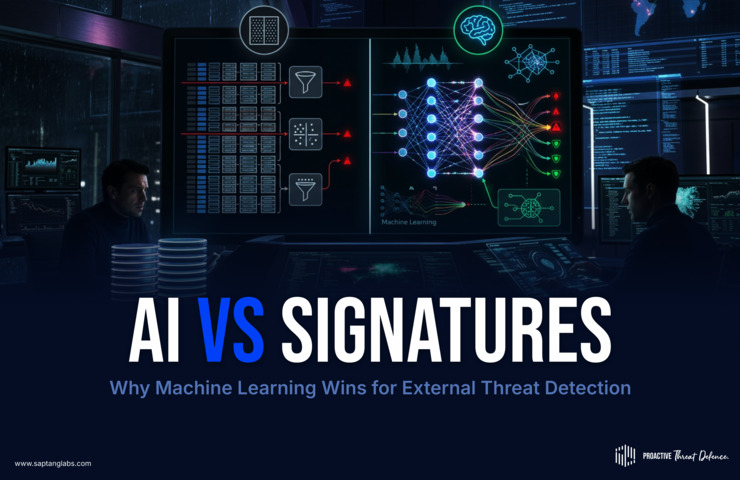
Instead of asking “Have we seen this before?”, AI threat detection asks “Does this look like something that should exist?”
It evaluates patterns such as domain structure, hosting behavior, linguistic cues, and activity correlations. It builds a contextual understanding rather than relying on exact matches.
This shift allows detection of threats that have never been seen before.
Many organizations adopt AI with the expectation that it will simply enhance existing systems. That is where the disconnect begins.
AI is not just an add-on. It requires a different way of thinking about detection.
Three common mistakes tend to appear:
These assumptions often lead to disappointment, not because the technology fails, but because it is not implemented with the right expectations.
A global enterprise relied heavily on signature-based tools to monitor phishing domains. Their system flagged known malicious domains effectively.
However, attackers began using dynamically generated domains that changed frequently. Each domain existed for only a few hours before being replaced.
The signature system failed to detect these domains because they did not match existing patterns.
At the same time, the system generated hundreds of alerts for benign domains that shared superficial similarities.
SOC analysts spent most of their time investigating noise.
When the organization introduced AI threat detection, the approach shifted. Instead of matching known indicators, the system analyzed domain behavior, registration patterns, and hosting anomalies.
The result was fewer alerts, but significantly higher accuracy.
The difference was not in volume. It was in relevance.
The real advantage of AI threat detection is not just detection capability. It is signal refinement.
SOC teams often operate under the assumption that more data leads to better security. In practice, more data often leads to more confusion.
AI changes this by prioritizing context.
It connects signals across sources. It identifies relationships between seemingly unrelated activities. It reduces the need for manual correlation.
Another critical aspect is adaptability.
While signature systems require constant updates, machine learning models evolve with new data. This allows them to keep pace with changing threat landscapes without relying solely on predefined rules.
This adaptability is what makes AI particularly effective for external threat detection, where variability is high.
Moving toward AI threat detection is not about abandoning existing systems. It is about rebalancing the detection strategy.
Signature-based tools still have value. They are effective for known threats and compliance requirements. However, they should not be the primary defense against dynamic external risks.
A more effective approach involves combining both methods, with AI handling pattern recognition and anomaly detection.
At the same time, organizations need to rethink how success is measured. Instead of focusing on the number of alerts generated, the focus should shift to:
Integration also plays a key role. AI systems should not operate in isolation. They need to be part of a broader security framework that includes visibility, context, and response capabilities.
This is where a unified external threat detection approach becomes critical. When signals are connected and prioritized effectively, SOC teams can focus on what truly matters.
The debate between AI and signature-based security is not about choosing one over the other. It is about recognizing the limitations of each.
Signature systems were built for a world where threats were predictable. That world has changed.
External threats today are fast, adaptive, and distributed. Detecting them requires systems that can learn, adapt, and understand context.
For SOC teams dealing with alert fatigue, this shift is more than a technological upgrade. It is a necessary evolution.
Because in the end, the goal is not to generate more alerts.
It is to find the ones that matter.
Because they rely on known indicators, while external threats evolve rapidly and often do not match existing patterns.
By prioritizing context and reducing false positives, allowing analysts to focus on high-confidence threats instead of noise.
No system is fully autonomous. AI enhances detection but still requires human validation and continuous tuning.
Its ability to detect previously unseen threats by analyzing behavior and patterns rather than relying on predefined rules.
No. A hybrid approach that combines signatures for known threats and AI for unknown threats is more effective.
You may find this insight helpful: The Hidden Attack Surface: 5 External Threats Your Firewall Can’t See