A few months ago, a security team at a large enterprise ran what they thought was a routine external scan. The goal was simple. Identify outdated assets and clean up unused infrastructure.
What they found was anything but routine.
A subdomain, created nearly three years ago for a temporary campaign, was still live. No one owned it. No team claimed responsibility. It pointed to a cloud resource that no longer existed.
Within hours of deeper inspection, the team realized something unsettling. The subdomain had already been claimed by an external actor. It was hosting a phishing page that looked identical to the company’s official login portal.
No alarms had been triggered. No internal systems were breached.
Yet, the damage had already begun.
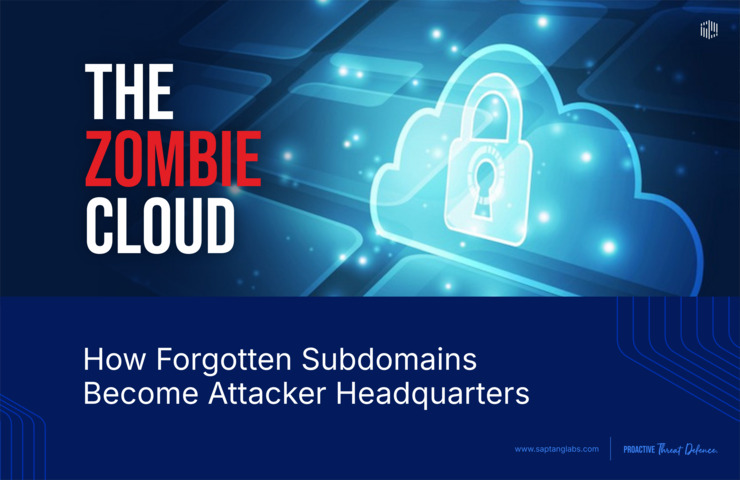
This is the reality of the Zombie Cloud. It is not about active systems. It is about forgotten ones. And in today’s environment, what is forgotten rarely stays unused for long.
Most organizations believe their biggest risks lie in active infrastructure. Production servers, live APIs, and customer-facing applications receive the most attention.
That assumption is increasingly flawed.
The real problem often exists in the gaps between ownership and visibility. Assets that were once created for a purpose but no longer serve one. Subdomains spun up for testing, marketing campaigns, or short-term deployments. Cloud resources that were decommissioned without fully disconnecting dependencies.
These are not seen as threats because they are not part of active operations.
But attackers do not see it that way.
To them, these forgotten assets are opportunities. They come with one powerful advantage. Trust. A subdomain under a legitimate enterprise domain carries inherent credibility. It bypasses suspicion. It blends in.
The Zombie Cloud thrives in this blind spot.
At a technical level, the Zombie Cloud is created through a simple but dangerous sequence.
An organization creates a subdomain and links it to a cloud resource. Over time, the resource is removed, but the DNS record remains. The connection is broken, but the pointer still exists.
This creates a dangling reference.
An attacker monitoring for such opportunities can identify these orphaned subdomains. Once found, they can recreate the missing resource in their own environment and attach it to the same endpoint.
From the outside, nothing looks different. The subdomain resolves correctly. The connection appears valid.
But the control has shifted.
What makes this more dangerous is how silent the transition is. There is no alert when ownership changes at the infrastructure level. No immediate signal that something has been hijacked.
This is why the Zombie Cloud is not just a technical issue. It is an operational blind spot.
The issue is rarely about lack of tools. It is about assumptions.
Organizations often assume that once a resource is decommissioned, the risk disappears. In reality, the risk simply changes form.
Another common mistake is treating asset inventory as a static exercise. A list created once and updated occasionally cannot keep up with the dynamic nature of cloud environments.
Three patterns appear repeatedly in enterprise environments:
These gaps create the perfect conditions for the Zombie Cloud to exist and grow.
A global retail organization launched a seasonal campaign that required a dedicated microsite. The project was executed quickly, with a new subdomain pointing to a cloud-hosted application.
The campaign ended successfully. The infrastructure was taken down. The team moved on.
Months later, customers began reporting suspicious emails. The messages directed them to what appeared to be a legitimate company page hosted under the same domain used during the campaign.
The security team investigated and discovered that the subdomain was still active in DNS. The original cloud resource was gone, but the endpoint had been re-registered by an attacker.
The attacker had not breached any system. They had simply taken advantage of what was left behind.
The phishing campaign was highly effective because it leveraged an authentic domain. Customers trusted it. Security filters did not flag it.
The organization faced reputational damage and had to respond publicly.
All of it traced back to a forgotten subdomain.
The Zombie Cloud is not just about subdomains. It is about how modern infrastructure behaves.
Cloud environments are designed for speed and flexibility. Resources can be created and destroyed in minutes. This agility is powerful, but it also introduces complexity.
What many teams miss is the persistence of external references. Even when internal resources are removed, external identifiers such as DNS records, certificates, and cached links continue to exist.
This creates a disconnect between what the organization believes exists and what is actually accessible from the outside.
There is also a second layer of risk that is often overlooked. Attackers do not just exploit these assets individually. They combine them.
A hijacked subdomain can be used to host phishing pages, distribute malware, or even act as part of a larger attack chain. When combined with social engineering or credential harvesting, the impact multiplies.
This is where the risk moves from technical exposure to business impact.
Addressing the Zombie Cloud requires a shift in how organizations think about external assets.
It starts with continuous visibility. Not just knowing what exists internally, but understanding what is exposed externally at all times.
Organizations need to move from periodic audits to ongoing discovery. Every subdomain, every endpoint, every external reference should be tracked as part of a living inventory.
Equally important is ownership. Every asset must have a clear owner, even if its purpose is temporary. Without accountability, assets are easily forgotten.
Decommissioning processes also need to evolve. Removing infrastructure is only part of the process. DNS records, certificates, and any external links must be reviewed and cleaned up.
Finally, monitoring must extend beyond internal systems. External threat signals, domain activity, and unusual patterns should be continuously analyzed.
This is where a unified approach becomes critical. When visibility, context, and response are brought together, risks like the Zombie Cloud can be identified and addressed before they are exploited.
The Zombie Cloud is not a rare edge case. It is a natural byproduct of how modern enterprises operate.
In a world where infrastructure is created rapidly and often temporarily, the chances of something being left behind are high.
What has changed is how attackers take advantage of it.
They no longer need to break in. They simply wait for something to be forgotten.
For organizations, this means security can no longer focus only on what is active. It must also account for what has been left behind.
Because in cybersecurity, forgotten does not mean gone. It often means exposed.
Zombie Cloud refers to inactive or forgotten cloud-linked subdomains that can be taken over by attackers due to unresolved DNS records.
They identify dangling DNS entries and recreate the missing cloud resource, gaining control over the subdomain.
Because the domain remains legitimate and no internal system is breached, making the activity appear normal.
Enterprises with large, dynamic cloud environments and frequent deployments are especially vulnerable.
By maintaining continuous asset visibility, enforcing ownership, and ensuring complete decommissioning of resources and DNS records.
It is an ongoing process, as new assets are constantly created and old ones retired in cloud environments.
You may also find this insight helpful: Why External Threats Demand a Command Center Approach