
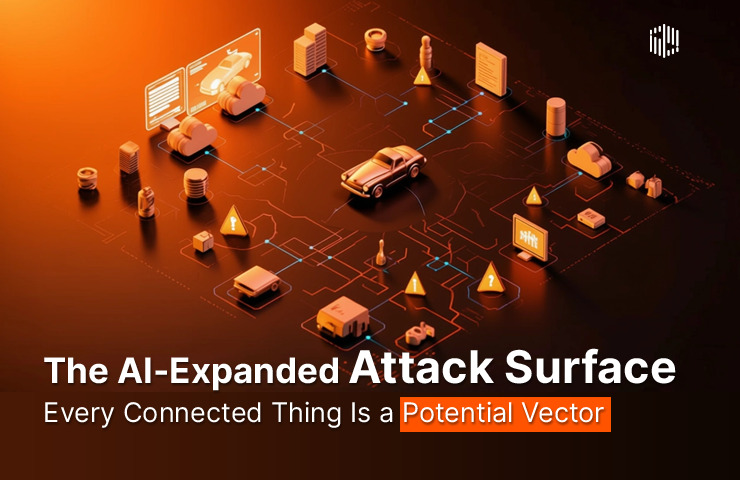
Enterprise security strategies were built on a stable assumption for decades: assets are known, environments are bounded, and change is measurable. Security teams catalog systems, apply controls, and monitor activity within a defined perimeter.
That operating model no longer exists.
In 2026, the enterprise attack surface is no longer shaped only by what IT deploys or security approves. It is shaped by the speed of cloud provisioning, the autonomy of AI systems, the scale of SaaS adoption, the depth of API integrations, and the growing dependence on third-party services. Many of these exposures emerge without deliberate security decisions and often without security awareness.
What makes this moment dangerous is not simply expansion. It is invisibility.
Most enterprises believe they understand their digital footprint. In reality, they are defending an incomplete version of their environment. Assets appear and disappear faster than inventories update. AI tools are introduced by business units without oversight. Cloud services inherit permissions through trust relationships that no one revisits. External connections outnumber internal systems.
Attackers do not need to defeat sophisticated defenses if they can simply walk through what was never monitored.
For executive leadership, this represents a fundamental shift. Unknown exposure is no longer an operational gap. It is a governance issue, a financial liability, and a board-level accountability risk.
Security programs were designed around static assets such as servers, endpoints, applications, and networks. These assets had owners, change windows, and predictable lifecycles.
Cloud infrastructure can be deployed globally in minutes. Development teams spin up temporary environments that persist longer than intended. APIs connect internal systems to partners, vendors, and customers. SaaS platforms integrate deeply into workflows with minimal friction.
Each of these components may be legitimate in isolation. The risk emerges when they accumulate faster than governance can adapt.
Periodic discovery cannot keep pace with real-time change. Asset inventories become snapshots of a past state. By the time security reviews exposure, the environment has already shifted.
AI has accelerated this problem significantly.
AI agents, copilots, and automation frameworks are increasingly embedded into business processes. They access data, trigger workflows, and interact with external systems. Many operate continuously and autonomously.
In many organizations, AI adoption is decentralized. Business units deploy tools to improve productivity, customer engagement, or analytics without formal security review. These systems often rely on APIs, external models, and third-party infrastructure.
When AI assets are not governed as first-class enterprise systems, they become invisible attack paths.
The modern enterprise is defined by connectivity. APIs link applications across organizational boundaries. SaaS platforms become operational dependencies. Vendors require access to internal systems to deliver services.
Each connection extends the attack surface beyond organizational control.
Trust is often transitive. A trusted partner connects to another service. Permissions accumulate over time. What began as a narrow integration becomes a broad access path.
Security teams frequently lack a complete map of these relationships. When incidents occur, responders discover connections they did not know existed.
Attackers actively seek these weak links because they offer lower resistance than direct attacks on hardened infrastructure.
Threat actors continuously scan the internet for exposed services, misconfigured assets, and forgotten systems. They do not rely on internal inventories. They observe reality as it exists externally.
This asymmetry is critical.
While organizations perform periodic assessments, attackers perform continuous reconnaissance. They identify exposure long before security teams notice gaps. In many breaches, compromise occurs weeks or months before detection.
By the time alerts trigger internally, attackers have already established persistence.
What an Invisible Attack Surface Costs the Business
Unknown exposure is not a theoretical risk. It has measurable financial, operational, and reputational consequences.
Breaches involving unknown or unmanaged assets are consistently more expensive.
Incident response costs increase when teams must first identify what was compromised. External consultants are brought in to map systems. Downtime extends while ownership is clarified.
Regulatory fines and legal costs escalate when organizations cannot demonstrate control over their environment. Cyber insurance claims may be challenged if governance failures are identified.
The financial impact is not limited to remediation. Opportunity cost, delayed initiatives, and lost customer confidence compound losses.
When assets are not clearly owned, response slows.
Teams waste time determining who is responsible for remediation. Access credentials may be unknown. Configuration baselines may not exist. Logs may be unavailable.
Operational disruption extends beyond IT. Business units experience service outages. Customer-facing platforms go offline. Internal trust erodes as teams assign blame.
Regulators increasingly view unknown exposure as a failure of governance, not an acceptable oversight.
Frameworks require organizations to demonstrate control, accountability, and continuous risk management. Incomplete asset visibility undermines these requirements.
During audits and investigations, the question is not whether an organization had tools. The question is whether leadership exercised reasonable oversight.
Post-incident reviews often converge on a single question: Why did we not know this existed?
Boards expect security leaders to articulate risk posture clearly. When unknown assets are revealed during incidents, confidence erodes.
Brand damage follows public disclosures. Customers question trust. Partners reconsider relationships. Reputation becomes harder to rebuild than systems.
Solving this challenge does not require chasing every new technology. It requires reframing how exposure is governed.
Move From Inventory to Continuous Exposure Management
Static inventories are insufficient.
Executives should mandate continuous visibility into externally exposed assets, cloud workloads, and integrations. The goal is not perfection but awareness of change.
Exposure should be monitored as a living metric, not a compliance checkbox.
Assign Clear Ownership to Every Exposed Asset
Every externally reachable system must have a documented owner.
Ownership drives accountability. It ensures remediation decisions can be made quickly. Assets without owners represent unmanaged risk.
This includes AI systems, automation pipelines, and integrations created outside traditional IT processes.
Organizations must understand how attackers see them.
External exposure assessment provides insight that internal tools cannot. It reveals misconfigurations, forgotten assets, and inherited trust relationships.
This perspective should inform strategy, not just technical remediation.
AI systems must be treated as enterprise assets.
Executives should require policies for AI deployment, data access, integration approval, and monitoring. Shadow AI must be addressed through governance, not prohibition.
Visibility into AI behavior and connectivity is essential.
Boards do not need technical detail. They need clarity.
Attack surface risk should be reported in terms of trends, potential impact, and decision implications. Metrics should focus on exposure reduction, ownership coverage, and response readiness.
This elevates security from operational noise to strategic insight.
Why is our current asset inventory no longer sufficient?
Because environments now change continuously. Periodic snapshots cannot reflect real-time exposure.
How does AI increase our attack surface?
AI systems introduce persistent access, new integrations, and autonomous behavior that often lack traditional oversight.
Is this a tooling problem or a leadership problem?
Primarily a governance problem. Tools support visibility, but leadership defines accountability and priorities.
How do attackers find assets we do not know exist?
They scan externally and continuously. They observe reality, not internal documentation.
What level of visibility is acceptable for the board?
Boards should expect awareness of external exposure trends, ownership coverage, and material risk changes.
How often should attack surface risk be reviewed?
Continuously at the operational level, and regularly at the executive and board level.
Who should own attack surface risk?
Ultimately, executive leadership. Security teams execute, but accountability resides at the top.
Closing Insight
In 2026, security is no longer defined by what an organization owns. It is defined by what leadership can see, govern, and act on in real time.
Every connected system, AI agent, API, cloud workload, and third-party integration is a potential vector. Unknown exposure is not accidental. It is unmanaged. And unmanaged exposure is where modern breaches begin.
This is precisely where platforms like Saptanglabs change the security equation.
Rather than reacting to incidents after internal controls trigger alerts, Saptanglabs enables organizations to proactively understand how they are exposed externally, exactly as attackers see them. By continuously mapping the evolving attack surface, identifying unknown and unmanaged assets, and correlating exposure with real-world threat intelligence, security teams gain foresight instead of hindsight.
For executive leadership, this means fewer surprises, faster decision-making, and measurable reduction in risk before incidents occur. It transforms security from a defensive cost center into a strategic visibility function, aligned with governance, compliance, and business continuity.
In a world where the attack surface no longer has edges, resilience is built on awareness. The organizations that will lead in 2026 are not those trying to defend everything, but those that know what matters, know when it changes, and act before exposure becomes impact.
Proactive visibility is no longer optional. It is the foundation of modern enterprise security.
The attack surface has no edges anymore. Executive awareness is the new perimeter.
You may also find this helpful insight: The New Rules of Social Verification: What Every Corporate Leader Must Know in 2026